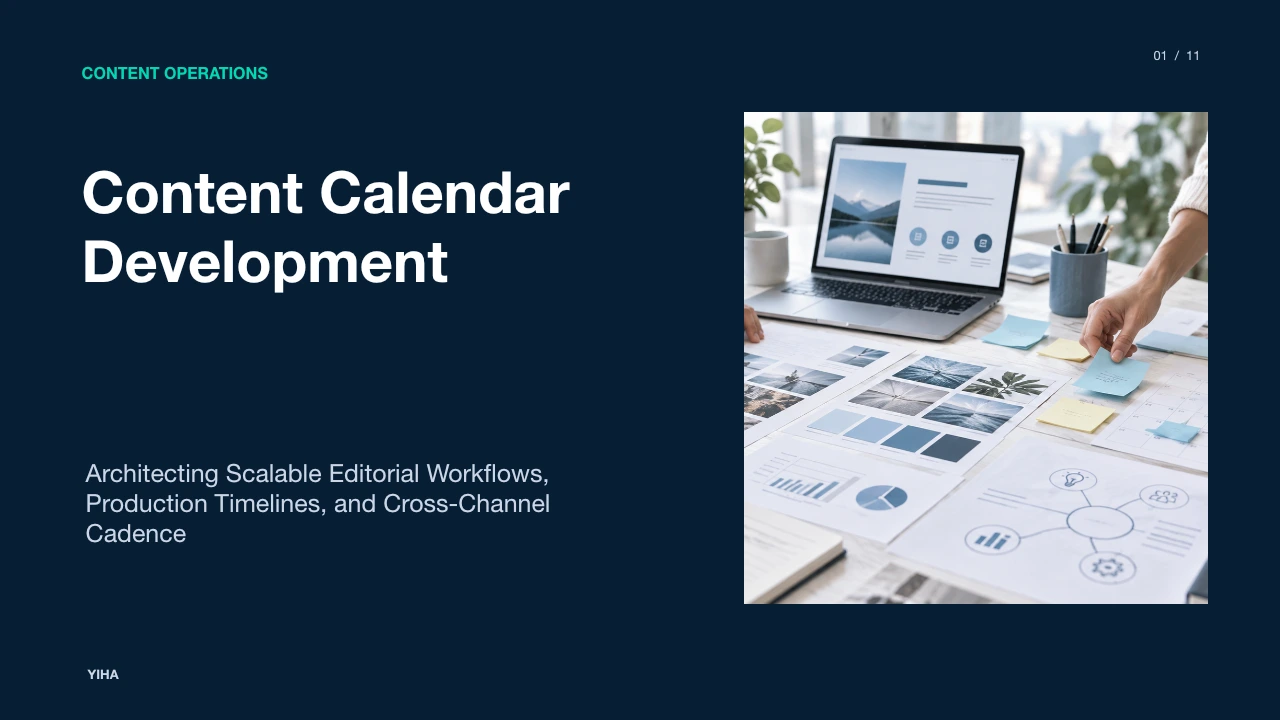
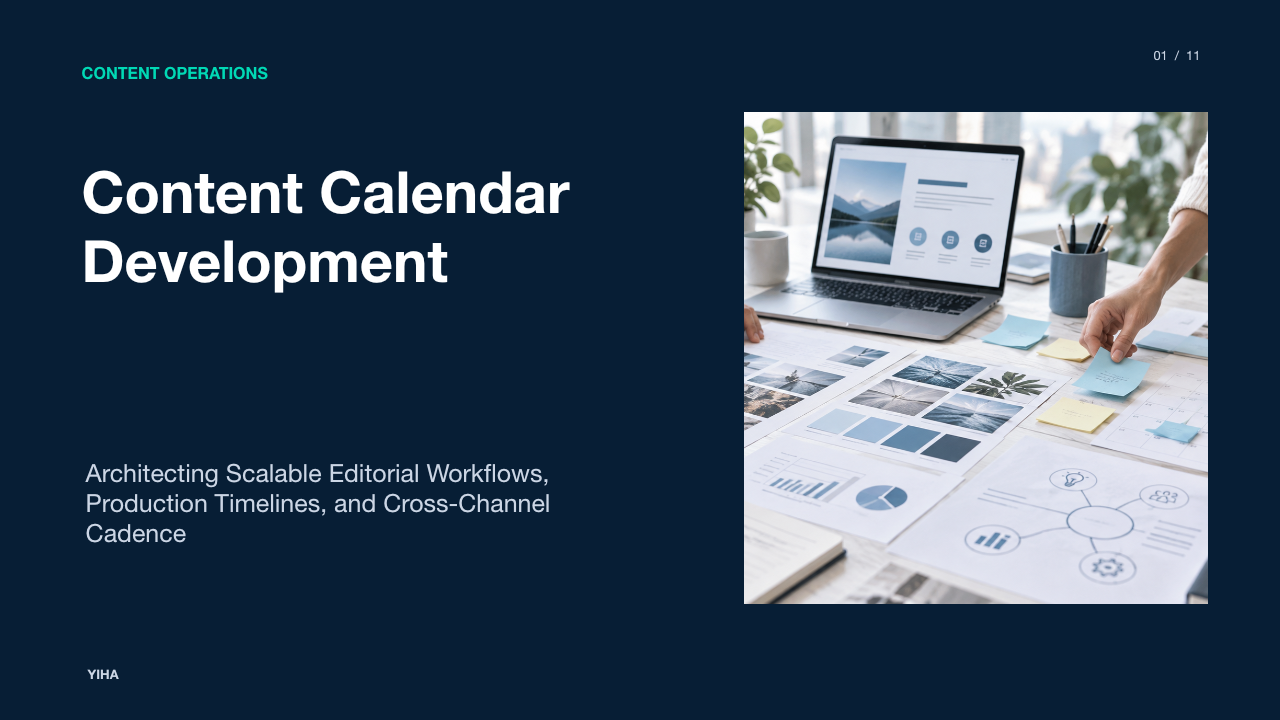
Content Calendar Development
A comprehensive guide to developing an operational content calendar, covering data taxonomies, workback production schedules, cross-channel repurposing models, and editorial governance workflows.
Free download · 4.9 MB11 editable slides · PowerPoint format
Download the editable PPTX
PPTX · 4.9 MB · 11 editable slides · Free to edit and reuse with attribution to Yiha.ai
View every slide
Use ← →, Home/End, or swipe on mobile
A content calendar functions as the central operating system of a media or marketing team. Without a structured operational framework, publishing inevitably devolves into reactive scrambling, missed publishing deadlines, uneven thematic coverage, and strained creative resources. Building an effective editorial calendar requires moving beyond static dates on a blank page. Instead, teams must establish structured metadata, define realistic workback production timelines, align publishing cadences to business pillars, coordinate multi-channel assets, and enforce governance mechanisms that keep production predictable and scalable.
The Operational Purpose of a Content Calendar
At its core, an editorial calendar is an operational infrastructure tool rather than a passive schedule. As outlined by Blog Content Calendar: Complete Planning Guide 2026, a calendar transforms content generation from a chaotic cycle of urgent assignments into a predictable, strategic workflow that systematically aligns publishing output with business goals and topical authority. When marketing teams treat publishing as a day-to-day decision, they expend mental energy asking what to publish next instead of optimizing how each piece serves audience discovery and long-term search visibility.
A systematic calendar provides visibility into upcoming milestones, product releases, and seasonal opportunities well before they arrive. According to the Editorial Calendar Templates guide from the Content Marketing Institute, tracking core editorial elements such as headlines, authors, deadlines, and workflow status directly prevents reactive bottlenecks and ensures content supports specific calls to action and business missions. Furthermore, operating through a planned schedule allows social and content teams to evaluate post volume and channel health in advance, ensuring that output remains steady rather than oscillating between silence and sudden bursts of disorganized activity, as detailed in Create A Social Media Content Calendar (7 Simple Steps).
Core Data Fields and Taxonomy Structure
An editorial calendar is only as effective as the metadata structure that underpins it. When records lack standardized fields, teams struggle to track asset ownership, search intent, and production progress. As noted in How to Create a Content Calendar That Actually Works - Taja.AI, high-performing calendars operate as production trackers holding execution metadata rather than plain date logs, routinely capturing asset type, title, target publication date, summary description, and target search keywords.
A robust taxonomy should capture several critical data points for every asset entry:
- Publishing Date and Production Status: Defining the target live date alongside real-time state flags such as Idea, Briefed, Drafting, In Review, Staged, and Published.
- Working Title and Summary: Providing a concrete working headline and brief synopsis so contributors immediately understand the asset scope.
- Channel and Content Format: Specifying whether an entry is a technical tutorial, thought leadership essay, quick industry update, or case study, as different formats dictate completely different production times, as described in the Blog Content Calendar: Complete Planning Guide 2026.
- SEO and Search Intent Metadata: Recording primary search terms, secondary variations, and target search intent to ensure the resulting text directly matches what searchers require.
- Topic Pillar and Funnel Stage: Categorizing each asset into a core thematic cluster and buyer journey stage (such as Awareness, Consideration, or Decision).
- Ownership and Review Roles: Explicitly assigning the primary creator, visual designer, and designated editorial approver.
Establishing these standardized fields at the intake and planning stage prevents last-minute confusion when staging articles in the content management system.
Building Production Workflows and Workback Schedules
A workback schedule calculates operational deadlines in reverse, starting from the fixed publication date and allocating defined lead times to every necessary milestone. Too many teams plan solely around the launch date, ignoring the cumulative time required for briefing, outlining, drafting, SME interviews, graphic design, and copyediting. When these intermediate stages lack defined boundaries, assets compress against publishing deadlines, forcing editors to sacrifice quality assurance.
The framework documented in the Content Production Schedule Template illustrates that comprehensive production timelines must break content cycles into distinct sequential phases. These encompass initial topic research, brief development, writing batches, visual asset creation, editorial review, and pre-launch quality checks. For an illustrative example of an in-depth long-form article scheduled for publication on day 20, an editorial team might work backward by assigning initial brief sign-off to day 2, first draft completion to day 8, subject-matter expert review to day 12, visual asset design to day 15, final proofreading and staging to day 18, and final distribution prep on day 19.
Building buffers into this production timeline is vital. As emphasized in Blog Content Calendar: Complete Planning Guide 2026, production pipelines must account for realistic team capacity across research, drafting, and design phases, embedding buffer time to accommodate unexpected revisions or urgent opportunities without collapsing the scheduled roadmap.
Aligning Publishing Cadence with Thematic Pillars
Maintaining a sustainable publishing cadence requires balancing release frequency with thematic distribution. If an editorial calendar solely prioritizes high-frequency posting without structural balance, teams risk fatiguing their audience with repetitive topics or neglecting crucial areas of their value proposition. In Organize Your Success: Mastering Editorial Calendar for Content Planning - Marketing Smartly, the author explains that an editorial calendar must distribute assets systematically across predetermined content themes and buyer stages, balancing evergreen foundations with timely industry moments.
Establishing content pillars allows planning teams to evaluate editorial balance over monthly and quarterly horizons. For instance, an enterprise software publication might establish four primary pillars: product updates, technical tutorials, customer case studies, and industry trends. In Create A Social Media Content Calendar (7 Simple Steps), the author highlights that tagging posts by pillar or grouping enables direct measurement of performance across content categories over time. A balanced calendar ensures that a week dedicated to top-of-funnel industry news is followed by mid-funnel implementation guides, preventing content saturation while systematically addressing every stage of customer education.
Managing Multi-Channel and Repurposing Schedules
A single long-form asset represents substantial research and intellectual investment. Leaving that asset isolated on a blog or resource center severely limits its reach. However, attempting to publish derivative channel variants simultaneously without coordination leads to chaotic workflows. As demonstrated in How to create a content calendar: The ultimate guide, maintaining a centralized content library and database of core assets enables teams to adapt one primary theme across multiple formats, such as turning long-form articles into visual slide decks, video clips, and newsletter features without duplicating foundational research.
Synchronizing these formats requires a phased distribution model. In Content development workflow explained with key approval gates and AI, the editorial process establishes the canonical, approved long-form asset as the single source of truth. Once the long-form asset clears the final publishing gate, automated and scheduled repurposing routines extract derivative assets, including social media posts, newsletter summaries, and sales enablement briefs. As an illustrative example, teams can schedule social commentary on day one, an in-depth newsletter breakdown on day three, and quote cards the following week. This staggers promotional reach while keeping messaging strictly aligned with the vetted source material.
Comparing Spreadsheets, Relational Tables, and PM Tools
Selecting the right technological foundation for an editorial calendar involves weighing collaboration needs, structural flexibility, and software complexity. Teams commonly evaluate options across spreadsheets, relational databases, and enterprise project management software:
- Spreadsheets (Google Sheets, Microsoft Excel): Spreadsheets offer low barriers to entry and universal accessibility. As highlighted in 4 free content calendar templates + tips, spreadsheet templates can keep deadlines organized and workflows clean for small teams, though excessive columns can quickly make them unwieldy.
- Relational Database Tables (Airtable, Notion): Relational databases solve the core flaw of spreadsheets by linking distinct datasets together. In I rebuilt my entire content calendar in Airtable's free plan — and it's better than most paid PM tools, the author notes that separating content items, evergreen topics, and publishing platforms into linked tables allows changing one record to update the entire ecosystem. This setup gives teams flexible calendar, Kanban, and gallery views without requiring enterprise software subscriptions.
- Enterprise Project Management Platforms (Asana, Monday.com): For larger marketing departments, dedicated platforms incorporate automated handoffs, customized approval gates, and multi-team notification systems. However, as noted in the Editorial Calendar Templates analysis, project management systems designed primarily for software engineering or generic task tracking often require substantial modification to fit editorial processes, which can introduce operational drag if improperly configured.
Organizations must match their tool choice to their team size and operational complexity rather than selecting software based on feature quantity alone.
Addressing Bottlenecks and Review Delays
Publishing schedules rarely fail because writers lack creative ideas. Instead, timelines collapse during review, feedback, and sign-off stages. In Content development workflow explained with key approval gates and AI, the analysis points out that drafts slow down primarily because initial briefs are ambiguous, subject-matter expert review queues are unmanaged, or managing editors are overwhelmed with competing tasks. Bottlenecks manifest between operational handoffs rather than within the writing process itself.
Another significant risk is structural rigidity. As cautioned in Blog Content Calendar: Complete Planning Guide 2026, over-planning every calendar slot across a full quarter creates extreme vulnerability when unexpected news, market shifts, or trending opportunities require rapid publication. To preserve operational flexibility, planning teams can reserve an unassigned capacity buffer for reactive content, allowing writers to address timely commentary without delaying core strategic deliverables. Setting strict bounds on revision rounds and clarifying exact decision rights at each milestone prevents scope creep and keeps production moving forward.
Implementing Team Governance and Intake Protocols
To prevent ad-hoc content requests from derailing scheduled production, marketing organizations must formalize editorial intake protocols and team governance. Unscheduled requests from sales, product marketing, or leadership often bypass the calendar, creating hidden workloads that delay committed deliverables. Establishing structured intake requires all incoming ideas to submit a brief containing business rationale, target audience, format, and deadline before consideration.
Effective governance structures also rely on standardized approval gates. In Content development workflow explained with key approval gates and AI, the publishing process is formalized into distinct human approval gates: strategy approval, brief sign-off, draft review, and the final publish gate. This separates editorial evaluation from technical verification. Furthermore, holding weekly operational intake reviews allows cross-functional teams to review progress, reprioritize backlogs, and establish service-level agreements between writers, designers, and editors. Documenting specific review criteria, such as checking for inclusivity, accessibility, and subject-matter accuracy as practiced in Editorial Calendar Templates, ensures that governance functions as a reliable quality filter rather than an arbitrary roadblock.
Iterative Calendar Auditing and Cadence Optimization
A content calendar cannot remain static once launched. It requires scheduled maintenance and iterative optimization based on real performance signals. In Maintaining SEO Content Calendar: Complete Guide 2026, the author observes that many marketers build elaborate calendars but allow them to calcify because performance data sits isolated in analytics dashboards without feeding back into scheduling decisions. Without structured maintenance, teams repeatedly produce content based on outdated assumptions.
To establish continuous improvement, teams should implement structured audit cycles. As detailed in Content Audit Frequency: The Complete 2026 Audit Checklist, auditing content health every six months provides a solid baseline for mid-market domains to assess decay, update internal links, and prune underperforming assets, while teams publishing over 50 pages monthly benefit from quarterly audits to manage rapid content accumulation. Complementing these broader audits with weekly operational reviews allows managers to track publishing adherence rates, identify production bottlenecks, and reallocate team capacity toward high-performing thematic clusters.
Research sources
- Editorial Calendar Templates · contentmarketinginstitute.com
- Create A Social Media Content Calendar (7 Simple Steps) · buffer.com
- Blog Content Calendar: Complete Planning Guide 2026 · www.trysight.ai
- news · contentmarketinginstitute.com
- How to Create a Content Calendar That Actually Works - Taja.AI · www.taja.ai
- Content Production Schedule Template | Free Gantt Chart Template | Instagantt · www.instagantt.com
- Organize Your Success: Mastering Editorial Calendar for Content Planning - Marketing Smartly · marketingsmartly.com
- Content development workflow explained with key approval gates and AI | Vectoron Blog · www.vectoron.ai
- How to create a content calendar: The ultimate guide · async.com
- 4 free content calendar templates + tips | Zapier · zapier.com
- I rebuilt my entire content calendar in Airtable's free plan — and it's better than most paid PM tools · www.xda-developers.com
- Content Audit Frequency: The Complete 2026 Audit Checklist · www.thesharpdigital.com
- Maintaining SEO Content Calendar: Complete Guide 2026 · www.trysight.ai