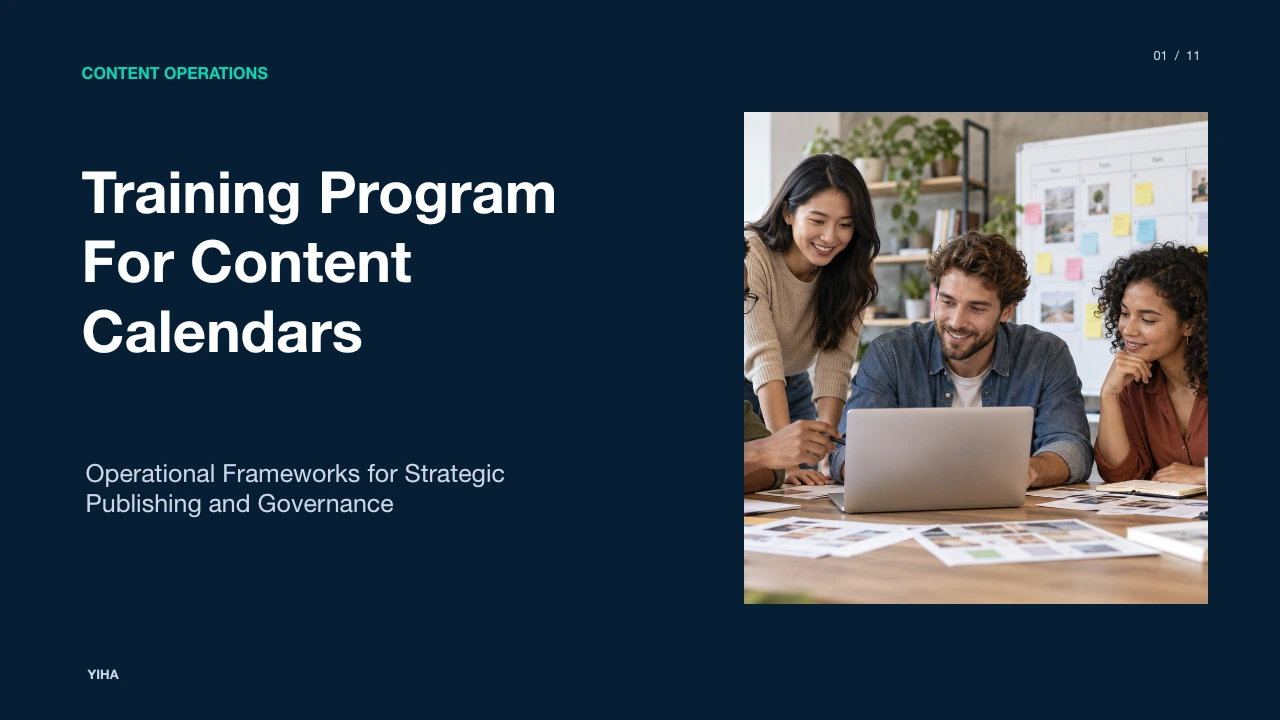
Training Program For Content Calendars
A comprehensive operational training program for building, managing, and governing strategic content calendars across multi-channel editorial teams.
Free download · 4.9 MB11 editable slides · PowerPoint format
Download the editable PPTX
PPTX · 4.9 MB · 11 editable slides · Free to edit and reuse with attribution to Yiha.ai
View every slide
Use ← →, Home/End, or swipe on mobile
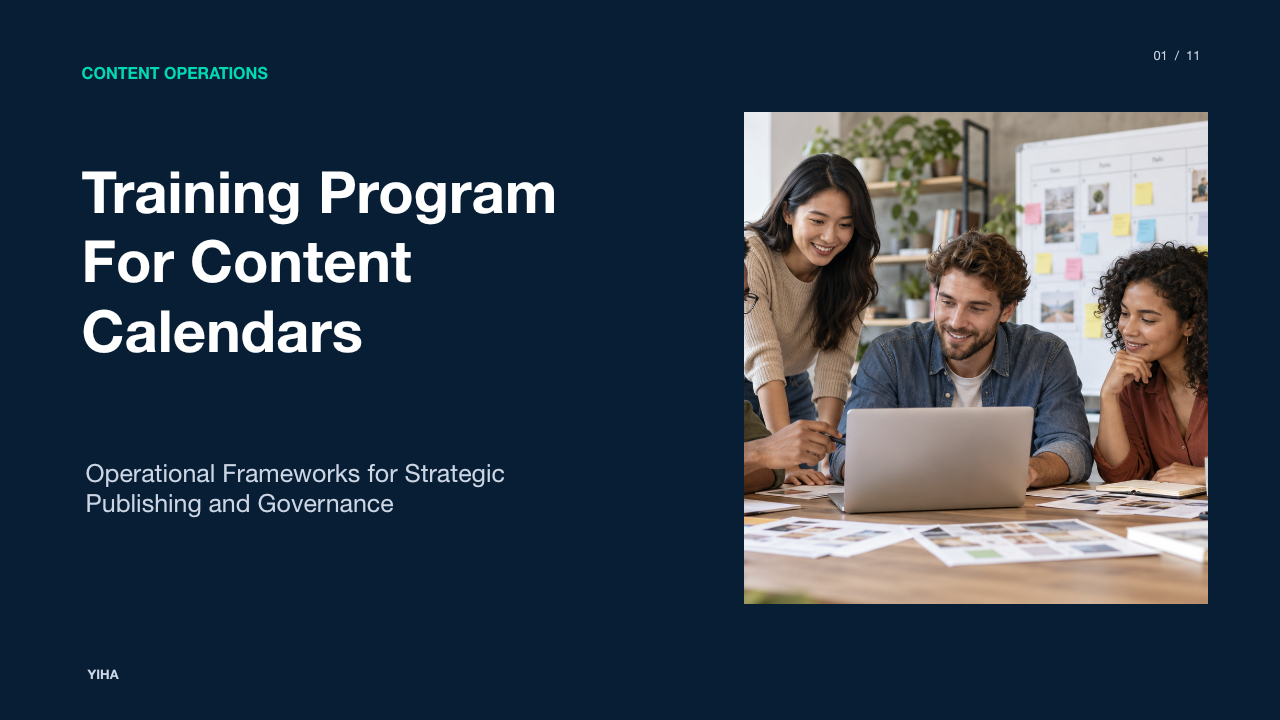
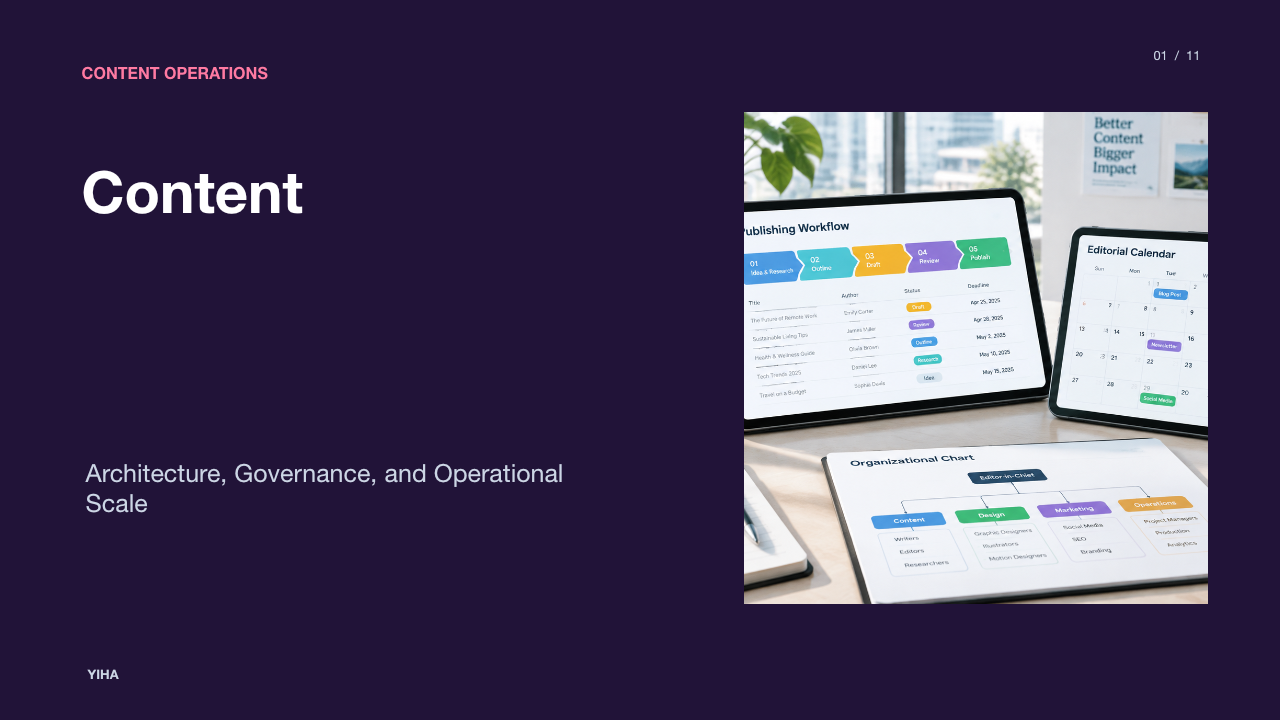
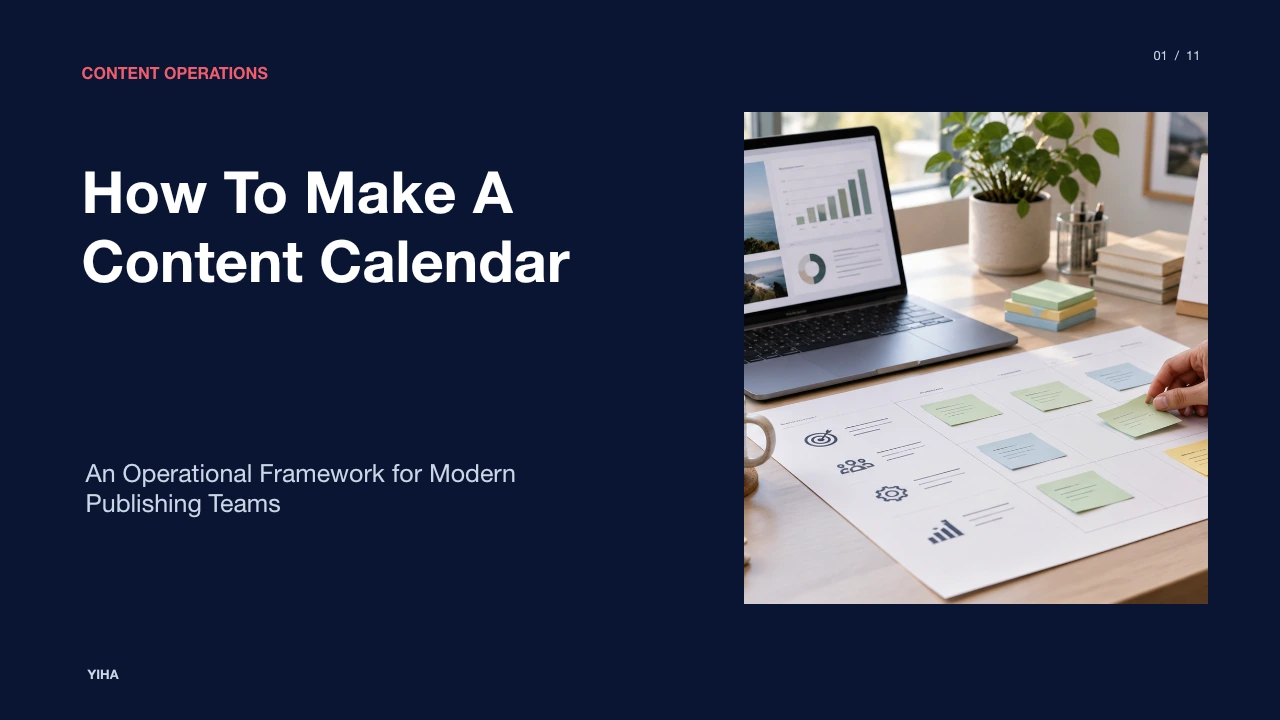
Operating an editorial calendar requires moving beyond basic publishing checklists. Without structured workflows, teams quickly encounter conflicting publication deadlines, unclear responsibilities, and content production bottlenecks. A disciplined training program establishes clear operational standards, standardizes metadata tracking, aligns quarterly business priorities, and governs production schedules across every distribution channel.
Aligning Content Strategy with Publishing Schedules
Many marketing organizations confuse a publishing schedule with an editorial strategy. When teams view a content calendar simply as a chronological roster of due dates, they lose sight of overarching business objectives. According to Kelsey Raymond in 7 Steps to a More Strategic Editorial Calendar, an editorial calendar must function as the living execution plan for a documented content strategy rather than a rigid list of publishing dates.
To establish alignment, teams should organize planning into quarterly sprints rather than committing to fixed annual plans. Quarterly sprints enable editorial managers to respond to real-time audience engagement data and industry developments without throwing the entire schedule into disarray. Grouping topic brainstorming sessions around designated strategic themes ensures that upcoming publications support specific business objectives instead of filling calendar slots at random.
Illustrative example: An enterprise editorial team schedules a quarterly sprint dedicated to customer security education. Instead of assigning individual weekly articles in isolation, the editor maps nine interdependent assets to that specific theme, ensuring each asset addresses a targeted stage in the customer lifecycle.
This approach has practical constraints. Quarterly cycles require documented brand goals and active participation from internal leaders. If business priorities shift unpredictably or executive stakeholders demand unplanned coverage, even a well-structured quarterly sprint can fracture without clear governance rules.
Standardizing Calendar Data Architecture and Metadata
An editorial calendar cannot function effectively if team members log contradictory or incomplete project information. Standardizing the calendar data schema ensures every contributor tracks each asset with identical operational fields. As outlined in Editorial Calendar Templates, baseline calendar records should capture key attributes including content headlines, assigned creators, target distribution channels, current status, calls to action, and SEO metadata.
A robust calendar schema should record the following fields for every asset:
- Asset title and working headline
- Assigned author, editor, and subject matter expert
- Current lifecycle status (such as Pitch, Outline, Draft, Review, Staged, or Published)
- Primary distribution channels (such as Blog, Email Newsletter, LinkedIn, or YouTube)
- Planned publication date and release timeframe
- Core target keyword, SEO title, and meta description
- Primary call to action (CTA) and destination URL
- Accessibility and inclusivity review confirmations
By including fields for calls to action and target keywords directly within the tracking record, the editorial team maintains strategic intent through each revision. Adding governance fields for inclusivity checks or external partner agreements creates accountability before assets proceed to staging.
Standardized metadata also brings operational overhead. Requiring creators to fill out dozens of fields can create administrative friction, leading some contributors to skip fields or enter incorrect information. Editorial leads must balance detailed tracking against daily workflow simplicity.
Organizing Content Pillars and Message Distribution
Sustained publishing requires balanced coverage across distinct subject categories, commonly known as content pillars. Relying on ad-hoc topic selection often produces repetitive coverage of narrow subjects while ignoring broader customer needs. As explained in the Guide to Content Calendars, a calendar provides a bird's-eye view that allows managers to balance topics, allocate resources across formats, and maintain sustained audience engagement.
Dividing publication slots among primary pillars ensures consistent thematic distribution. A structured balance might allocate dedicated proportions of monthly capacity to product education, industry research, thought leadership, and tactical tutorials. Within that mix, maintaining evergreen content provides long-term value, as evergreen guides can be distributed repeatedly over time without losing relevance.
Illustrative example: A software marketing team divides its monthly output into three pillars: forty percent technical guides, thirty percent industry news commentary, and thirty percent foundational tutorials. This distribution prevents the team from overproducing speculative news commentary at the expense of evergreen reference materials.
The main limitation of pillar distribution is market unpredictability. Rigid adherence to fixed pillar percentages can prevent teams from capitalizing on breaking industry trends or sudden corporate announcements. Editorial systems must retain room to adjust planned pillar allocations when urgent events occur.
Evaluating Tool Architecture: Spreadsheets Versus Software
Selecting the right infrastructure is a foundational operational decision. Marketing teams usually choose between flexible spreadsheets (such as Microsoft Excel or Google Sheets) and dedicated project management software. As documented in A Guide to Content Calendars (+ Free Templates for Making One), organizations should choose tools that match their team size, production volume, required integrations, and approval workflows.
Spreadsheets offer accessible, low-cost options for smaller teams. They allow contributors to sort, filter, and color-code entries easily without complex setup steps. However, as noted in Editorial Calendar Templates, spreadsheets lack automated handoffs, multi-channel permissions, and direct connections to publishing platforms. As publication volume grows, spreadsheets become unwieldy and prone to version discrepancies.
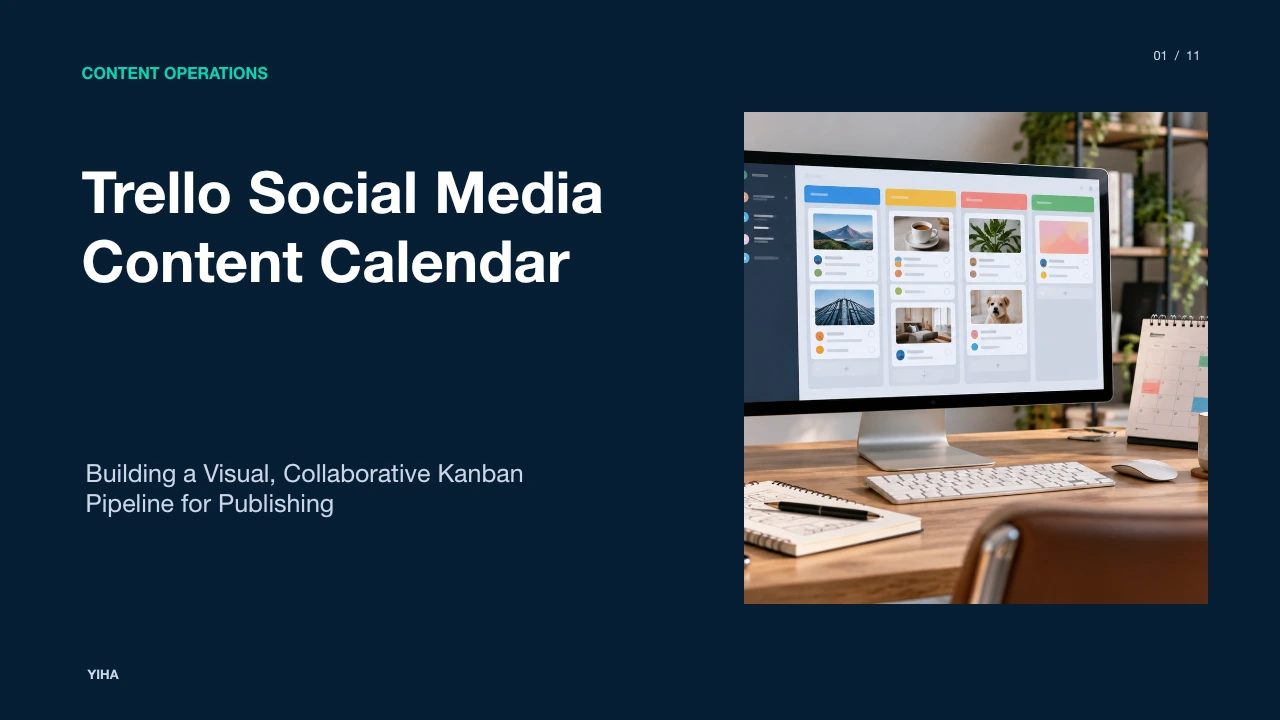
Dedicated workflow platforms (such as Asana, Notion, Trello, or integrated content schedulers) provide automated notifications, status dependencies, and database views. These systems notify task owners automatically when an asset moves between production stages. The primary limitations of dedicated platforms are licensing costs, setup complexity, and tool fatigue among team members who only need simple publishing dates.
Establishing Production Gateways and Review Workflows
Deadlines fail when production processes treat drafting and publishing as a single step. Reliable calendars break production down into sequential checkpoints, or production gateways. As Kelsey Raymond notes in 7 Steps to a More Strategic Editorial Calendar, successful workflows involve clear coordination among writers, editors, distribution specialists, and internal subject-matter experts (SMEs).
Subject-matter experts possess vital domain knowledge but rarely have time to write original drafts. A proven gateway model uses structured interviews: a writer conducts a targeted interview with the expert, drafts the material, and returns it to the expert for technical review. For example, allocating two hours of an expert's time per asset (one hour for an interview and one hour for technical review) enables predictable scheduling across quarterly cycles.
Formal production gateways should include:
- Brief intake and editorial sign-off
- Expert interview and source outline
- First draft submission
- Editorial and brand review
- Technical expert accuracy sign-off
- Legal or compliance clearance (where applicable)
- Final staging and distribution scheduling
Illustrative example: An editorial team schedules a technical review gate five days prior to publication. If the SME identifies inaccurate technical steps during the review gate, the asset is held in the review stage, preventing flawed material from reaching the distribution queue.
The constraint of sequential gateways is schedule delay. If a critical reviewer is unavailable, an asset can stall indefinitely, causing downstream publishing delays unless managers establish clear backup approval protocols.
Incorporating Topic Discovery and Structured AI Prompts
An editorial calendar requires continuous idea discovery to keep upcoming sprints populated. Rather than relying on guesswork, teams can use systematic research techniques to uncover audience demand. As outlined in A Guide to Content Calendars (+ Free Templates for Making One), managers can use search research tools and question databases to uncover recurring customer queries and address content gaps across competitive landscapes.
Teams can also integrate structured generative prompts into their research phase to brainstorm working titles, identify adjacent subtopics, and produce outline options. Pairing audience search data with prompt templates ensures teams evaluate real audience search intent before assigning calendar slots.
Illustrative example: An editorial manager enters a high-volume customer query into a keyword research tool to identify common sub-questions. The manager then prompts an internal language model to produce five distinct outline angles targeting those specific questions, selecting the most actionable angle for the upcoming sprint.
However, automated ideation carries risks. Search discovery tools reflect historical query volume rather than future developments, and language models can suggest generic or repetitive topics. Human editorial review remains essential to ensure planned topics offer genuine insight and match internal technical capabilities.
Multi-Channel Cadence Design and Asset Repurposing
Managing multiple distribution channels requires customized publishing rhythms. What works as a weekly cadence for a technical blog will not match the publishing pace needed for social channels or email newsletters. As highlighted in the Guide to Content Calendars, calendars allow teams to schedule content across diverse platforms, tailoring distribution to platform characteristics while setting sustainable time limits.
To maximize production investments, teams should schedule derivative assets alongside primary foundational content. A single comprehensive long-form guide can be scheduled to yield multiple derivative assets across different channels:
- A summary post tailored for professional social networks
- A visual process graphic adapted for image-led channels
- A condensed case breakdown featured in a weekly email newsletter
- Short video clips highlighting core interview insights
Scheduling foundational assets and their derivative pieces together inside the editorial calendar ensures coordinated campaign timing while preventing content teams from reinventing topics for each separate channel.
The challenge of multi-channel distribution is asset fatigue. If a team mechanically repurposes material without altering tone or context, audience engagement drops across secondary channels. Every channel deliverable requires intentional formatting and distinct messaging.
Managing Schedule Volatility and Governance Protocols
Even well-structured editorial calendars encounter unexpected scheduling volatility due to urgent stakeholder requests, production bottlenecks, and shifting corporate priorities. Without formal governance mechanisms, publication schedules quickly break down as teams react to unscheduled demands. As documented in A Guide to Content Calendars (+ Free Templates for Making One), an editorial calendar provides operational visibility by tracking each asset's lifecycle stage, showing what comes next, and highlighting production delays before deadlines fail.
To maintain schedule stability, editorial teams must establish realistic production timelines that reflect actual team capacity. As outlined in the Guide to Content Calendars, planning effective schedules requires assessing the time necessary for content creation, accounting for optimal posting windows, and factoring in seasonal or industry events that influence publishing priorities. Establishing explicit time allocations for drafting and review prevents unexpected delays from creating cascading publishing backlogs.
Editorial governance also requires a structured intake protocol to evaluate ad-hoc content requests. When stakeholders introduce urgent requests, editorial leads should assess the submission against documented strategic priorities and current team capacity. If an urgent piece must enter the current schedule, teams must reallocate release dates or postpone existing deliverables rather than overloading production pipelines. Semrush recommends holding walkthrough meetings to gather feedback and refine calendar workflows, ensuring all contributors understand how timeline adjustments are managed.
Illustrative example: An executive requests an urgent article covering an unscheduled industry partnership. Under the team's intake protocol, the editor assesses the deliverable, assigns it to the current sprint, and moves a lower-priority evergreen tutorial into the following month, maintaining balanced team workloads.
The primary constraint of schedule governance is organizational adherence. If executive leaders override intake protocols without agreeing to postpone lower-priority deliverables, editorial teams experience capacity strain, increasing error rates and compromising content quality.
Auditing Publishing Performance and Archival Records
An editorial calendar serves as both a forward-looking roadmap and a permanent operational record. As noted in Editorial Calendar Templates, recording performance metrics and update dates within the calendar turns the schedule into a running content audit, helping teams spot high-performing assets for future refreshing and republishing.
At the close of each quarterly sprint, editorial leaders should review archived assets against target key performance indicators, such as page views, audience engagement, or goal conversions. Incorporating retrospective reviews into the planning cycle enables teams to refine upcoming schedules based on proven audience interest rather than subjective assumptions, as reinforced in the Guide to Content Calendars.
Illustrative example: During a quarterly audit, an editorial team notices that three how-to guides published five months earlier continue to drive high organic traffic. The editor schedules these pieces for minor factual updates and plans follow-up guides on related topics for the next sprint.
Auditing has clear operational limitations. Retrospective analytics reflect past channel algorithms and seasonal trends, which may not repeat in future quarters. Teams must treat retrospective data as informative context rather than a guarantee of future content performance.
Research sources
- 7 Steps to a More Strategic Editorial Calendar · contentmarketinginstitute.com
- How to create a content calendar for your marketing strategy · www.adobe.com
- A Guide to Content Calendars (+ Free Templates for Making One) · www.semrush.com
- Editorial Calendar Templates · contentmarketinginstitute.com
- news · contentmarketinginstitute.com