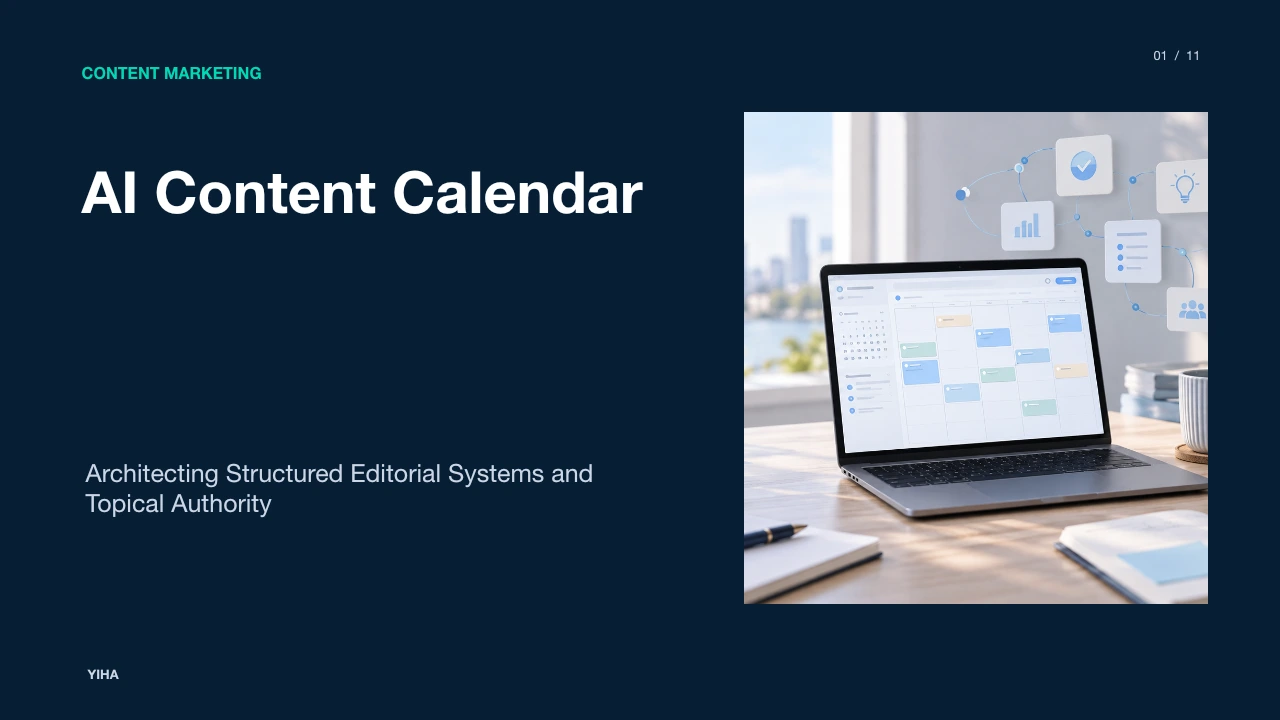
AI Content Calendar
A comprehensive guide to designing an AI content calendar. Discover how to move beyond static spreadsheets by connecting structured prompt templates, topical authority clusters, and editorial verification pipelines.
Free download · 4.9 MB11 editable slides · PowerPoint format
Download the editable PPTX
PPTX · 4.9 MB · 11 editable slides · Free to edit and reuse with attribution to Yiha.ai
View every slide
Use ← →, Home/End, or swipe on mobile
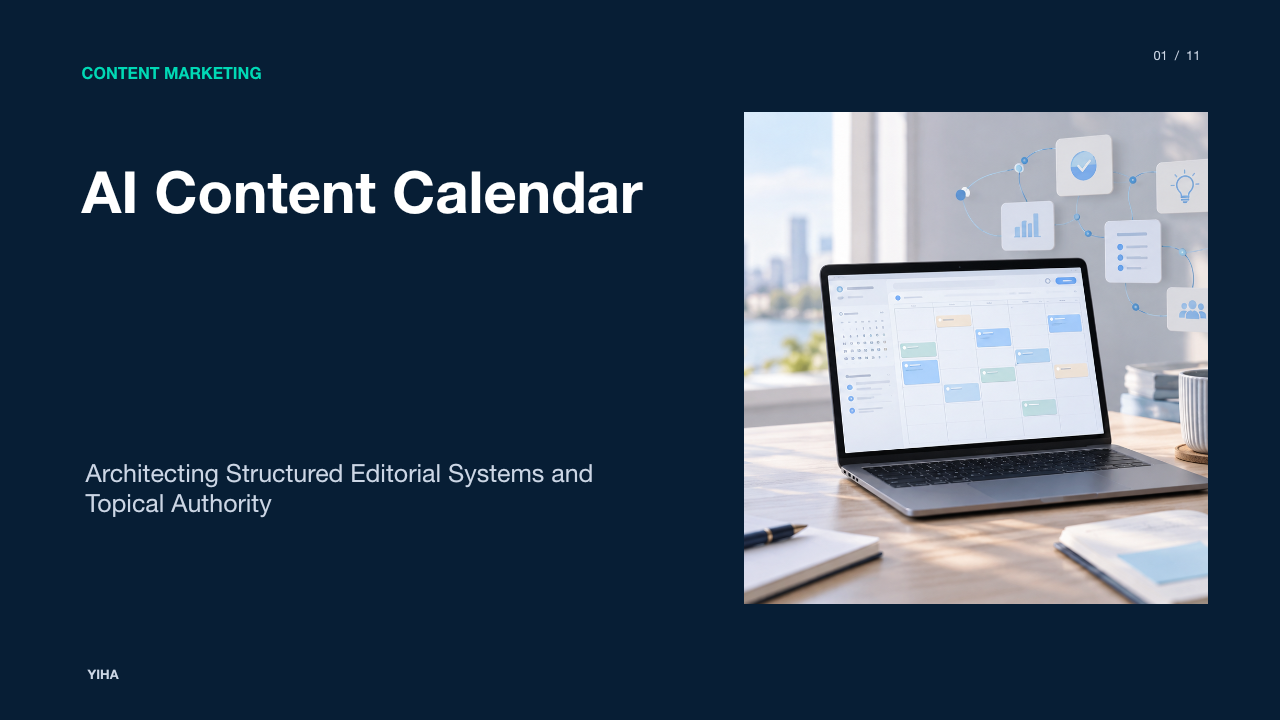
Content planning often breaks down when editorial teams attempt to bridge high-level strategy with daily publishing output. Traditional spreadsheets record deadlines and asset assignments, but they offer no guidance on topical depth, search demand, or publishing balance. When teams treat calendar production as a routine administrative exercise, publishing schedules quickly fall apart.
An artificial intelligence content calendar is an active operational system rather than a passive record. It uses machine learning models and structured prompt architectures to turn strategic marketing themes into coherent topic clusters, structured production briefs, and distribution assets. When managed with human editorial supervision, this model helps marketing teams maintain consistency while protecting publication quality.
Why Traditional Content Calendars Break Down
Manual editorial planning relies heavily on spreadsheets, static task boards, and weekly brainstorming sessions. This approach frequently collapses under normal business friction. When a team sits down to plan upcoming content without structured inputs, they encounter blank-page paralysis. Deciding what to produce consumes more energy than drafting the actual material, which delays quarterly schedules.
As explained in AI Content calendar - the complete guide, static documents answer what goes where and when, but they cannot assess whether publishing cadences are too dense or whether topic coverage has become unbalanced. Over time, publishing consistency deteriorates. A calendar outlined with great enthusiasm at the beginning of a quarter is often abandoned within several weeks as team bandwidth tightens.
Furthermore, manual ideation leads to fragmented topic selection. Marketing teams often react to short-term competitor movements or disconnected keyword lists rather than building topical depth. According to AI Content Calendar: Pillars, a 90-Day Plan and the Prompts, attempting to plan topics before establishing underlying strategic themes results in scattered, reactive articles. These individual posts fail to form internal links or build compounding authority over time.
How AI Content Calendars Differ from Schedulers
To build an effective publishing operation, teams must distinguish between a static grid, a distribution scheduler, and an AI content calendar. A static spreadsheet functions like a fixed historical record. Social media schedulers automate distribution by pushing pre-written posts to various platform networks at pre-set times. Neither tool evaluates whether the scheduled material serves a coherent strategy.
An AI content calendar operates one level above both tools as an active planning engine. As outlined in AI Content calendar - the complete guide, a traditional calendar is comparable to a static map, whereas an AI calendar behaves like a navigation system that re-evaluates routes based on performance data and gaps in topic coverage. It identifies under-covered strategic themes, suggests balanced publishing intervals, and produces initial briefs before items enter a queue.
As noted in How to Build an AI-Powered Content Calendar (2026 Guide), modern AI calendar systems combine ideation, search optimization, and scheduling data into a connected workflow. Intelligence is divided between human strategic judgment and machine pattern recognition. The AI model handles topic expansion, schedule spacing reviews, and multi-format drafts, freeing human editors to direct brand positioning, audience empathy, and factual accuracy.
Structuring Calendars Around Core Topic Clusters
Content calendars often fail because teams select topics based on surface-level curiosity or isolated search volume rather than structured thematic pillars. When editorial planning covers too many unrelated topics, search engines struggle to recognize the publication's topical authority.
As described in How to Build an AI Content Calendar: A Step-by-Step Guide for 2026, establishing topical authority requires concentrating editorial output on three to five core topic clusters rather than spreading resources across dozens of fragmented subjects. Focusing output on core clusters allows internal link structures to compound, signaling topical depth to search algorithms.
To structure a calendar around clusters, an organization must first define core themes that directly support customer acquisition and business goals. As explained in AI Content Calendar: Pillars, a 90-Day Plan and the Prompts, defining pillars before asking for individual titles ensures every generated concept belongs to a strategic family. An AI engine can then map out granular subtopics across each cluster, addressing customer objections, practical use cases, and technical comparisons. This cluster architecture ensures that every calendar slot reinforces a core theme.
Designing Layered Prompts for Calendar Ideation
Feeding open-ended requests into large language models produces generic, repetitive content ideas that fail to engage readers. Prompting an AI engine with vague requests yields bland lists that dilute brand differentiation. Reliable calendar planning requires layered prompt architectures that enforce strict strategic constraints.
As detailed in AI Content Calendar: Pillars, a 90-Day Plan and the Prompts, prompt architectures should separate background context, operational variables, and output requirements into reusable templates. Key layers include:
- Commercial Context and Audience Boundaries: Outlining specific customer segments, their daily friction points, and primary conversion objectives.
- Pillar and Cluster Constraints: Restricting topic generation to the three to five established core themes to avoid unrelated concepts.
- Funnel Stage and Cadence Parameters: Specifying target publishing formats, posting frequency, and customer buying stages across the planning period.
Using persistent workspace context, such as documented brand guidelines and style documents, prevents prompt drift across planning cycles. As explained in AI Content Calendar Automation: A Marketer Guide 2026, grounding AI models with verified customer pain points allows marketing teams to generate weeks of structured editorial angles in a single focused session without suffering planning fatigue.
Sequencing Calendar Slots Across the Customer Funnel
An editorial calendar should not treat every publication date as an identical broadcast slot. Distributing content requires a deliberate progression across audience awareness stages. Without intentional funnel sequencing, teams risk over-indexing on broad introductory articles while neglecting the practical resources needed to convert interested readers.
According to How to build a content marketing plan in 7 steps [+ free template], balancing editorial output across awareness, consideration, and decision tiers is critical for pipeline contribution. Neglecting mid-funnel and conversion-stage assets leaves readers without clear paths toward product evaluation.
As discussed in How to Build an AI Content Calendar: A Step-by-Step Guide for 2026, teams should map topics to buyer readiness prior to assigning calendar dates. An illustrative example of quarterly scheduling organizes content into three progressive phases:
- Month 1 (Awareness Phase): Focuses on problem identification, industry friction, and foundational concepts without promoting specific products.
- Month 2 (Consideration Phase): Introduces evaluation frameworks, system architectures, and comparative workflows.
- Month 3 (Decision Phase): Highlights detailed implementation blueprints, workflow teardowns, and practical case studies.
This deliberate pacing ensures that readers who enter through informational search terms are systematically guided toward practical solutions.
Repurposing Core Pillars Across Multiple Channels
Producing custom assets from scratch for every distribution channel strains team capacity and leads to inconsistent messaging. An AI content calendar resolves this issue by treating long-form pillar assets as the source for derivative channel variations.
As described in AI Content calendar - the complete guide, content repurposing follows an 80/20 principle where the majority of informational value stems from the comprehensive core asset, while platform-adapted variants distribute that value efficiently. Once a comprehensive article brief is established, an AI model can extract platform-specific derivatives, including newsletter summaries, social discussion points, short-form video scripts, and presentation outlines.
However, derivative distribution requires strict channel adaptation. As highlighted in How to Build an AI-Powered Content Calendar (2026 Guide), professional networks demand data points and tactical steps, while visual feeds require concise phrasing and clear formatting. AI models accelerate format translation, but human creators must adjust the final copy to match audience expectations on each specific platform.
Overcoming the Planning Versus Production Gap
Generating a filled calendar spreadsheet accounts for only a minor fraction of overall content marketing work. The primary breakdown in content marketing occurs when teams fail to turn planned calendar slots into completed, polished assets on schedule. When an editorial system outputs titles without production specifications, the calendar quickly becomes a list of missed deadlines.
To bridge this operational gap, calendar slots must connect directly to structured production briefs. As detailed in AI Content calendar - the complete guide, a robust calendar workflow converts each approved topic into an outline that specifies target search intent, section structures, and research sources. This documentation reduces writer research time and clarifies article objectives before drafting begins.
Automated workflow tools also help maintain production momentum. As Nicole Donnelly discusses in How to Use AI to Build a Content Calendar That Works - AI Smart Ventures, workspace platforms can utilize automated triggers to run repeat drafts, organize records, and provide reminders. However, automated velocity introduces real risks of inaccurate or unverified content. A calendar tool must incorporate clear editorial review gates, ensuring that faster production schedules do not sacrifice verification and brand reputation.
Preventing Content Decay and Indexation Pitfalls
Accelerated publishing introduces serious technical search risks. When teams use generative AI to publish high volumes of superficial, repetitive content, search engine crawlers often classify those pages as low value. In Google Search Console, these URLs frequently receive the status "Crawled - currently not indexed," indicating that crawlers evaluated the page but found insufficient unique value to include it in the primary index.
As emphasized in AI Content calendar - the complete guide, brand safety and indexation require adhering to Google search guidance regarding helpful, reliable, people-first content. Publications must offer original research, expert perspective, and clear user utility. Scheduling dozens of AI-drafted pages that simply rephrase existing web results increases technical debt and wastes crawl budget.
Editorial planning must also account for continuous content decay. According to AI Content Calendar: Pillars, a 90-Day Plan and the Prompts, search rankings require regular maintenance to remain competitive. An AI content calendar should allocate recurring monthly slots for auditing existing URLs, incorporating updated findings, and refreshing decaying assets rather than focusing solely on new publishing.
Establishing a Human-in-the-Loop Content Pipeline
Sustainable content planning requires a strict division of responsibility between software tools and human editors. Automated systems excel at processing information, uncovering keyword clusters, and drafting structural outlines. However, they lack commercial judgment, real-world context, and emotional resonance.
As described in What Is an AI Content Calendar? (2026 Guide), professional content teams implement review queues where editors verify factual accuracy, evaluate tone consistency, and approve visual assets before publication. Retaining human oversight ensures that automated volume does not lead to brand drift or factual errors.
Similarly, AI Content calendar - the complete guide emphasizes that human editorial review must remain a substantive requirement rather than an administrative formality. Teams should feed verified performance data, customer feedback, and internal product updates back into the planning system every month. When human strategists control editorial goals while delegating generative formatting to AI, the publishing calendar becomes a dependable driver of sustainable audience growth.
Research sources
- AI Content calendar - the complete guide · timothe.ai
- AI Content Calendar: Pillars, a 90-Day Plan and the Prompts · acluebox.com
- How to Build an AI-Powered Content Calendar (2026 Guide) · www.aitoolsdigest.com
- How to Build an AI Content Calendar: A Step-by-Step Guide for 2026 · contentvibing.com
- AI Content Calendar Automation: A Marketer Guide 2026 · aipromptsx.com
- How to build a content marketing plan in 7 steps [+ free template] · blog.hubspot.com
- How to Use AI to Build a Content Calendar That Works - AI Smart Ventures · aismartventures.com
- AI Content Calendar Automation: Getting Started in 2026 · multilogin.com
- What Is an AI Content Calendar? (2026 Guide) · market4me.ai