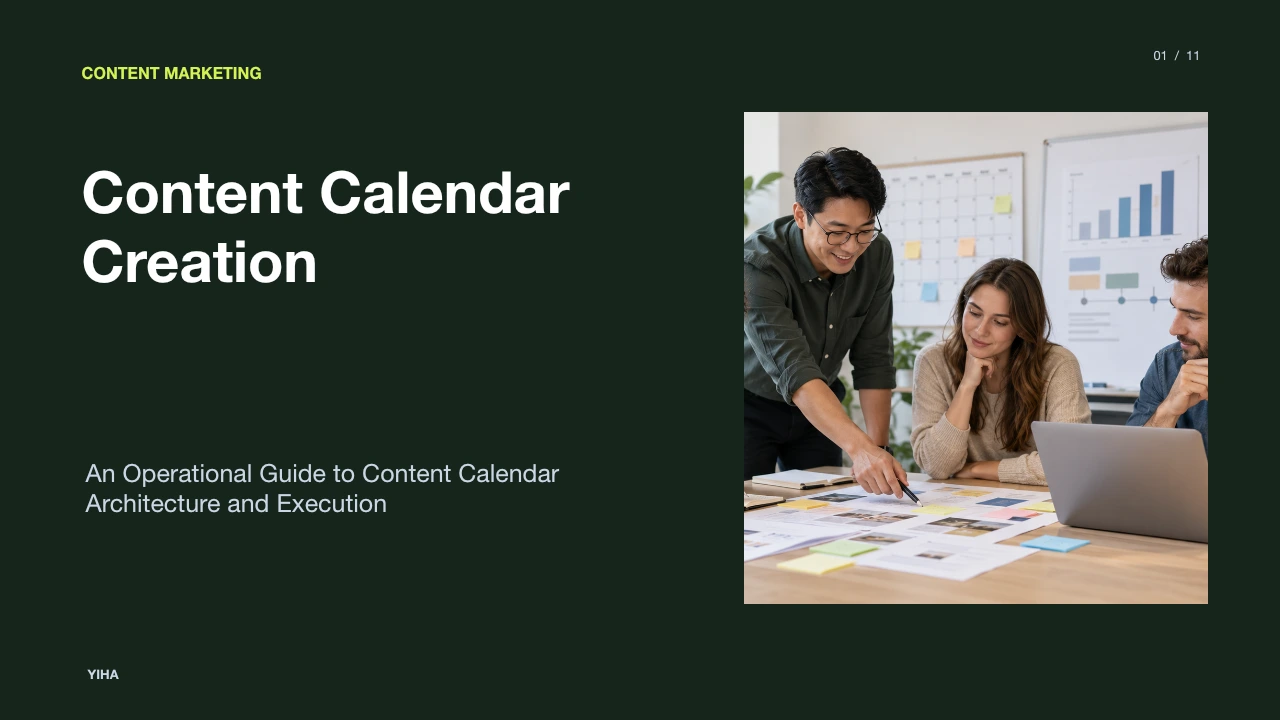
Content Calendar Creation
A practical guide to building an operational content calendar that connects high-level marketing strategy to daily asset production, capacity limits, and performance feedback.
Free download · 4.9 MB11 editable slides · PowerPoint format
Download the editable PPTX
PPTX · 4.9 MB · 11 editable slides · Free to edit and reuse with attribution to Yiha.ai
View every slide
Use ← →, Home/End, or swipe on mobile
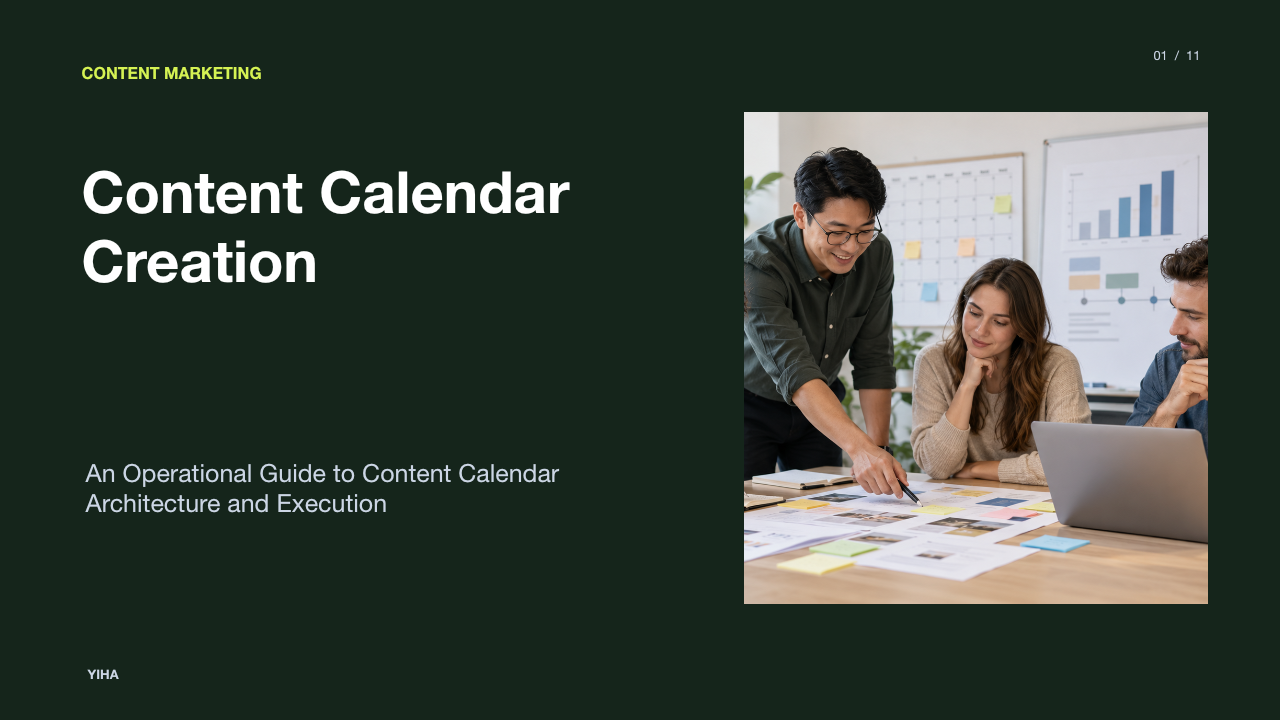
Publishing schedules often collapse into disorganized task lists when organizations view their content calendar merely as a date tracker. Without a robust operational structure, marketing teams struggle with conflicting deadlines, unaligned themes, and burnout. A functional content calendar bridges overarching business goals with the concrete mechanics of asset delivery. It standardizes production stages, governs incoming requests, balances team workloads, and provides a continuous feedback loop between published content and future planning.
The Operational Function of Content Calendars
Many teams treat content calendars as static distribution sheets that record publish dates. When treated only as a log, a calendar fails to coordinate the complex interdependencies of digital publishing. As outlined by the Content Marketing Institute, content creation involves dozens of small tasks. A reliable system keeps track of all those processes and monitors each asset status as it moves through production, transforming reactive chaos into predictable execution.
In practical terms, an operational calendar connects overarching business goals to daily creation tasks. For example, if leadership prioritizes thought leadership or lead generation, the calendar reflects this by prioritizing specific themes and assigning explicit calls to action. The calendar also prevents last-minute scrambles by highlighting dependencies such as keyword optimization, metadata completion, and executive approvals before publication takes place.
A common limitation is over-reliance on the schedule itself without defining underlying workflows. If team members do not know who reviews a draft or when creative assets must be finalized, a calendar date becomes meaningless. Successful operations treat the calendar as an ongoing system of record that visualizes asset movement and flags production roadblocks early.
Separating Editorial Strategy from Production Schedules
Organizations frequently make the mistake of combining strategic planning and tactical task management into a single messy document. A strategic editorial calendar answers what an organization publishes and why it matters to the target audience. In contrast, a production schedule details how each asset moves from an outline to final distribution, tracking tasks like copy editing, graphic design, and technical formatting.
The framework documented by Umbrex clarifies this distinction by separating master narrative themes from granular production boards. A master calendar tracks quarterly objectives, narrative arcs, and major campaigns. Production boards track discrete asset stages, task assignments, and review milestones. This separation ensures executives and strategists can review message alignment without sorting through granular subtasks, while creators can manage daily assignments without losing sight of broader goals.
A notable operational limitation arises when these two layers are disconnected. If changes made on the production board do not reflect back on the strategic master calendar, deadlines drift and strategic themes become desynchronized. Teams must maintain clear synchronization rules between their high-level editorial roadmap and tactical workflow tools.
Structuring Core Metadata and Tracking Fields
An editorial calendar requires structured metadata to categorize assets and maintain accountability across multiple contributors. According to Salesforce Trailhead, a well-designed calendar hub documents key fields such as publication dates, format types, operational owners, and target audience personas to ensure comprehensive coverage across marketing priorities.
Core fields typically include the working headline, content owner, target distribution channel, audience segment, and workflow status. Advanced setups expand this architecture to include target keywords, customer journey stages, call-to-action tracking, and internal review deadlines. Capturing target audience personas prevents the team from over-indexing on one persona while ignoring others.
The primary danger in metadata design is administrative bloat. When a calendar requires twenty manual inputs for every social post or short update, contributors bypass the system entirely. Marketing operations leads must distinguish between essential fields required for all items and optional fields reserved for major tentpole projects.
Planning Across Multi-Horizon Timeframes
Effective editorial governance balances long-term strategic predictability with near-term flexibility. Teams that plan an entire year down to the daily post end up throwing away their schedules when priorities shift. Conversely, teams that operate strictly week to week experience constant disruption and reactive fire drills.
The Umbrex framework outlines a layered time-horizon structure: an annual 12-month thematic outlook, a rolling 90-day production roadmap, and a locked 30-day execution sprint. The annual horizon establishes major product milestones, industry events, and overarching corporate narratives. The rolling 90-day roadmap outlines planned campaigns, content pillars, and initial research briefs. The locked 30-day sprint contains finalized drafts, scheduled assets, and committed publication dates.
The locked 30-day window protects the production team from disruptive scope creep. Except for critical corporate emergencies, new requests cannot displace committed work within the 30-day sprint without explicit trade-off decisions. This multi-horizon model provides clear visibility for executive leadership while preserving the production team's focus.
Balancing Production Workload and Team Capacity
Content calendars frequently fail because they represent aspirational wish lists rather than capacity-constrained schedules. Editorial managers often schedule deliverables based on publishing targets without calculating the labor required to draft, design, edit, and approve each asset. This mismatch causes chronic missed deadlines and employee burnout.
As explained in the Atlassian Jira framework, visual workflow boards allow teams to monitor resource allocation, balance workloads, and identify bottlenecks before they derail deadlines. Implementing work-in-progress limits prevents editorial staff and designers from juggling too many concurrent projects. For instance, an illustrative example team might cap simultaneous long-form drafts at two per writer to maintain production momentum and prevent half-finished drafts from accumulating.
Capacity planning requires realistic baseline time allocations. An in-depth research paper or webinar deck requires significantly more production hours than a short promotional post. Teams that treat all calendar entries as equal units of work fail to forecast accurate delivery timelines. Establishing clear throughput baselines per asset type ensures the calendar reflects actual delivery capabilities.
Establishing Intake Gateways and Editorial Governance
Without centralized intake governance, external departments submit disorganized content requests through informal channels such as direct messages, corridor conversations, and casual emails. This lack of structure leads to redundant assets, conflicting messaging, and fractured priorities.
To manage this dynamic, marketing organizations establish structured intake forms and formal review cadences. The operational system described by Mavic AI highlights the value of standardizing required brief details, including intended audience, primary objective, delivery timeline, and distribution channels. Formalizing these requirements forces requestors to clarify business justification before production resources are allocated.
Governance is maintained through recurring operational meetings. As outlined in the Mavic AI operational playbook, teams establish daily status checks, weekly planning standups, and monthly reviews to coordinate upcoming content and chase approvals. This cadence eliminates ad-hoc interruptions and ensures transparent prioritization.
Orchestrating Cross-Channel Content and Derivative Assets
Publishing disconnected single-use pieces across siloed channels wastes creative effort and dilutes messaging. A mature content calendar acts as an orchestration engine, synchronizing hero assets with derivative content across social media, email newsletters, and sales enablement.
As documented by Mavic AI, structuring content around hub-and-spoke models maximizes return on creative investment. A central pillar asset, such as an industry benchmark report or comprehensive guide, forms the hub. The calendar then sequences supporting spoke assets, such as summary articles, video excerpts, infographic panels, and promotional emails, over several weeks. This approach reinforces key themes across multiple touchpoints without requiring a completely new concept for every post.
The operational challenge lies in managing dependencies. If the publication of a core white paper is delayed by two weeks, all associated derivative posts, newsletter features, and sales enablement collateral must automatically reschedule in tandem. The content calendar architecture must clearly link derivative child records to parent pillar assets to prevent orphaned promotional messages from going live prematurely.
Evaluating Tool Architectures and Common Pitfalls
Selecting the right tool architecture determines whether a content calendar remains an active operational asset or becomes an abandoned spreadsheet. Organizations typically choose between spreadsheets, general project management software, and relational database systems.
While spreadsheets offer low friction, they lack automated dependency tracking and create manual maintenance overhead. Analysis from XDA Developers highlights how relational databases like Airtable overcome these limitations by using linked records. A relational structure allows teams to connect individual content assets to broader topics, campaigns, and distribution platforms, ensuring that updating a single record reflects across all linked views.
A significant pitfall in tool selection is software over-engineering. Teams frequently spend weeks configuring intricate enterprise suites with dozens of mandatory fields and brittle automations that active writers and editors find burdensome. If the maintenance cost of the tool exceeds its operational value, contributors revert to offline tracking. The most effective calendar architecture matches the team's genuine process complexity without imposing unnecessary administrative overhead.
Integrating Performance Feedback into Future Schedules
A content calendar should never function as a one-way publishing pipe. Without closing the feedback loop, teams repeatedly produce low-performing content formats and miss opportunities to refresh high-value assets. Operational planning must systematically feed post-publication metrics back into future planning cycles.
The editorial workflow detailed by Libril demonstrates that high-performing teams integrate regular performance reviews into their monthly and quarterly cycles. By reviewing engagement metrics, conversion indicators, and audience drop-off data, editors identify topics that justify follow-up coverage and retire themes that failed to resonate. Furthermore, tracking historical performance directly alongside calendar records enables teams to schedule timely refreshes for evergreen articles that drive consistent organic visibility.
A common limitation in performance integration is attribution delay. Content such as search-optimized articles often requires several months to demonstrate measurable organic traction. Review cadences must distinguish between immediate promotional metrics, like email open rates and social clicks, and delayed compounding metrics, like search traffic and inbound pipeline contribution, before deciding to alter the long-term editorial schedule.
Research sources
- Editorial Calendar Templates · contentmarketinginstitute.com
- news · contentmarketinginstitute.com
- The Complete Playbook to Content Calendar Creation | Mavic AI · mavic.ai
- Streamline Content Creation: Editorial Calendar · umbrex.com
- Content Calendar Creation Guide · trailhead.salesforce.com
- Editorial calendar template | Jira · www.atlassian.com
- I rebuilt my entire content calendar in Airtable's free plan — and it's better than most paid PM tools · www.xda-developers.com
- Editorial Calendar Planning & Production System - Libril: Intelligent Content Creation · libril.com