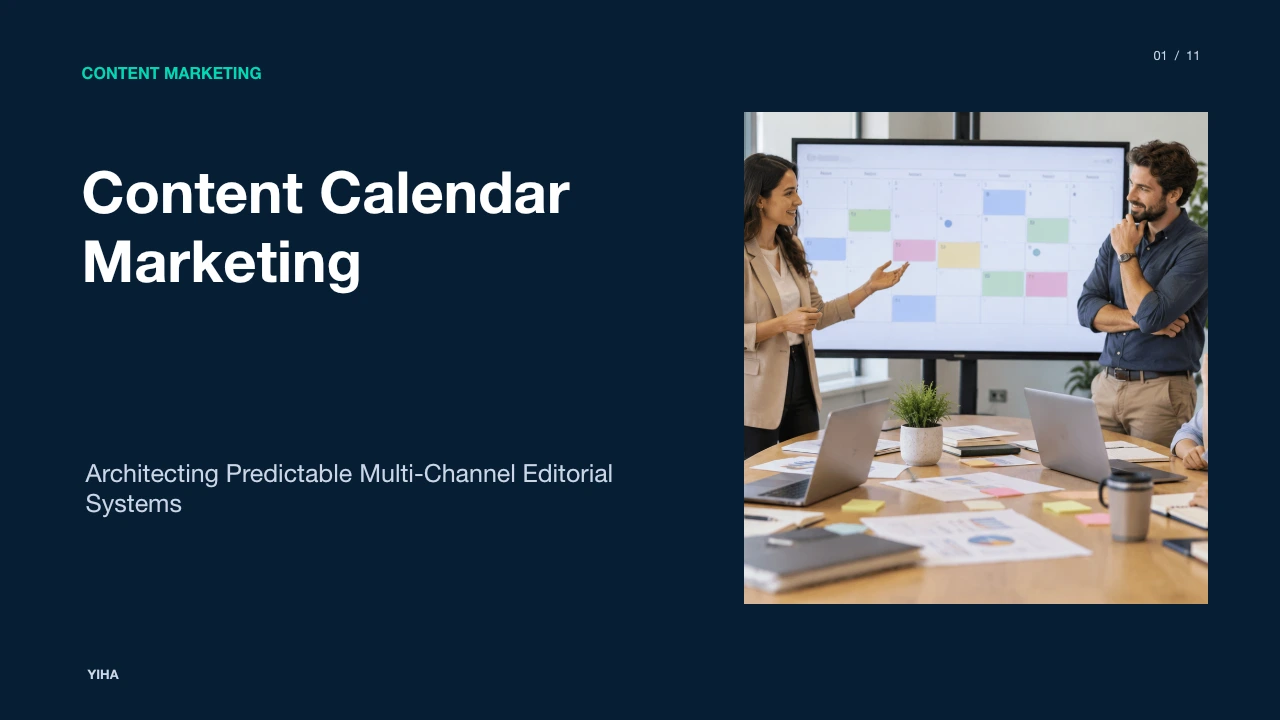
Content Calendar Marketing
A comprehensive guide to content calendar marketing, covering editorial architecture, multi-channel distribution workflows, buyer journey alignment, and long-term calendar governance.
Free download · 4.9 MB11 editable slides · PowerPoint format
Download the editable PPTX
PPTX · 4.9 MB · 11 editable slides · Free to edit and reuse with attribution to Yiha.ai
View every slide
Use ← →, Home/End, or swipe on mobile

Marketing teams frequently struggle with irregular publishing schedules, fragmented messaging, and rushed production cycles. When content creation is reactive, teams spend valuable time scrambling to produce assets at the last minute rather than executing a deliberate strategy. A structured editorial calendar transforms content marketing from an unpredictable chore into an organized operational system.
A content calendar serves as the operational blueprint that connects high-level marketing strategy with day-to-day execution. By establishing clear timelines, assigned responsibilities, and channel destinations, organizations build predictable workflows that maintain engagement and support broader business milestones.
The Operational Pitfalls of Ad-Hoc Publishing
Publishing content without an operational framework creates friction across the entire marketing department. In an ad-hoc model, topic selection is driven by immediate pressure rather than strategic intent. Teams attempt to produce assets without sufficient lead time, resulting in compromised editorial depth, missed review cycles, and uneven publication intervals. Without a clear overview, work often clusters around short-term distractions while critical business initiatives receive insufficient support.
According to Digital Codex, an editorial calendar creates visibility across the team, establishes accountability by assigning owners and deadlines, and creates the steady rhythm that makes content marketing effective over time. When companies publish reactively, cross-functional partners like sales and public relations remain disconnected from upcoming releases. This lack of visibility prevents teams from coordinating complementary promotional efforts or gathering expert input in advance.
Furthermore, ad-hoc publishing masks capacity bottlenecks. Teams cannot accurately forecast the effort required for research, writing, graphic design, and approvals. A structured schedule exposes these dependencies early, preventing resource exhaustion and rushed handoffs.
Core Architectural Elements of an Editorial Calendar
An editorial calendar requires structured metadata to function as an actionable management tool. Without standard data fields, the calendar quickly deteriorates into an ambiguous list of intentions rather than an enforceable operational schedule.
As outlined by the Content Marketing Institute, an effective editorial tracking template records fundamental production details for every asset, including headline, author, target category, deadlines, and current workflow status. Teams can also record technical attributes such as search titles, meta descriptions, and specific performance metrics to maintain strategic focus.
A robust calendar architecture incorporates several non-negotiable fields:
- Topic and Working Title: A descriptive title conveying the primary focus.
- Asset Format and Channel: The designated medium, such as an article, email newsletter, or case study, alongside its distribution platform.
- Target Audience and Persona: The specific segment or buyer profile the content addresses.
- Funnel Stage: The intended buyer journey touchpoint, from initial discovery to purchasing decision.
- Production Status: Granular stage tags such as brief approved, drafting, editing, review, and scheduled.
- Ownership and Deadlines: Distinct assignments for writing, design, review, and publishing dates.
Coordinating Multi-Channel Content Distribution
Modern marketing campaigns rarely succeed through a single channel. High-impact initiatives require coordinated distribution across long-form blogs, organic social feeds, dedicated email newsletters, and sales enablement materials. A centralized editorial calendar synchronizes these touchpoints so that each channel reinforces the same core narrative at the right time.
In their operational guide, ContentPod explains that monthly planning should balance major anchor assets with supporting promotional pieces. A unified planning calendar prevents repetitive standalone efforts by orchestrating a cohesive cluster: a comprehensive whitepaper or guide can be scheduled alongside supporting newsletter features, executive social posts, and targeted sales follow-up templates.
For an illustrative example of this mechanism, consider an enterprise software provider releasing a guide on data privacy. In a synchronized calendar, week one introduces the comprehensive long-form article. Week two distributes a curated breakdown through the email newsletter. Week three deploys bite-sized takeaways on professional networks, and week four arms account executives with a one-page summary sheet. Without a centralized calendar, these distribution channels function in silos, diluting brand coherence and confusing potential buyers.
Predictable Publishing Cadence and Audience Engagement
Publishing consistency directly impacts audience retention and brand trust. When target readers know when to expect fresh analysis or industry insights, they form predictable consumption habits. Irregular cadence signals disorganization and causes audience interest to drop over time.
As noted in the Dotdigital Guide, maintaining a steady publishing schedule builds anticipation and familiarity. Sticking to regular cadences across blogs and email updates keeps the organization top of mind and establishes ongoing credibility. Systematic calendar scheduling also benefits organic discovery, as search engine crawlers index fresh pages on a reliable, sustained basis.
However, cadence planning requires realistic capacity assessment. Marketing leaders must not confuse ambitious targets with sustainable output. Committing to a weekly high-quality piece is preferable to announcing a daily cadence that deteriorates in quality or collapses after two months. The calendar provides the operational visibility needed to balance volume against available creative resources.
Mapping Editorial Themes Across Buyer Journey Stages
A common limitation in editorial planning is an over-reliance on top-of-funnel educational articles. While broad informational posts generate search visits, they rarely move prospective clients toward a buying decision on their own. An effective calendar balances content across every stage of the buyer journey.
According to Robotic Marketer, mapping editorial assets to buyer journey stages enables teams to visualize touchpoints clearly. Early-stage assets raise awareness, mid-stage assets foster detailed consideration, and late-stage assets provide the justification needed to secure final conversion decisions.
To implement this balance, calendar planners categorize content slots into three distinct tiers:
- Awareness (Top of Funnel): Industry trends, foundational guides, and high-level problem definitions designed to attract relevant organic traffic.
- Consideration (Middle of Funnel): Technical comparison frameworks, detailed methodologies, and solution criteria that help prospective buyers evaluate operational approaches.
- Decision (Bottom of Funnel): Implementation breakdowns, customer case studies, and security documentation that validate commercial commitments.
Reviewing the calendar distribution on a monthly basis ensures that marketing budgets and creator hours are not disproportionately consumed by top-of-funnel content.
Tool Selection: Comparing Spreadsheets and Dedicated Platforms
Selecting the right tooling for content calendar management depends on team size, distribution complexity, and integration requirements. There is no universally superior platform; the optimal choice aligns with team operational habits.
As highlighted in the Async Guide, editorial tools generally fall into three categories:
- Spreadsheets (Google Sheets, Microsoft Excel): Highly customizable, immediately accessible, and cost-effective. Spreadsheets excel for solo creators and small teams. However, they lack native automated notifications, automated publishing integrations, and robust asset versioning.
- Project Management Platforms (Asana, Notion, Trello): These tools offer flexible views, such as Kanban boards and timeline Gantt charts. They allow teams to attach files, tag collaborators, and manage subtasks directly within production cards.
- Dedicated Editorial and Social Automation Suites: Specialized platforms provide native social publishing integrations, built-in approval workflows, and centralized social media analytics. They reduce manual copying and pasting between drafting tools and live networks.
The Content Marketing Institute cautions that complex enterprise project management software can sometimes create excessive administrative overhead if it requires extensive custom configuration. Teams should adopt the simplest platform that fully supports their production gates and team visibility.
Preventing Rigidity and Managing Unplanned Disruptions
A rigid editorial calendar creates friction when market conditions change. If a calendar is planned to total capacity months in advance without flexibility, marketing teams cannot respond to breaking regulatory updates, urgent product changes, or sudden customer questions.
As highlighted by Robotic Marketer, even well-constructed content planning strategies require deliberate flexibility. Unforeseen events, shifting news cycles, or sudden product releases demand adjustments. Maintaining a flexible publishing schedule by assigning backup assets for urgent use and conducting regular reviews empowers teams to adapt quickly while protecting their core marketing plan.
To manage disruptions effectively, organizations establish triage criteria. When an urgent request emerges, the editorial lead evaluates whether it aligns with core messaging pillars and targets an active business priority. If approved, the asset occupies reserved flexible production space, or a lower-priority scheduled item moves to the next planning cycle. The calendar functions as a living roadmap rather than an unchangeable constraint.
Establishing Sprint-Based Workflows and Approval Cycles
A schedule is only as effective as the underlying production workflow. Without defined production handoffs, calendar due dates are routinely missed. Establishing multi-tier sprint cadences ensures predictable delivery from initial ideation through to final publication.
According to the Marketing Agency Singapore Guide, editorial planning works best with rolling horizons: teams map themes three to six months ahead, but reserve detailed topic briefs and weekly sprints for near-term cycles of four to six weeks. Granular scheduling too far in advance often produces work that loses relevance before publishing.
A practical production workflow incorporates structured gates:
- Strategic Theme Review: Quarterly leadership sessions to establish high-level priorities and campaign milestones.
- Monthly Topic Allocation: Finalizing article briefs, assigned keywords, target personas, and publishing dates for the upcoming 30 to 60 days.
- Weekly Production Sprints: Checking active draft statuses, identifying review bottlenecks, approving design assets, and verifying staging in CMS platforms.
By delineating clear review gates, content creators, editors, subject matter experts, and compliance teams know exactly when their input is needed, eliminating last-minute review panic.
Long-Term Calendar Governance and Content Audits
A content calendar requires ongoing maintenance to remain useful over multiple quarters. Without active governance, backlogs accumulate abandoned concepts, links break, and older published assets become obsolete.
As outlined in Adobe Express Content Guidelines, integrating performance tracking directly into the calendar enables teams to evaluate past content outcomes, identify patterns, and systematically plan evergreen updates. Maintaining evergreen assets ensures audiences continue to receive accurate, high-value information months after initial publication.
Governance routines should include:
- Monthly Backlog Pruning: Archiving outdated topic ideas and re-evaluating stalled drafts that have remained unassigned for multiple cycles.
- Quarterly Performance Audits: Evaluating published assets against conversion and traffic benchmarks to determine which top-performing pieces warrant scheduled updates.
- Repurposing and Refresh Schedules: Allocating calendar slots specifically for refreshing outdated statistics, updating product screenshots, and redistributing evergreen guides across secondary channels.
Embedding continuous maintenance routines into the calendar ensures marketing operations remain disciplined, scalable, and closely aligned with organizational objectives.
Research sources
- How to create a content calendar for your marketing strategy · www.adobe.com
- news · contentmarketinginstitute.com
- Content Calendar Planning: Editorial Calendar & | Digital Codex · www.clarigital.com
- Editorial Calendar Templates · contentmarketinginstitute.com
- Content Calendar Planning for Marketing: Practical Guide · www.contentpod.co
- How to create a marketing content calendar · dotdigital.com
- How to Create a Marketing Content Calendar That Works · www.roboticmarketer.com
- How to create a content calendar: The ultimate guide · async.com
- Content Calendar Guide: Plan Marketing Consistently · marketingagency.sg