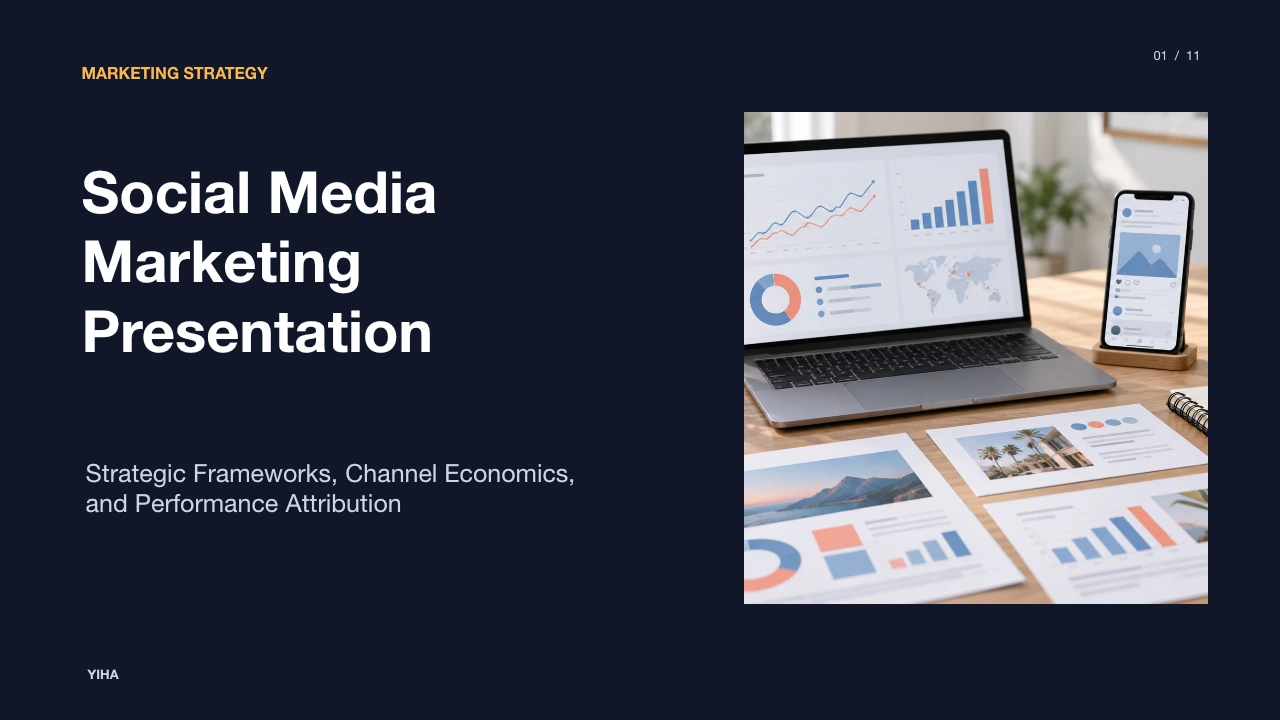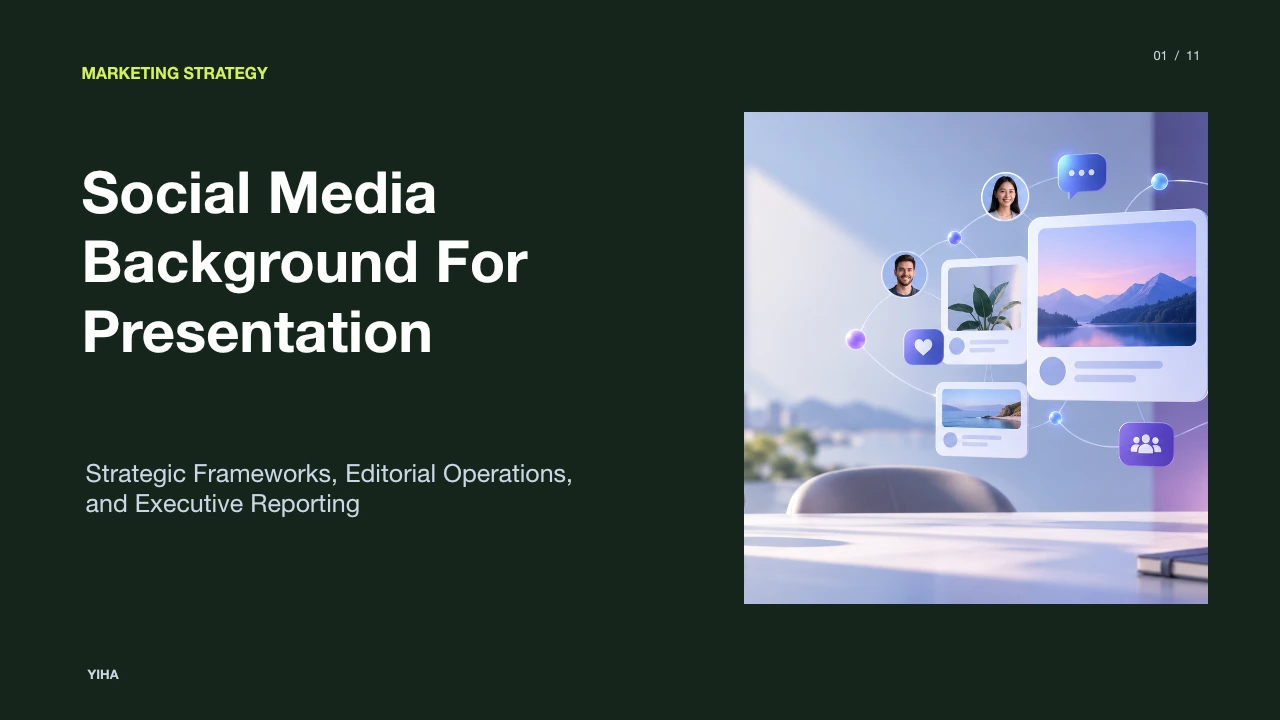
Social Media Background For Presentation
A comprehensive operational guide to presenting social media background context to executive leadership, establishing clear content pillars, publishing cadence, cross-platform workflows, and business-focused performance measurement.
Free download · 4.9 MB11 editable slides · PowerPoint format
Download the editable PPTX
PPTX · 4.9 MB · 11 editable slides · Free to edit and reuse with attribution to Yiha.ai
View every slide
Use ← →, Home/End, or swipe on mobile
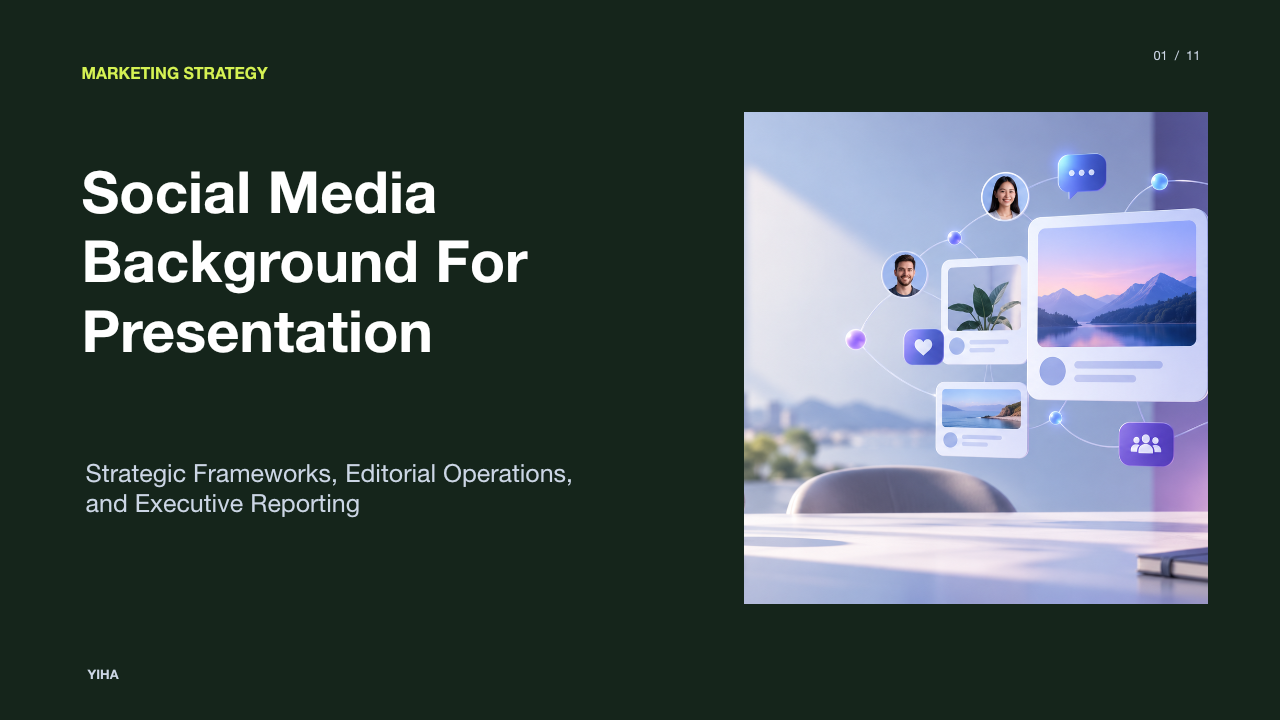
Executive presentations require a clear narrative that links day-to-day channel operations to broader commercial priorities. Presenting the background of a social media program means explaining how audience demand is identified, how editorial production is governed, and how quantitative measurement proves business impact. Without this foundational structure, stakeholders frequently view social networks as disconnected broadcast tools rather than coordinated drivers of corporate communication and audience research.
The Strategic Role of Social Media in Business Planning
When presenting social media context to internal leaders, teams must frame channel operations as structured systems for market research, message validation, and customer acquisition. Treating social channels as simple publishing outlets misses their ability to deliver direct market intelligence. Organizations that connect social activity to commercial objectives use formal goal frameworks to evaluate whether each channel justifies its ongoing production costs.
Establishing this background requires tying communication targets directly to broader corporate milestones. As detailed in the Semrush guide on social media calendars, defining specific, measurable, achievable, relevant, and time-bound (SMART) objectives ensures that channel activities reflect organizational priorities rather than vanity targets. When team members evaluate audience behavior against competing organizations using traffic tools, social channels surface tangible shifts in consumer interest before those trends appear in quarterly sales figures.
An illustrative example of this alignment occurs when a business software provider prepares an executive deck for annual planning. Instead of reporting aggregate impressions, the team presents social listening insights highlighting customer pain points around cloud compliance. By linking those conversation themes to top-of-funnel discovery, the marketing team proves that organic outreach supports product positioning. The chief limitation of this strategic framing is attribution: organic brand touchpoints often influence prospective buyers across multiple sessions, making direct revenue mapping difficult without disciplined tracking parameters.
Defining Core Content Pillars for Strategic Focus
Presentations detailing social architecture must establish clear content boundaries. Without structured categories, teams suffer from content drift, where publishing decisions become reactive and disjointed. Developing distinct content pillars maintains a disciplined thematic baseline that preserves brand authority across distributed teams.
According to Zapier's social media calendar guide, categorizing each post under a defined content pillar or theme, such as educational guidance, community building, behind-the-scenes perspectives, or direct promotions, preserves a healthy content mix and prevents accounts from devolving into persistent sales pitches. Viewers rarely stay engaged with accounts that broadcast promotional pitches continuously. When brands anchor their feeds in educational material that solves specific user problems, audiences follow longer and develop genuine credibility with the organization.
An illustrative example involves an enterprise supply chain consultancy establishing its pillar structure during quarterly planning. The team organizes output across educational regulatory briefings, customer transformation highlights, internal operational culture, and solution demonstrations. This structured balance gives reviewers an objective framework to assess whether monthly releases reinforce the firm's advisory standing. The primary operational constraint remains governance: departments outside marketing often request urgent promotional announcements that violate established thematic boundaries, requiring strict approval oversight.
Structuring Message Themes and Media Formats
An operational social background must articulate how messaging themes translate into specific platform formats. Identical messages perform differently depending on whether they are delivered as short-form video, static carousels, or focused text updates. Executive slide decks must clarify that asset distribution is determined by user consumption habits rather than personal creative preference.
Empirical research highlights the necessity of pairing narrative length with channel conventions. In their study on video benchmarks, Socialinsider's social media video statistics noted distinct duration dynamics across networks based on 2026 data. On Instagram Reels, audience engagement drops sharply past the three-minute threshold, whereas Facebook audiences sustain retention for videos running beyond ninety seconds. Similarly, LinkedIn videos achieve peak engagement within the two to three minute window, while TikTok demonstrates strong engagement for both rapid clips under thirty seconds and detailed instructional videos extending past three minutes.
An illustrative example involves an industrial manufacturing brand translating an engineering white paper into presentation assets. For LinkedIn, the team packages the data into an eight-slide document carousel accompanied by a two-minute executive interview. For Instagram, the same topic is compressed into a sixty-second Reel highlighting visual equipment testing. The limitation of format diversification is production overhead: re-encoding, resizing, and scripting distinct native assets requires specialized design and editing capacity that can strain lean marketing groups.
Operational Cadence and Publishing Calendars
Maintaining message consistency requires an operational calendar that governs daily production workflows. Teams that publish reactively experience inconsistent brand tone, missed deadlines, and unforced factual errors. Presenting a formal editorial schedule demonstrates that social output follows an established operational rhythm.
As outlined in Smartsheet's editorial calendar guide, a complete editorial system distinguishes between standard scheduling and campaign-level deliverable tracking. Operational templates track assignment ownership, review status, target release windows, and multi-channel dependencies. By organizing campaigns into modular production tasks, content teams prevent publishing bottlenecks during high-priority commercial launches.
Batch production forms the operational engine of this process. Rather than writing copy each morning, teams reserve designated production blocks to draft and design weekly releases. For an illustrative example, an educational publishing company schedules monthly production sprints where writers create curriculum tips in a single working session. Copy editors and compliance officers then review the material inside a centralized dashboard before assets enter the scheduling queue. A tangible constraint of rigid calendar planning is reduced agility: unexpected industry developments or breaking news events require pre-planned assets to be delayed or rewritten to avoid tone-deaf releases.
Workflow Automation and Cross-Platform Distribution
Presenting social operations requires detailing the technical architecture that coordinates scheduling across external networks. Manual distribution across multiple platforms consumes disproportionate staff hours and introduces human error into posting schedules. Strategic presentations should outline how database systems and automation tools streamline publishing while preserving native formatting.
In their operational overview, Zapier's social media calendar guide explains how central tables and workflow automation platforms bridge the gap between creative planning and channel execution. Automated systems ingest approved rows from database tables, format text variables, and trigger release protocols at designated times without manual intervention. This technical handoff ensures that copy character limits, tailored link cards, and platform-specific mentions remain intact.
An illustrative example is a multi-brand retailer that maintains a master database in automated spreadsheet tables. When a marketing specialist flags an asset as approved, an automated pipeline routes the vertical video asset to TikTok, reformats the caption with appropriate line breaks for Instagram, and generates tracking links for analytics reporting. The limitation of automated distribution systems lies in native platform feature deprecation: application programming interface updates by social platforms can break automated connections without advance warning, requiring technical monitoring and maintenance.
Creator Partnerships and Influencer Collaboration
External creator programs represent an increasingly essential pillar of corporate brand awareness. When presenting social media background context, strategists must explain how third-party creators, subject-matter influencers, and brand ambassadors complement owned channel reach. These partnerships provide authentic social proof that internal promotional campaigns cannot replicate alone.
Structuring creator initiatives requires clear contractual scopes, brand guidelines, and review cycles. In their framework for creator alignment, the Storydoc influencer pitch deck template highlights the importance of standardizing collaboration deliverables, timeline milestones, and performance expectations before campaigns begin. Brand presentations should clearly map which creator tiers, such as niche technical experts or broad lifestyle creators, support specific campaign outcomes.
An illustrative example involves a commercial software firm collaborating with industry analysts on LinkedIn. Instead of purchasing scripted product promotions, the company contracts recognized industry analysts to co-host live educational discussions and write objective perspectives on regulatory trends. The limitation of creator partnerships is the loss of total message control: external personalities retain their own voices and risk public controversies that can reflect unpredictably on sponsoring organizations, necessitating strict contractual morality and review clauses.
Performance Metrics and Data-Driven Reporting
Reporting social media performance to leadership requires moving beyond surface-level reach metrics. Executive teams require quantitative evidence that audience engagement translates into commercial value. Presenting social background data requires establishing a reporting hierarchy that separates vanity counts from measurable business outcomes.
As emphasized in Sprout Social's social media reporting guide, effective reporting connects social activities directly to organizational priorities such as web traffic, qualified sales leads, and pipeline revenue. Dashboards should highlight engagement rates, click-through efficiency, and sentiment trends alongside competitive benchmarks. Comparing internal performance against competitor share of voice provides executive teams with market context rather than isolated internal numbers.
An illustrative example is a corporate financial services team presenting monthly results to executive directors. Instead of leading with raw video views, the presentation opens with a dashboard showing verified website referral sessions tagged with campaign tracking codes, followed by demo request form completions. Platform metrics like post saves and comments are analyzed strictly as leading indicators of message clarity. A significant constraint of performance reporting is cross-platform data discrepancy: each social network calculates metrics such as video views and impressions using differing technical criteria, making direct comparisons across channels difficult.
Channel Tradeoffs and Attention Saturation Challenges
An honest strategic background must evaluate channel-specific limitations and the growing challenge of attention saturation. Social feeds are crowded with competing commercial broadcasts, resulting in audience fatigue when brands publish repetitive, low-value messages. Executive stakeholders need a realistic assessment of organic algorithm shifts and audience decay.
Strategic presentation frameworks, such as those described by Sangfroid Studio's pitch deck analysis, stress that channel selection requires matching platform demographics and consumption behaviors to strategic goals. Broadcasting identical copy across LinkedIn, Instagram, and other networks ignores the differing motivations of each platform's user base. Furthermore, algorithmic reach on major platforms consistently declines over time for accounts that post low-engagement sales text, effectively penalizing brands that treat feeds like billboards.
An illustrative example involves an enterprise hardware firm that previously published promotional brochures across multiple platforms daily. Over several months, audience reach and interaction dropped noticeably due to content fatigue. By reducing posting cadence and replacing generic promotional posts with in-depth technical case analyses, the brand recovered organic engagement. The operational limitation of addressing attention saturation is resource discipline: reducing volume requires investing significantly more time and creative research into each individual publication.
Implementation Roadmap and Resource Allocation
Concluding an executive briefing on social media background requires presenting a concrete operational roadmap. Stakeholders need to understand the precise phasing, staffing requirements, and technology investments needed to execute the proposed content strategy. A phased implementation plan builds confidence by outlining measurable milestones across onboarding, pilot testing, and full deployment.
Guidance from Socialinsider's guide on social media pitch decks demonstrates that successful presentations address internal operational roadblocks candidly. Roadmaps must delineate tool subscription costs, team responsibilities, and pilot review intervals. Establishing clear governance upfront prevents resource disputes and ensures marketing teams can execute without friction.
A structured rollout typically follows three phases over a multi-month schedule. In Phase One, the team conducts platform audits, establishes content pillars, and configures scheduling databases. In Phase Two, a pilot deployment tests batch production schedules and baseline engagement metrics. In Phase Three, the organization conducts metric reviews and refines distribution channels based on performance. The primary limitation of implementation roadmaps is organizational inertia: shifting internal subject-matter experts toward consistent content contribution requires sustained executive support and change management.
Research sources
- Social Media Calendar: How to Create One in 2026 · www.semrush.com
- Social media calendar templates: Plan & automate | Zapier · zapier.com
- 15 AI Prompts for Social Media Content Calendars · www.theailibrary.co
- Social Media Video Statistics 2026: Engagement & Views · www.socialinsider.io
- Free Social Media Editorial Calendar Templates | Smartsheet · www.smartsheet.com
- Social Media Content Calendar Template (2026) — Free & Pre-Filled | SocialCal · www.socialcal.app
- How to Create Social Media Content Pillars: A Complete Guide · www.socialpilot.co
- Social media influencer marketing pitch deck template (customize with AI) · www.storydoc.com
- Social media reporting guide and templates | Sprout Social · sproutsocial.com
- How to Build a Social Media Pitch Deck That Wins Clients | Sangfroid! · www.sangfroidstudio.com
- How to Craft a Social Media Pitch Deck | Socialinsider · www.socialinsider.io