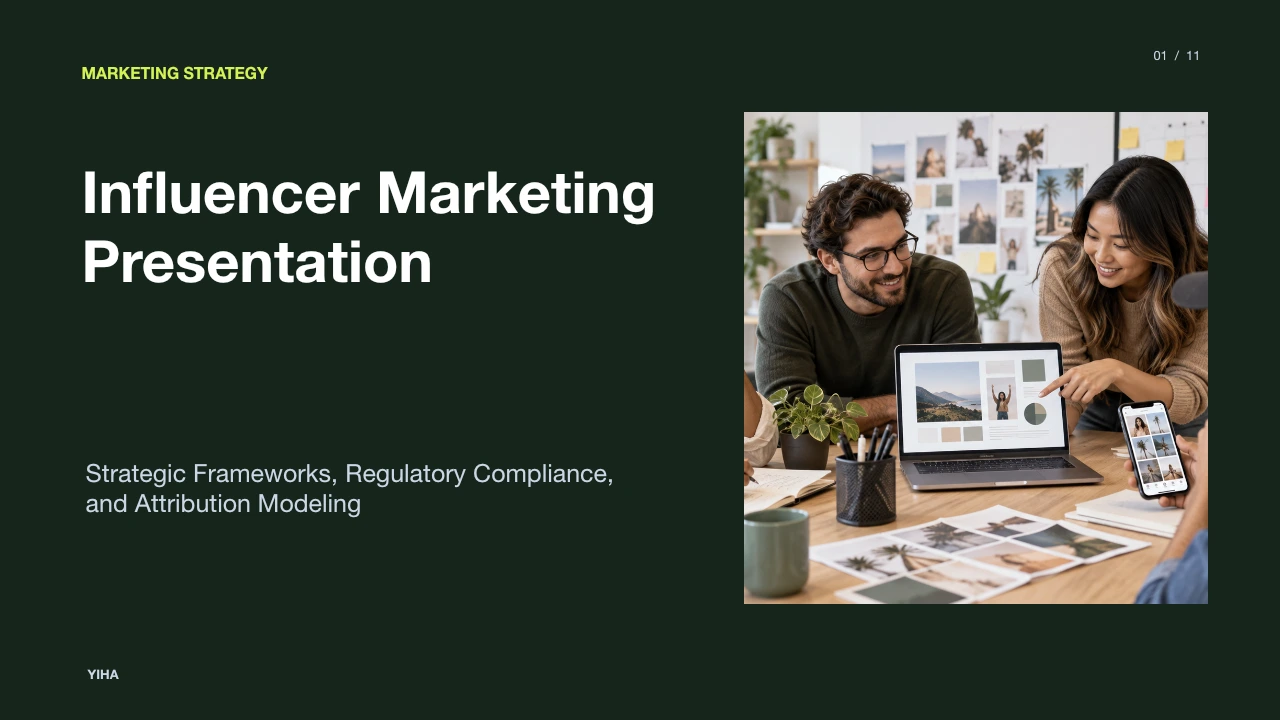
Influencer Presentation
A comprehensive guide to delivering an executive influencer presentation that connects creator partnerships to commercial outcomes, attribution, and governance.
Free download · 4.9 MB11 editable slides · PowerPoint format
Download the editable PPTX
PPTX · 4.9 MB · 11 editable slides · Free to edit and reuse with attribution to Yiha.ai
View every slide
Use ← →, Home/End, or swipe on mobile
Presenting an influencer marketing strategy to senior stakeholders requires shifting the conversation away from vanity metrics toward clear commercial accountability. Executive teams, brand directors, and finance leaders evaluate creator programs on their ability to solve business challenges, reach qualified target segments, and deliver verifiable business lift. Whether an agency is pitching a brand client, an internal team is seeking budget approval, or a creator is proposing a long-term collaboration, an effective influencer presentation must clearly outline strategic alignment, creator selection methodology, compliance controls, and measurement architecture.
Defining the Strategic Role of Influencer Partnerships
Executive buy-in for creator programs frequently breaks down when presentations focus primarily on social visibility rather than commercial contributions. As explored in SparkLine USA's Agency Playbook, executive objections rarely stem from skepticism about the creator channel itself. Instead, decision-makers hesitate because they lack clarity on whether a specific investment will perform and how that performance will be measured. Presentations that win approval address this concern directly by defining clear creator selection criteria and demonstrating how creator audiences match target customer profiles.
To move beyond surface-level metrics, presenters must frame creator collaborations as structured customer acquisition and brand-building channels. As outlined by InfluenceFlow's Guide, sophisticated pitches incorporate advanced metrics such as brand lift, sentiment analysis, and multi-touch sales attribution rather than relying strictly on top-of-funnel reach or follower counts. Demonstrating an understanding of full-funnel business objectives reassures executive leadership that marketing spend is tied to quantifiable growth.
An illustrative example of this approach involves presenting a partnership not as sponsored content, but as an acquisition test targeting an underpenetrated demographic segment. By establishing baseline customer acquisition costs and comparing creator engagement against existing paid channels, marketing leaders position the creator program as a rigorous performance initiative rather than an experimental social media tactic.
Core Presentation Archetypes and Decision Contexts
Influencer decks serve different strategic purposes depending on the stakeholder environment and decision context. As detailed in the ReelMind Influencer Presentation Guide, presentations generally follow three core archetypes: the creator media kit, the brand partnership pitch, and the operational campaign proposal. Each format requires a distinct structure to satisfy the operational needs of reviewers.
The creator media kit acts as a foundational portfolio summarizing creator niche, platforms, audience demographics, and previous brand collaborations. In contrast, a brand partnership pitch connects a creator's unique audience and content style directly to a brand's strategic goals, directly answering why that specific creator fits the brand's campaign. Finally, an operational campaign proposal details content deliverables, timelines, usage rights, and reporting milestones to remove ambiguity before contract execution. Furthermore, analyses of effective deck structures by SlideGenius show that successful decks typically run between 10 and 18 slides, opening with clear positioning and organizing modular slides around verified data and structured rate packages.
Matching the deck archetype to the operational context prevents misaligned expectations. Presenting an exhaustive operational proposal during an initial strategic alignment meeting overwhelms decision-makers, while presenting an introductory media kit during budget review fails to supply the governance and deliverable details required for financial sign-off.
Evaluating Creator Tiers and Audience Trade-Offs
Justifying a creator roster to finance and marketing leadership demands a clear analysis of follower tiers and performance trade-offs. According to tier benchmarks documented by Sprout Social, nano-influencers typically maintain 1,000 to 10,000 followers, micro-influencers hold 10,000 to 100,000 followers, macro-influencers manage over 100,000 followers, and mega-influencers reach 1,000,000 or more followers. Each tier provides distinct advantages across the marketing funnel.
Academic research published by the MIT Sloan Management Review reveals that smaller creators often deliver high returns on investment and higher sales conversion rates compared to prominent influencers. As follower counts expand, personal intimacy and relatability tend to decline, causing macro-influencer engagement rates to flatten as audiences transition from feeling like personal peers to distant fans. Nano- and micro-influencers often drive strong mid- and bottom-funnel conversion where niche credibility directly impacts purchase decisions. Conversely, macro- and mega-influencers provide the broad reach required for high-velocity top-of-funnel brand awareness and national product launches.
When presenting roster compositions to internal committees, marketing teams should illustrate how combined tiers balance scale against cost efficiency. While micro-influencer campaigns offer lower individual acquisition costs, managing dozens of individual creator contracts introduces operational overhead that must be accounted for within campaign resourcing.
Audience Verification and Authenticity Analysis
Before financial capital is allocated to creator partnerships, presentations must document rigorous audience verification and authenticity audits. As noted in research on pitch decks by SlideGenius, incorporating verified analytics dashboard screenshots with visible date ranges provides verifiable authenticity that distinguishes high-quality audiences from vanity metrics. Executive presentations must validate follower age distributions, geographic concentration, gender splits, and historical engagement consistency.
According to strategic guidance from Prezent's Presentation Guide, identifying audience preferences, behaviors, and psychographics before finalizing channels ensures that creator messaging resonates with genuine target buyers. Engagement rate analysis, calculated by evaluating active interactions relative to reach, helps teams detect artificial engagement patterns, such as sudden follower spikes or generic automated comments.
A recognized limitation in audience vetting involves private profile metrics and cross-platform demographic shifts. Presenters should clearly state the analytical methods used to audit creator followings, highlighting third-party verification tools or verified native insights to assure stakeholders that projected reach represents authentic commercial potential.
Balancing Creative Authenticity with Brand Guidelines
Creator partnerships fail when campaigns either lack brand guardrails or stifle the organic creative style that built audience trust. The operational briefing guide from Mysocial recommends balancing campaign control by providing structured brand direction through messaging guardrails, brand safety boundaries, and clear call-to-action requirements, while reserving creative freedom for the creator's natural voice, humor, and editing style. Imposing word-for-word scripts often causes content to underperform because audiences detect rigid promotional language.
To ensure brand safety without alienating creators, campaign briefs should outline clear parameters. As explained in InfluenceFlow's Brand Guidelines Guide, formal guidelines establish non-negotiable standards, including visual identity parameters, disallowed claims, competitor restrictions, and mandatory compliance protocols. Providing recommended hook concepts and customer pain points allows creators to translate brand values into natural conversational styles suitable for specific social platforms.
An illustrative example of balancing creative control involves supplying creators with core product benefits and compliance boundaries while permitting them to select their own visual backdrops and narrative framing. This structure ensures that regulatory requirements are maintained while preserving the personal engagement style that followers expect.
Attribution Models and Multichannel Measurement
Demonstrating business impact requires moving past simplistic attribution. Single-touch models fail because consumer decision journeys are inherently complex. As analysis from inBeat Agency highlights, multi-touch frameworks and matched-market geo testing help organizations measure true incremental lift in revenue and customer acquisition beyond basic platform reporting.
Relying exclusively on last-click attribution creates systematic bias against upper-funnel activations. As reported by Influencers Time on Incremental Lift, last-click mechanisms like affiliate promo codes and direct swipe links reward bottom-of-the-funnel touchpoints while giving zero revenue credit to creators who generated initial product consideration. Over time, this misleads marketing teams into funding only discount-oriented channels while cutting top-of-funnel brand builders. A balanced presentation introduces a dual-layer reporting model that separates direct response conversions from assisted brand influence.
Presenting statistically sound incrementality requires running controlled experiments comparing audiences exposed to creator messaging against unexposed control groups. Presenters should show confidence intervals alongside revenue lift figures, reassuring finance teams that observed gains reflect actual behavioral changes rather than baseline organic sales.
Usage Rights, Licensing, and Deliverable Structures
Contractual scope definitions form the operational backbone of any creator presentation. Presenters must articulate precisely what assets are being procured and how the brand intends to utilize them across marketing channels. The presentation guide from ReelMind notes that proposals must explicitly state content formats, asset quantities, target platforms, and review workflows, while clarifying whether assets are intended for organic posting, website hosting, or paid advertising.
As described in Beautiful.ai's Campaign Brief Template Guide, defining deliverables, timelines, usage rights, and review expectations upfront aligns marketing teams and creators before content production begins. When brands intend to whitelist creator profiles or run paid amplification behind organic posts, licensing parameters, run durations, and territory scopes must be formally defined. Omitting usage terms leads to contract renegotiations, project delays, and unexpected licensing expenses.
A limitation in creator deliverable planning involves production revisions. Presentations should outline explicit boundaries, such as a single round of creative feedback within specified timelines, ensuring projects remain on schedule while respecting creator production workflows.
Regulatory Compliance and Disclosure Requirements
Legal compliance represents an essential component of professional influencer presentations. Under the Federal Trade Commission (FTC) Endorsement Guides, documented in Disclosures 101 for Social Media Influencers, creators must clearly and conspicuously disclose any material connection with an endorsing brand. A material connection includes financial compensation, free merchandise, discounts, or employment relationships that consumers would not expect.
As clarified in the FTC's staff advisory publication, FTC's Endorsement Guides: What People Are Asking, disclosures must be obvious to consumers evaluating an endorsement. For video content, disclosures must be embedded directly within the video itself rather than relegated solely to the written video description. Furthermore, if an endorsement is made through both visual and audible elements, disclosures must be delivered simultaneously across both audio and visual channels to ensure viewers who watch without sound or miss overlay text remain informed. In live streams, disclosure statements must be repeated periodically.
Presenting compliance protocols directly to stakeholders demonstrates thorough risk management. Including standardized disclosure language, such as clear partnership tags, in the presentation reassures legal and corporate communications teams that brand reputation and regulatory standards are safeguarded.
Pitching the Execution Roadmap and Approval Gates
Winning final sign-off requires presenting a structured implementation timeline that outlines operational gates, feedback milestones, and reporting schedules. Strategic frameworks outlined by Sprout Social emphasize establishing predetermined milestones to track progress, coordinate review windows, and evaluate performance data after activation.
According to presentation planning standards detailed by Prezent, a well-organized presentation maps out strategic objectives, creator channel selections, and structured content schedules. Review gates should define clear production phases: creative brief alignment, concept review, content submission, compliance verification, and final publishing. Establishing an explicit schedule prevents delayed product launches and ensures marketing teams can execute synchronized promotional campaigns.
Finally, the presentation roadmap must detail ongoing performance reporting cadences. Outlining when preliminary engagement data, multi-touch attribution metrics, and comprehensive lift studies will be delivered to executive stakeholders builds long-term operational credibility and supports recurring program funding.
Research sources
- Influencer Pitch Deck Examples: 2026 Guide - InfluenceFlow · influenceflow.io
- How to Pitch Influencer Marketing to Brands: Agency Playbook · www.sparklineusa.com
- Effective Examples of Influencer Pitch Decks: Key Elements and Tips · www.slidegenius.com
- Influencer Presentation PPT Template Guide | ReelMind · reelmind.ai
- Influencer Pitch Template - Email & Deck Examples · tapfiliate.com
- The Surprising ROI of Small Online Influencers · sloanreview.mit.edu
- 12 Types of Influencers Are Reshaping Marketing | Sprout Social · sproutsocial.com
- The Power of Micro-Influencers: Rethinking Digital Marketing ROI | Journal of Marketing & Social Research · jmsr-online.com
- Disclosures 101 for Social Media Influencers | Federal Trade Commission · www.ftc.gov
- Influencer Marketing Strategy Presentation Guide · www.prezent.ai
- Brand Guidelines Document for Influencer Partnerships |... · influenceflow.io
- Influencer Marketing Brief Template [+ Free Download] · mysocial.io
- How to Write an Influencer Brief [+ Free Template] · www.meltwater.com
- Influencer Lift Studies for 2025 Attribution | Maximize Marketing ROI · www.influencers-time.com
- Incremental Sales Lift Attribution for Creator Revenue · www.influencers-time.com
- Influencer Marketing Attribution Models Explained: 6 Frameworks to Prove ROI - inBeat Agency · inbeat.agency
- Influencer Marketing Campaign Brief Presentation Template · www.beautiful.ai
- FTC's Endorsement Guides: What People Are Asking | Federal Trade Commission · www.ftc.gov
- What Is Influencer Marketing: A Strategy Guide for 2026 | Sprout Social · sproutsocial.com