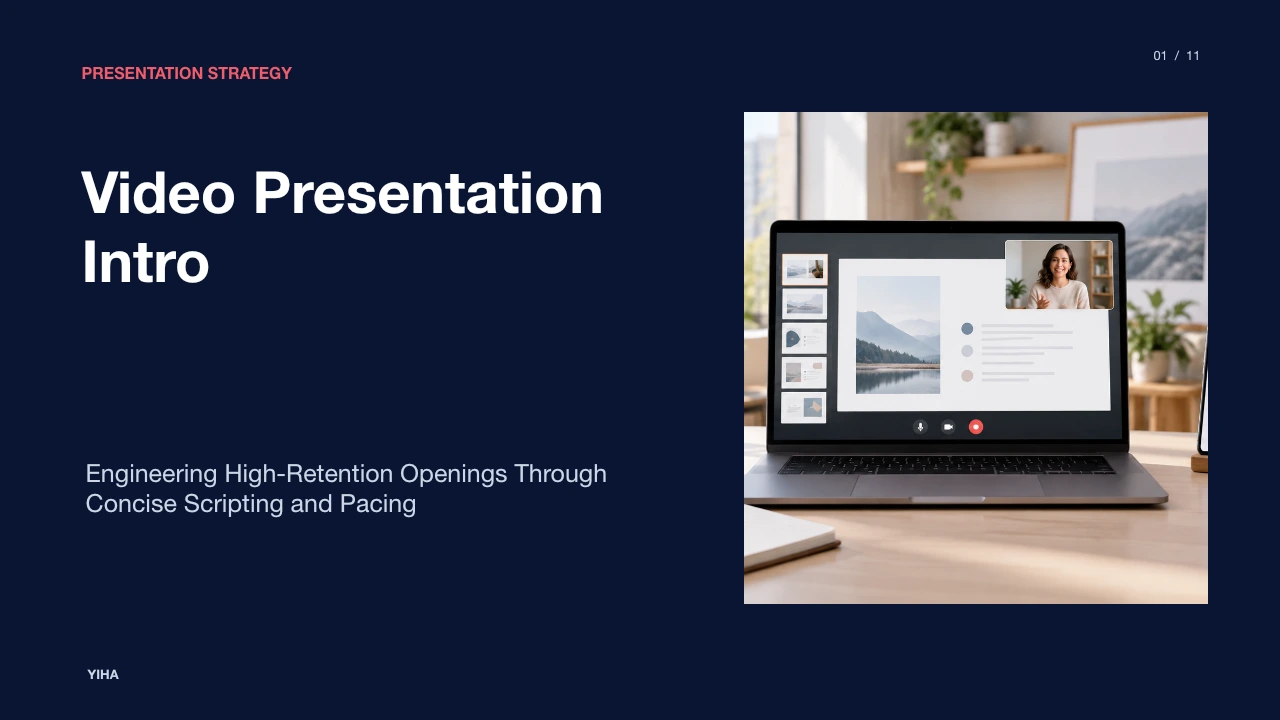
Presentation Storytelling Techniques
A comprehensive guide to presentation storytelling techniques, examining the neural mechanisms of narrative processing, structural models, cognitive dual coding, and visual pacing to build persuasive slide decks.
Free download · 4.9 MB11 editable slides · PowerPoint format
Download the editable PPTX
PPTX · 4.9 MB · 11 editable slides · Free to edit and reuse with attribution to Yiha.ai
View every slide
Use ← →, Home/End, or swipe on mobile

Executive audiences make high-stakes determinations within minutes, yet traditional business presentations often assemble fragmented data tables and disconnected bullet points. When strategic information lacks structural continuity, listeners experience cognitive friction and fail to retain core conclusions. Applying systematic presentation storytelling techniques transforms static technical information into coherent decision journeys. By understanding the neurobiological principles of information delivery, organizing logical arguments through tested structural frameworks, and enforcing strict visual hierarchy, presenters can lead analytical audiences from initial tension to verified strategic action.
The Neuroscience of Narrative Processing
Human cognitive architecture processes organized narratives differently than lists of unstructured facts. Controlled neurobiological investigations demonstrate that narrative immersion triggers specific endocrine responses that direct attention and foster interpersonal trust. Research led by Paul Zak indicates that character-driven narratives prompt the release of cortisol, which focuses attention on critical dilemmas, alongside oxytocin, which fosters empathy and positive social alignment with the speaker. When narrative tension is absent, attention drops quickly, limiting deeper engagement.
Furthermore, brain-imaging investigations conducted by Uri Hasson at Princeton University reveal the biological mechanism of neural coupling during narrative reception. As detailed in research compiled by Science of People, fMRI scans confirm that a speaker communicating an organized narrative synchronizes their brain activity patterns with those of the audience. This neural synchronization deteriorates when presentation material is scrambled, fragmented, or delivered without narrative structure. In addition, experimental recall data synthesized by Deckary underscores that structured stories generate substantially higher long-term factual retention than uncontextualized metrics alone. However, narrative alignment depends entirely on establishing logical tension within the opening moments of an address.
Narrative Architecture and Structural Models
Translating strategic analysis into an engaging presentation requires an intentional structural architecture. Classical dramatic analysis offers foundational principles, but business presentations require adapted models that address corporate decision frameworks. One proven structure is the Context-Tension-Resolution framework analyzed by Deckary. In professional environments, context establishes the baseline operating reality, tension articulates the disruption or operational friction, and resolution presents the verified strategic recommendation.
This progression directly parallels the Problem-Solution-Impact model highlighted by Whitepage Studio, which organizes investor and corporate presentations to prevent cognitive drifting. The framework created by Nancy Duarte structures momentum by systematically oscillating between what is (the present friction) and what could be (the optimized future state). This deliberate contrast produces the dynamic energy required to motivate change. In corporate boardrooms, this model must be deployed alongside Barbara Minto's Pyramid Principle, which states the core resolution upfront before unfolding the deductive supporting narrative. Rather than relying on a suspense novel structure, executive narrative architecture anchors the bottom-line recommendation first and utilizes narrative tension to justify execution.
Cognitive Fluency and Dual-Coding Principles
Even a well-structured narrative will fail if visual slide assets overwhelm the audience's mental capacity. Cognitive fluency research confirms that human brains judge information that is effortless to process as significantly more credible and lower in risk. Presenting complex concepts requires applying Allan Paivio's dual-coding theory, which demonstrates that visual and verbal information are processed along distinct mental channels. When visual anchors complement verbal explanations, the mind stores the insight through dual retrieval pathways, multiplying recall fidelity.
As explored by Science of People, visual processing occurs rapidly: the brain can identify visual stimuli in mere milliseconds, whereas reading textual copy requires substantial decoding time. When presenters place dense paragraphs on slides while speaking, they trigger John Sweller's cognitive split-attention effect. Audiences cannot read complex text and listen to spoken exposition simultaneously without losing comprehension. Operational guidelines such as the six-by-six recommendation (suggesting a maximum of six bullets per slide and six words per bullet) help teams eliminate unnecessary clutter. Slide layouts must function as cognitive anchors that reinforce spoken arguments rather than redundant teleprompters.
Conflict Framing and Character-Driven Stakes
Strategic narratives require authentic stakes to hold attention. Statements claiming that organizational operations are entirely seamless fail to provoke executive engagement because without friction, there is no rationale for decisive resource allocation. As outlined by Qubit Capital, effective presentation design builds around context, conflict, character, and closure. Grounding organizational arguments in tangible conflict forces leadership to confront real market dynamics.
In business contexts, characters should represent authentic operational entities: the frontline customer enduring inefficient workflows, an internal product team facing legacy infrastructure hurdles, or an enterprise confronting regulatory volatility. Guidance from Effective Presentations emphasizes that presentation storytelling shifts the narrative focus directly to the listener's operational dilemmas. Presenters must articulate the conflict before proposing the technical remedy. If an audience does not feel the operational friction or economic cost of inaction, the corresponding strategic initiative appears merely speculative rather than essential.
Translating Quantitative Data into Narrative Insight
Technical and business reviews often rely on dense tables of quantitative metrics, assuming that empirical data speaks for itself. Yet empirical research documented by Deckary highlights a fundamental cognitive barrier: in recall evaluations conducted by Chip Heath at Stanford, audiences demonstrated substantially higher recall for structured narratives than for isolated standalone statistics. Raw metrics isolated from narrative context fail to stick within executive memory.
Transforming empirical data into strategic insight requires framing figures within an interpretive narrative arc. Presenters must eliminate non-essential data ink, as advocated in visual communication principles, and direct focus toward meaningful trendlines. Analysis from Whitepage Studio emphasizes that every data slide must answer one primary strategic question. Instead of displaying ten disparate variables on a single visual, presenters should annotate critical milestones, isolate the primary variance, and verbally explain the operational causes driving that change. Data visualization must not merely display calculations; it must illustrate the underlying reality behind those figures.
Visual Hierarchy, Spatial Blocking, and Focus Control
Audiences instinctively scan a slide within milliseconds to determine where their attention belongs. Without clear visual hierarchy and deliberate spatial blocking, viewers waste cognitive energy deciphering the slide rather than evaluating the argument. Research from the University of Minnesota and 3M, cited by Whitepage Studio, indicates that presentations using structured visual aids achieve markedly higher persuasive impact than unaided presentations. This advantage occurs because spatial structure streamlines information intake.
Establishing visual hierarchy requires applying Gestalt principles of proximity, similarity, and figure-ground contrast. Elements related in logic must be grouped together spatially, while critical takeaways should be emphasized using scale or color contrast. As analyzed by Qubit Capital, minimalist slide layouts use negative whitespace to frame focal points, ensuring that critical metrics or headlines capture attention without competing against ambient decoration. Blocking slides so that key concepts follow natural reading patterns prevents visual distraction and maintains audience focus.
Delivery Dynamics, Intentional Pauses, and Pacing
Slide design represents only half of presentation storytelling; vocal delivery and physical pacing govern whether the narrative resonates. Presenters often make the mistake of rushing through slides to cover dense content within tight agendas, creating acoustic exhaustion. Delivery frameworks discussed by Whitepage Studio demonstrate that impactful storytelling balances visual structure, spoken narrative, and intentional delivery pacing.
Mastering acoustic delivery requires utilizing intentional pauses. Pausing before delivering a significant metric signals analytical importance, while pausing immediately following a key statement provides the audience time to absorb the conclusion. Cadence modulation serves as an auditory guide: slowing down during the articulation of tension emphasizes gravity, while quickening pace during operational implementation reflects momentum. Seamless verbal transitions bridge the gap between slides, ensuring that the movement between problem framing and verified solutions feels logically integrated rather than disjointed.
Analytical Skepticism and the Risks of Over-Narrating
While narrative frameworks improve engagement, over-narrating can undermine technical credibility before skeptical executive committees. Analytical leaders and investment committees apply rapid scrutiny to presentation decks. Industry commentary from Whitepage Studio notes that evaluators quickly eliminate presentations during early screening if core operational substance is obscured by marketing slogans or excessive exposition.
Storytelling becomes counterproductive when emotional appeals take the place of rigorous mathematical analysis or technical validation. When presenting to finance directors, technical architects, or risk boards, narrative structure must act as a clear delivery vehicle for verified evidence rather than an emotional shield. Presenters must adhere to strict transparency: core slides should communicate direct hypotheses and verified findings, supported by an exhaustive appendix containing raw data sheets, sensitivity models, and methodology parameters. Guidance from Effective Presentations confirms that clear structure supports credibility when paired with substantive evidence, protecting professional standing against analytical skepticism.
Systematic Slide Scaffolding and Storyboard Assembly
Building an effective presentation should never begin in slide production software. Jumping straight into layout software causes teams to focus on slide formatting before finalizing narrative coherence. An end-to-end scaffolding workflow begins with analog outlines or card-based storyboards, as illustrated in presentation development frameworks discussed by Whitepage Studio. Teams must validate narrative continuity and stress-test the strategic thesis before opening digital design templates.
A foundational scaffolding practice involves writing active assertion titles for each slide. Instead of using generic topic headers such as "Regional Logistics Data" or "Market Dynamics," presenters must craft complete assertions. For example, in an illustrative scenario evaluating logistics, an assertion title such as "Illustrative example: Regional distribution centers reduce delivery transit times" guides the audience directly to the strategic outcome. Reading slide titles in sequence should form a coherent, standalone executive summary of the entire presentation. Analysis examined by Qubit Capital recommends keeping narrative presentations concise, with decks typically focused across 10 to 15 core slides where each asset fulfills a precise role in the narrative arc. Scaffolding decks around clear narrative beats ensures that the final presentation operates as an airtight strategic briefing.
Research sources
- Visual Storytelling: 10 Techniques to Master Your Next Pitch · www.scienceofpeople.com
- Storytelling in Presentations: Techniques That Keep Audiences Engaged | Deckary · deckary.com
- Storytelling Techniques for Presentations (+10 Examples) · www.effectivepresentations.com
- Visual Storytelling Techniques for High-Stakes Business Presentations | Whitepage · www.whitepage.studio
- Storytelling for Startups: Create Investor-Winning Pitch Decks · qubit.capital
- Pitch Deck Storytelling Techniques That Hook Investors · qubit.capital
- Presentation Storytelling Examples & Techniques (2026) · www.storydoc.com
- Storytelling Techniques in Presentations: AI Guidance | ReelMind · reelmind.ai