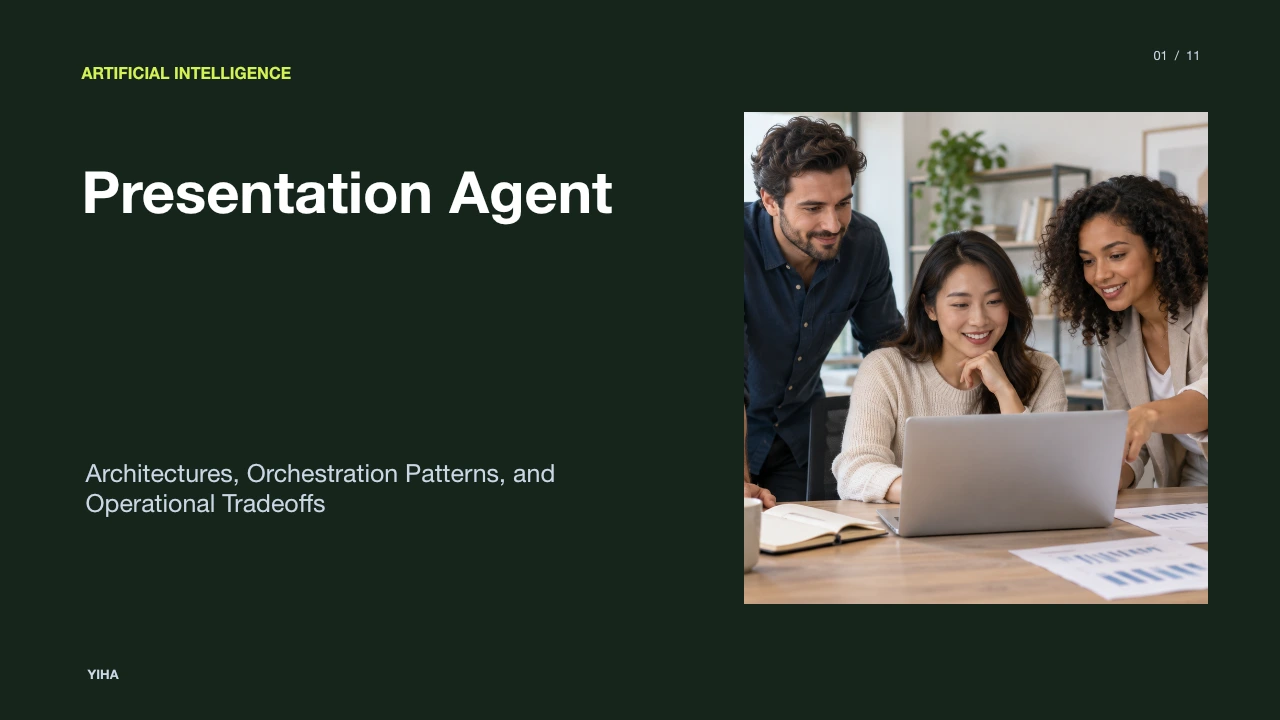
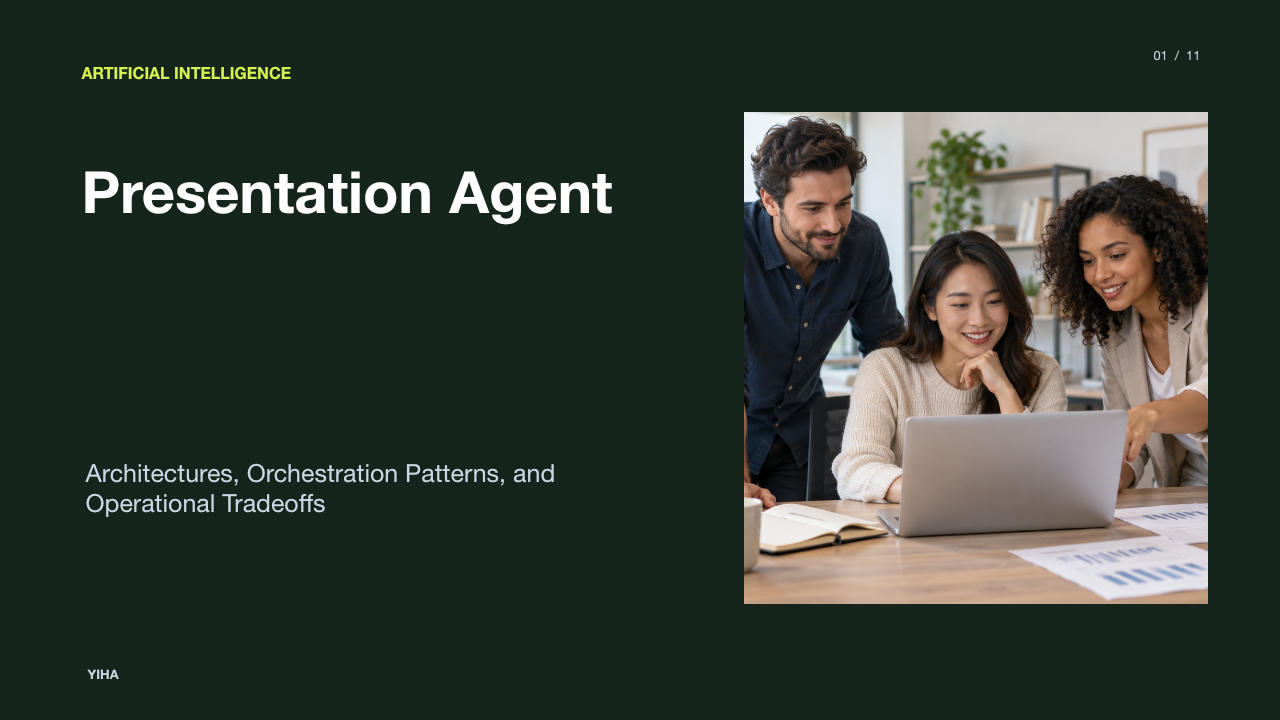
Presentation Agent
An architectural guide to autonomous presentation agents, comparing generative copilots with multi-agent orchestration for slide structuring, layout schemas, and enterprise document workflows.
Free download · 4.9 MB11 editable slides · PowerPoint format
Download the editable PPTX
PPTX · 4.9 MB · 11 editable slides · Free to edit and reuse with attribution to Yiha.ai
View every slide
Use ← →, Home/End, or swipe on mobile
Slide creation and live deck delivery have historically relied on manual manipulation within visual presentation software. While single-prompt generative assistants brought rapid text drafting to individual slides, enterprise presentation workloads require deeper document comprehension, coherent narrative progression, and strict brand adherence. The modern presentation agent transitions this paradigm from single-turn language prompts to coordinated multi-agent architectures that plan, generate, evaluate, and refine presentations systematically.
From Slide Templates to Autonomous Presentation Agents
The evolution of digital presentation tools spans three distinct architectural phases: static presentation templates, single-shot copilots, and multi-agent autonomous presentation systems. In traditional slide software, users manually choose master layouts, format text boxes, and insert graphical elements. When large language models entered office software, early integrations operated as prompt-based copilots that received a single prompt and outputted unstructured slide content or basic slide decks. However, monolithic single-agent systems face severe constraints when asked to process large briefing documents, enforce typographic constraints, and maintain visual consistency across dozens of slides.
As outlined in AI Agent Orchestration Patterns, engineering workloads increasingly encounter tasks that exceed the capabilities of a single agent equipped with broad tools. Monolithic setups struggle with prompt complexity, tool overload, and high failure rates when coordinating multi-faceted jobs. Multi-agent orchestration addresses these bottlenecks by breaking complex objectives into specialized units of work. Instead of relying on one model call to interpret raw documents, structure an outline, design visual bounding boxes, and verify formatting, modern presentation agents decompose the lifecycle into discrete, collaborative steps.
Research on multi-agent frameworks in The Orchestration of Multi-Agent Systems: Architectures, Protocols, and Enterprise Adoption demonstrates that dividing labor across modular agents produces higher precision, scalability, and robustness. A presentation agent functions not as an isolated chatbot, but as an orchestrated system where specialized agents handle document parsing, structural outlining, slide schema definition, and brand validation.
Dual Modalities: Authoring Engines vs. Interactive Presenters
Presentation agents operate across two primary modalities: backend authoring engines and interactive presenter agents. Backend authoring engines function asynchronously to synthesize complex reference data into visual document artifacts. These agents read enterprise knowledge bases, spreadsheets, or long-form strategy documents and produce structured presentation files or cloud-native decks. Their core responsibility centers on semantic decomposition, visual hierarchy, layout geometry, and brand asset placement.
Interactive presenter agents, by contrast, focus on runtime delivery, live voice narration, and audience dialogue. An interactive presenter agent tracks conversational turns, handles spoken interruptions, explains complex visuals, and answers audience questions during a presentation session. Guidance from Multi-agent orchestration patterns and best practices emphasizes that in conversational multi-agent systems, a single parent agent should maintain user-facing communication, while specialized worker agents retrieve information in the background. In an interactive delivery scenario, the parent presenter coordinates audience communication while querying specialized back-end analytical sub-agents to surface data points during live question-and-answer exchanges.
As noted in The Orchestration of Multi-Agent Systems: Architectures, Protocols, and Enterprise Adoption, standardizing communication between operational layers requires robust protocols. Emerging standards such as the Model Context Protocol (MCP) allow agents to retrieve external data and invoke rendering tools, while Agent-to-Agent (A2A) protocols allow delivery agents to delegate complex domain questions to analytical worker agents without interrupting the live user conversation.
Multi-Agent Pipelines for Content Structuring and Slide Layout
Generating an enterprise-grade presentation requires a coordinated pipeline rather than a single generation step. Presentation agent architectures often employ the sequential orchestration pattern described in AI Agent Orchestration Patterns. In sequential pipelines, each stage builds deterministically on the output of the preceding stage, mirroring traditional data transformation systems while utilizing language models for structured reasoning.
An illustrative example of a presentation authoring pipeline consists of four distinct sub-agents:
- Document Ingestion Agent: Ingests raw source collateral, extracts key numerical findings, isolates strategic narratives, and prunes non-essential text to fit context boundaries.
- Storyline Planning Agent: Establishes the macro-narrative structure, generating an ordered sequence of slide titles, central takeaways, and logical transitions.
- Layout Schema Agent: Translates each slide thesis into a structured schema, defining spatial containers, visual zones, callouts, and bullet structures.
- Design and Asset Agent: Selects visual assets, sets typography styles, aligns color palettes with brand tokens, and generates the final slide deck file.
As explained in The Orchestration of Multi-Agent Systems: Architectures, Protocols, and Enterprise Adoption, establishing an agent orchestration layer provides a control plane that decomposes system-level objectives into actionable subtasks. This structure ensures that each sub-agent acts strictly within its defined operational boundaries, eliminating the risk of arbitrary layout modifications or omitted source facts.
Session Memory, Multi-Turn Refinement, and Template Grounding
Real-world presentation preparation is inherently iterative. Users rarely accept a generated presentation deck on the first attempt without requesting adjustments to tone, slide ordering, or visual layouts. Autonomous presentation agents require durable session memory and rigorous state management to support multi-turn conversational edits.
Technical patterns documented in AI Agent Orchestration Patterns state that multi-agent systems must persist shared state externally rather than relying exclusively on in-memory context windows. Because agent context windows expand quickly as reasoning logs and tool results accumulate, architects must use context compaction techniques such as summarization and selective pruning. Storing slide state, layout trees, and conversation history in durable databases allows presentation agents to resume sessions, track revisions, and support rollbacks without reprocessing entire source documents.
Furthermore, template grounding ensures that adjustments respect established design frameworks. In The Orchestration of Multi-Agent Systems: Architectures, Protocols, and Enterprise Adoption, state units and knowledge units work together to maintain domain-specific standards and session progress. For presentation agents, template grounding links slide generation directly to master slide hierarchies, approved brand style guides, and reusable component libraries. When a user requests that the agent edit a single slide, the agent isolates that target node, applies the requested changes, and preserves the surrounding layout rules without overwriting global design variables.
Benchmark Evidence and Quality Evaluation for Agentic Decks
Evaluating the quality of agent-generated presentation decks requires multi-dimensional evaluation criteria. Unlike standard text generation, presentation decks combine semantic fidelity, communicative conciseness, visual hierarchy, and precise typographic constraints. System builders evaluate agent performance across factual groundedness, structural narrative coherence, visual balance, and reference preservation.
To enforce reliable outputs, multi-agent frameworks implement maker-checker loops. As detailed in AI Agent Orchestration Patterns, a maker-checker loop pairs a generation agent (the maker) with an evaluation agent (the checker). In presentation pipelines, the checker evaluates generated slide schemas against strict design and factual criteria. If the checker detects overlapping bounding boxes, unsupported claims, or excessive text density, it sends concrete feedback back to the maker agent for revision. This cycle continues until the slide schema meets acceptance standards or reaches a predefined iteration limit.
Research highlighted in The Orchestration of Multi-Agent Systems: Architectures, Protocols, and Enterprise Adoption demonstrates that control units and quality management modules are critical to maintaining consistency and preventing model drift. These operational layers enforce validation checks, verify references against source material, and log performance metrics across every generation run.
Document Transformation and Automated Reporting Workflows
One of the most valuable production use cases for presentation agents is automated reporting. Organizations generate recurring operational decks, such as weekly business reviews, monthly financial reports, and project portfolio summaries. Producing these decks manually consumes substantial administrative time and introduces data transcription errors.
By leveraging sequential and concurrent orchestration patterns outlined in AI Agent Orchestration Patterns, enterprise pipelines can automate data extraction and report rendering. As source spreadsheets or operational databases update, worker agents extract key performance indicators, calculate period-over-period variance, and draft analytical commentary. The presentation agent then populates approved presentation templates with updated charts, tables, and narrative summaries.
Enterprise studies in The Orchestration of Multi-Agent Systems: Architectures, Protocols, and Enterprise Adoption indicate that deploying networks of specialized agents to automate document-intensive workflows yields significant operational efficiency gains. In financial underwriting and insurance processing, specialized agents routinely ingest structured and unstructured customer submissions to synthesize verified decisions. Presentation agents apply these same principles to executive reporting, turning recurring data ingestion into continuous, reliable slide generation.
Architectural Tradeoffs: Autonomous Workflows vs Copilot Prompts
Choosing between lightweight copilot prompts and autonomous presentation pipelines involves distinct technical tradeoffs. System architects must balance latency, computational cost, determinism, and execution flexibility.
As outlined in AI Agent Orchestration Patterns, single-model calls with prompt engineering represent the lowest level of system complexity. Copilot prompts exhibit low execution latency and low token costs, making them suitable for inline text rewriting or single slide suggestions. However, copilots lack the capacity to orchestrate multi-page layouts or enforce enterprise brand systems reliably. When prompt complexity and tool interactions grow, monolithic agents often fail.
Platforms such as Microsoft Foundry Agent Service illustrate the spectrum of agent configurations, ranging from simple prompt agents to fully managed hosted agents that execute complex orchestration code. As highlighted in The Orchestration of Multi-Agent Systems: Architectures, Protocols, and Enterprise Adoption, multi-agent systems introduce noticeable coordination overhead, message passing latencies, and token multiplication across sequential and concurrent steps. For latency-sensitive user experiences, waiting for multiple agent verification loops can introduce delays. Architects must decide whether a task demands full autonomous generation or if a single prompt-assisted interaction is sufficient.
Technical Limitations in Layout Consistency and Real-Time Voice
Despite recent advancements, presentation agents face meaningful technical limitations across visual layout consistency and conversational speech rendering. Generating slides requires spatial reasoning that language models cannot always execute consistently. Common failure modes include text overflowing designated containers, overlapping graphic elements, visual hierarchy collapse, and awkward line breaks in presentation typography.
To counter these visual limitations, modern systems separate content reasoning from layout compilation. Rather than permitting models to output raw slide code directly, orchestrators force agents to populate deterministic schema objects with explicit character constraints, as recommended in AI Agent Orchestration Patterns. The visual engine then calculates spatial boundaries and renders shapes deterministically.
Interactive delivery agents encounter acoustic and cognitive latency challenges during real-time voice interactions. Running speech-to-text transcription, context retrieval, multi-agent reasoning, and text-to-speech synthesis creates noticeable delays that disrupt natural conversational turn-taking. As noted in The Orchestration of Multi-Agent Systems: Architectures, Protocols, and Enterprise Adoption, multi-agent communication overhead and message congestion exacerbate performance bottlenecks unless carefully managed. When real-time response times are required, extensive inter-agent debates become impractical.
Production Integration Patterns and Autonomous Delivery Pipelines
Deploying presentation agents in enterprise production environments requires structured integration patterns and governance guardrails. Rather than exposing standalone interfaces, organizations embed presentation agents into enterprise software via RESTful APIs, asynchronous job queues, and event-driven webhooks.
Because comprehensive slide compilation involves multiple sequential agent stages, long-running tasks should operate asynchronously. In accordance with guidelines in Multi-agent orchestration patterns and best practices, parent orchestrators must manage data handoffs carefully, ensuring that sub-agents receive only necessary parameters while audit logs record every tool invocation. Connecting agents through standardized interfaces preserves distinct security boundaries and audit trails.
Furthermore, AI Agent Orchestration Patterns recommends integrating Human-in-the-Loop (HITL) checkpoints at critical decision gates. By establishing mandatory approval checkpoints before slides are distributed to stakeholders, enterprises safeguard output quality and maintain operational compliance. Combining specialized agent roles, standardized tool protocols like MCP, and human oversight produces robust, enterprise-grade presentation systems.
Research sources
- AI Agent Orchestration Patterns - Azure Architecture Center | Microsoft Learn · learn.microsoft.com
- The Orchestration of Multi-Agent Systems: Architectures, Protocols, and Enterprise Adoption · arxiv.org
- Multi-agent orchestration patterns and best practices - Microsoft Copilot Studio | Microsoft Learn · learn.microsoft.com
- What is Microsoft Foundry Agent Service? - Microsoft Foundry | Microsoft Learn · learn.microsoft.com