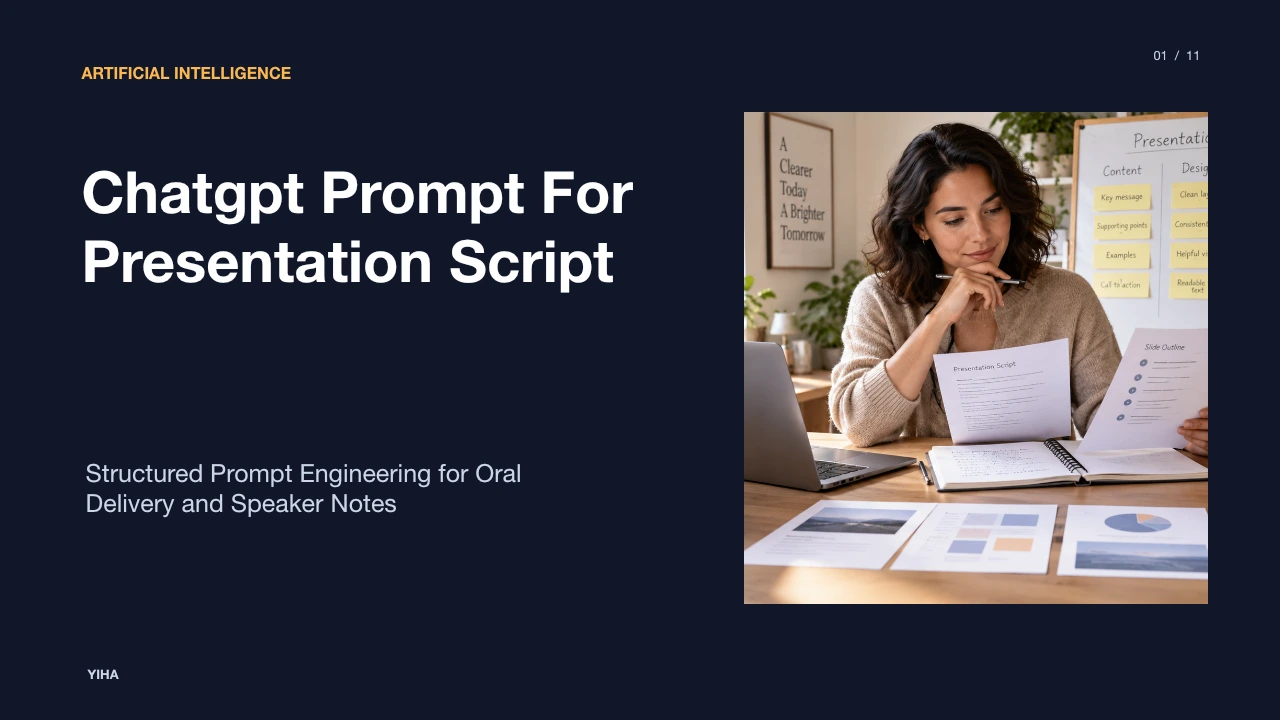
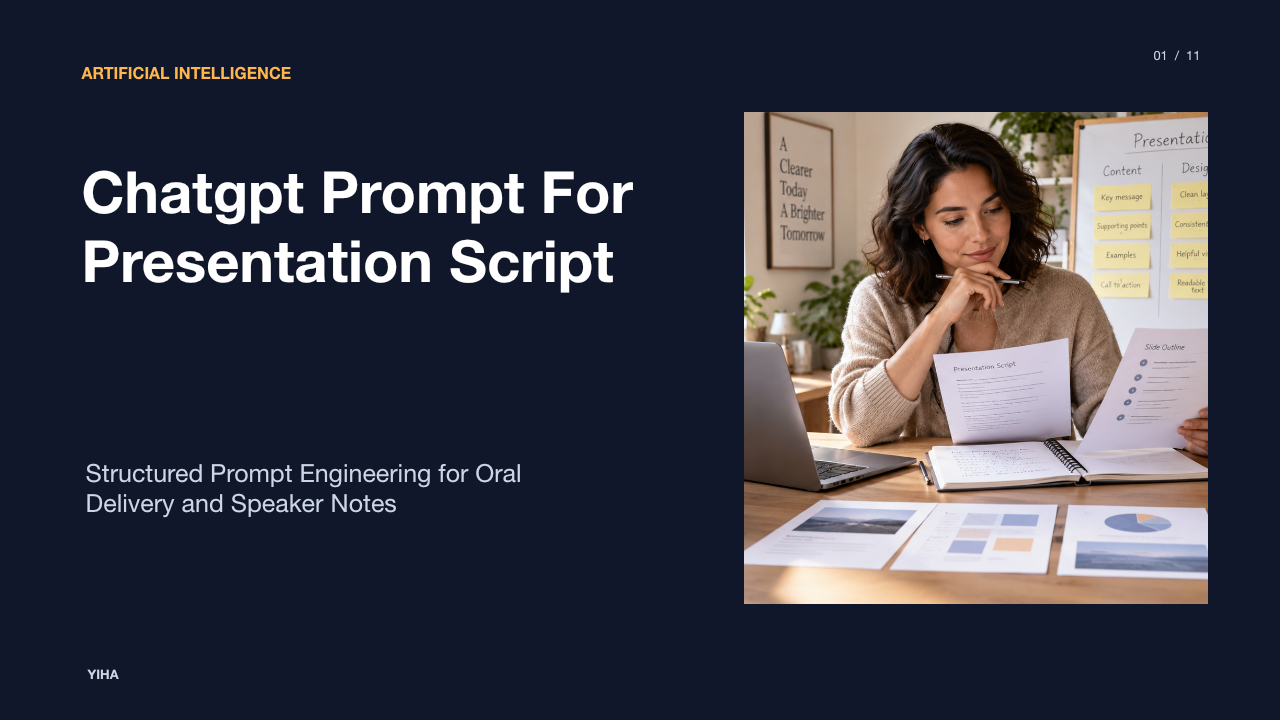
Chatgpt Prompt For Presentation Script
A technical guide to engineering ChatGPT prompts for oral presentation scripts, covering prompt anatomy, strict grounding, slide pacing, and rehearsal workflows.
Free download · 4.9 MB11 editable slides · PowerPoint format
Download the editable PPTX
PPTX · 4.9 MB · 11 editable slides · Free to edit and reuse with attribution to Yiha.ai
View every slide
Use ← →, Home/End, or swipe on mobile
Drafting an effective oral presentation script using a large language model requires fundamentally different techniques than generating written essays or marketing articles. While a standard text prompt often returns dense paragraphs, passive sentence structures, and abstract corporate vocabulary, spoken communication demands clear cadence, conversational rhythm, and strict time management. When speakers read text written for silent consumption, they often stumble over complex phrasing and lose audience attention. By treating speech script generation as a structured prompt engineering challenge, presenters can steer models like ChatGPT to produce spoken notes that match human delivery patterns, respect slide transitions, and remain grounded in verified facts.
Why Spoken Scripts Require Dedicated Prompt Architecture
Standard language model completions default to predictable text sequences based on token probability distributions. As documented in Prompt engineering techniques - Microsoft Foundry, generative language models attempt to produce the most likely series of words that follow an input prompt based on their training corpora. Because the majority of internet training data consists of articles, documentation, and essays, an unconstrained prompt produces prose optimized for the eye rather than the ear.
Spoken language requires shorter syntactic clauses, immediate clarity, and natural breathing intervals. In technical terms, prompts must establish clear role instructions, boundary constraints, and structural rules to prevent the model from drifting into academic or essay-style syntax. According to research on pattern catalogs in A Prompt Pattern Catalog to Enhance Prompt Engineering with ChatGPT, prompt patterns act as reusable architectural solutions that enforce rules, automate formatting, and govern both the quality and quantity of generated responses. When writing prompts for spoken scripts, creators must specify sentence length limits, dictate conversational structures, and replace passive constructions with direct, verbal hooks.
Core Anatomy of an Effective Script Generation Prompt
An effective presentation script prompt decomposes the generation task into explicit functional components. Rather than issuing a generic command such as "write a presentation script," structured prompt engineering separates the request into role definition, baseline audience knowledge, narrative objectives, delivery budgets, and negative constraints. Technical documentation from Prompt engineering | OpenAI API highlights that prompt engineering involves structuring instructions, context, and expected output parameters to ensure the model consistently meets operational requirements.
In a presentation context, the persona sets whose perspective and tone the model adopts. The core task clarifies the presentation topic and the required call to action. Format instructions define deliverables, such as slide-by-slide speaker notes. Finally, constraints establish hard guardrails. Practical templates such as those outlined in ChatGPT Prompts to Create a Pitch Deck demonstrate how restricting outputs to explicit target lengths, such as a recommendation of forty to seventy words per slide, and enforcing explicit purpose statements prevents bloated commentary.
Grounding Prompts with Strict Evidence and Context Boundaries
One of the most persistent hazards when generating business or academic scripts is model hallucination, where the system introduces unsupported statistics, fabricated case studies, or generic claims. Language models operate on statistical plausibility rather than ground truth. To eliminate this issue, presentation prompts must establish strict context boundaries using verified reference materials.
As described in official guidance from Prompt engineering | OpenAI API, developers can provide additional context within the prompt or retrieve it via external knowledge bases. Delimiters such as Markdown headers and XML tags help the model distinguish between operational instructions and grounding material. Furthermore, Prompt engineering techniques - Microsoft Foundry notes that instructing a model to cite source material directly and providing source data upfront significantly improves grounding. When prompting for speaker notes, explicitly state that the model must rely solely on the supplied briefing notes and must flag any missing evidence rather than inventing data.
Aligning Spoken Pacing and Narrative Flow Across Slides
An oral script does not exist in isolation; it must synchronize seamlessly with visual aids and slide transitions. Presenters cannot speak at an arbitrary pace while a static slide remains on screen. For example, spoken pacing often averages between 130 and 150 words per minute during professional presentations. A script prompt must incorporate these temporal constraints directly into its output format specifications.
Using structural prompt patterns described in A Prompt Pattern Catalog to Enhance Prompt Engineering with ChatGPT, authors can direct the model to partition the output into modular slide segments. Each segment should include a visual anchor, a transition statement, and a word-bounded spoken narrative. For example, as an illustrative recommendation, specifying that a slide script must contain no more than 65 to 75 words guarantees approximately thirty seconds of spoken delivery. In addition, prompt instructions should mandate explicit bridge sentences at the end of each slide note to prepare the audience for the subsequent visual display, as reinforced by structured task framing in Prompt engineering techniques - Microsoft Foundry.
Multi-Turn Iteration and Modular Script Deconstruction
Attempting to generate an entire 15-slide script in a single prompt often degrades quality. Language models can suffer from context drift or truncate later sections when handling large, multi-step requests in a single turn. Decomposing the writing process into a multi-turn, modular workflow produces superior narrative coherence.
As detailed in Prompt engineering techniques - Microsoft Foundry, large language models perform noticeably better when a complex task is broken down into smaller sequential steps. The prompt design documented in ChatGPT Prompts to Create a Pitch Deck exemplifies this approach: the first turn develops the narrative outline and checks stakeholder decision criteria; only after reviewing and agreeing on the structural outline does the user prompt the model to generate detailed speaker notes for individual slides. This stepwise decomposition ensures that presenters can inspect the logical arc before committing time to script phrasing.
Controlling Tone, Spoken Rhythm, and Delivery Markers
Spoken language possesses physical qualities that silent text lacks, including vocal inflections, deliberate pauses, and rhetorical emphasis. If left unguided, language models tend to produce uniform sentence lengths and formal business jargon. To create an engaging spoken script, prompts must include explicit stylistic directives and delivery notation.
According to Prompt engineering | OpenAI API, high-level instruction parameters allow users to govern tone, behavioral goals, and few-shot examples. Similarly, content generation patterns cataloged in AI Content Calendar Generator demonstrate that defining specific voice attributes and audience personas shapes output texture. Presenters can instruct ChatGPT to incorporate bracketed vocal markers, such as pause indicators or emphasis cues, directly into the script. Requesting short contractions and varied sentence structures further steers the output toward natural verbal performance.
Prompting for Objection Handling and Live Q&A Scenarios
An oral presentation rarely ends when the final slide is delivered. A complete presentation script must prepare the speaker for audience challenges, critical scrutiny, and live question-and-answer sessions. Prompt engineering can simulate skeptical audience personas to prepare defensible, factual responses.
By leveraging the structural framing detailed in ChatGPT Prompt Structure Explained, users can define a prompt where the model adopts the role of a skeptical stakeholder, such as a Chief Financial Officer or technical director. The prompt task instructs the model to review the presentation narrative, identify unstated assumptions, and generate difficult objections. Furthermore, as shown in Prompt engineering techniques - Microsoft Foundry, structuring the prompt to extract facts first and evaluate them in steps enables the model to draft concise, evidence-based speaking points to address identified risks without fabricating claims.
Model Limitations, Generic Rhetoric, and Failure Modes
While generative models are powerful writing assistants, they exhibit distinct failure modes that can undermine a presentation. Models frequently default to predictable corporate clichés, sycophantic praise, and hyperbolic claims. They also lack situational awareness regarding the physical room, real-time audience reactions, and subtle interpersonal dynamics.
Technical documentation in Prompt engineering | OpenAI API emphasizes that prompt engineering is an empirical discipline that requires testing and evaluation across different model families and snapshots. Furthermore, as ChatGPT Prompt Structure Explained observes, models may ignore poorly formatted constraints or misinterpret unquoted text. Presenters must recognize that an artificial intelligence model cannot verify whether a script feels natural when spoken aloud. Recognizing these technical boundaries prevents overreliance on automated drafts and underscores the need for human editorial oversight.
An End-to-End Workflow for Script Drafting and Rehearsal
To translate these prompt engineering principles into daily practice, presenters should follow an end-to-end operational workflow that combines systematic prompt sequencing with human rehearsal. The workflow begins with compiling verified primary sources and structuring them using clear boundaries and delimiters, consistent with recommendations from Prompt engineering techniques - Microsoft Foundry.
The author next executes a multi-turn generation sequence, moving from slide-by-slide narrative outlines to targeted speaker notes, following the iterative practices outlined in Prompt engineering | OpenAI API. Once the model outputs the draft script, the presenter must conduct a vocal stress test by reading the script aloud against a stopwatch. This auditory evaluation exposes awkward phrasing, tongue twisters, and unrealistic word counts that silent reading misses. By feeding these real-world friction points back into ChatGPT as targeted refinement prompts, the presenter achieves a polished, natural script that supports confident live delivery.
Research sources
- Prompt engineering techniques - Microsoft Foundry | Microsoft Learn · learn.microsoft.com
- Prompt engineering | OpenAI API · developers.openai.com
- [2302.11382] A Prompt Pattern Catalog to Enhance Prompt Engineering with ChatGPT · arxiv.org
- ChatGPT Prompts to Create a Pitch Deck | Something Big · somethingbig.ai
- AI Content Calendar Generator (Free ChatGPT Prompt) | GreatPrompts.ai · greatprompts.ai
- ChatGPT Prompt Structure Explained (Role, Task, Format, Constraints) | Prompt Architects · prompt-architects.com