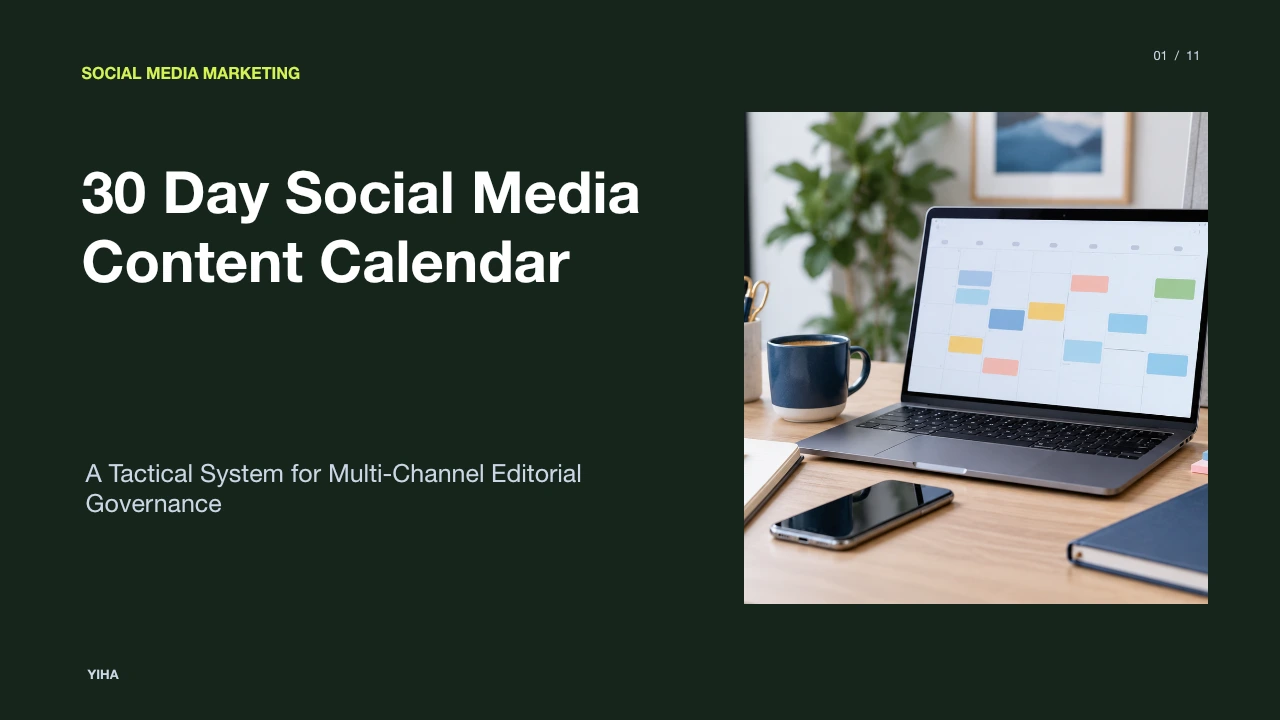
30 Day Social Media Content Calendar
A practical operational guide to designing, scheduling, and governing a 30-day social media content calendar across networks using structured pillars and collaborative workflows.
Free download · 4.9 MB11 editable slides · PowerPoint format
Download the editable PPTX
PPTX · 4.9 MB · 11 editable slides · Free to edit and reuse with attribution to Yiha.ai
View every slide
Use ← →, Home/End, or swipe on mobile
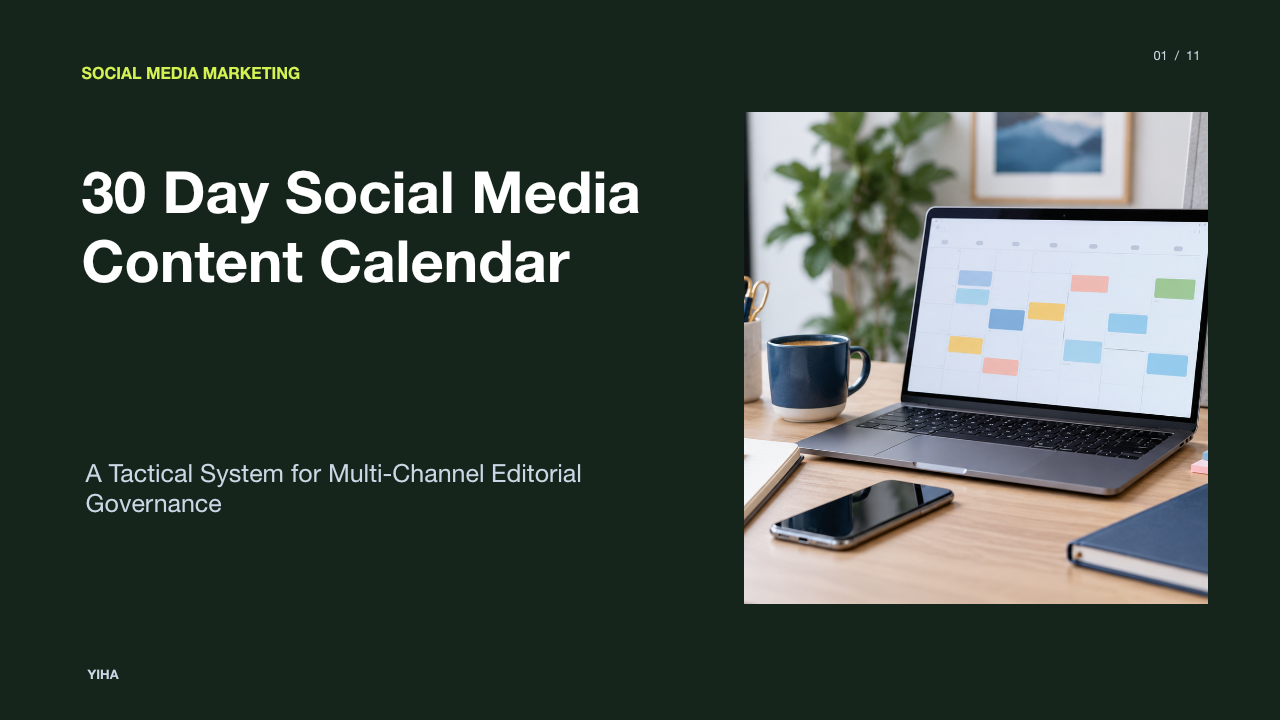
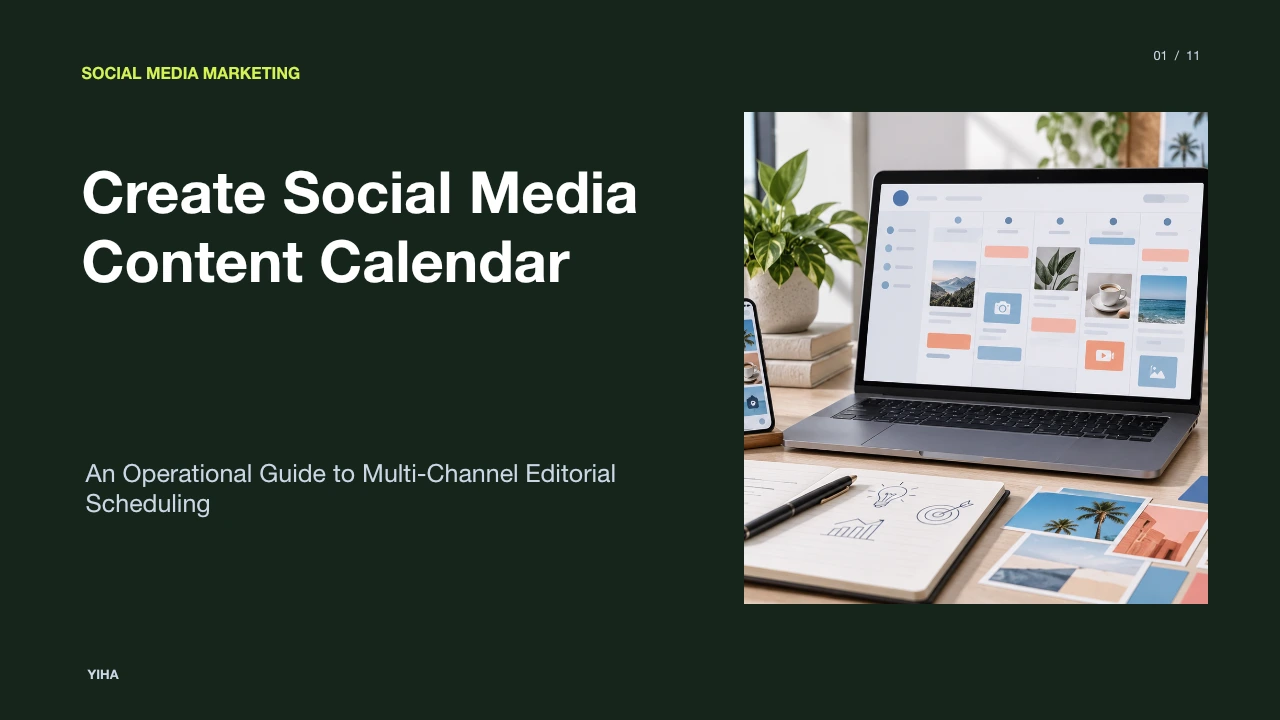
A 30-day social media content calendar is an operational roadmap that details what content an organization publishes, across which networks, and at what scheduled times over a monthly cycle. Without a forward-looking plan, marketing teams often default to day-of drafting that compromises brand voice, overwhelms creative resources, and fragments message continuity. Moving to an intentional monthly framework allows organizations to map publishing schedules to marketing objectives, protect production bandwidth, and evaluate what formats drive audience engagement.
Strategic Role of Monthly Social Media Planning
Ad-hoc posting forces social media teams into a continuous cycle of reactive publishing. When organizations decide what to post on the morning of publication, copy quality suffers, design assets are rushed, and cross-functional teams lose visibility into outgoing brand messaging. As highlighted by Sprout Social's Calendar Guide, an editorial calendar captures every post component in advance, shifting execution from hurried tactical scrambling to deliberate strategy.
Pre-planning publishing schedules across a month-long horizon aligns external messaging with wider business priorities, product release dates, and departmental initiatives. According to Buffer's Editorial Planning Insights, maintaining an organized calendar visualizes social strategy and gives extended teams, including copy editors and designers, advance notice for resourcing. This structural visibility ensures brand tone remains cohesive while providing legal, product, and leadership stakeholders ample time to review public communications.
However, monthly planning has operational limitations. Market environments change quickly, and rigidly scheduling thirty full days without editorial flexibility risks appearing insensitive or irrelevant during breaking events. A practical calendar must balance long-term brand narrative alignment with operational agility.
Defining Content Pillars and Topic Allocation
Editorial balance requires dividing monthly output into discrete thematic categories known as content pillars. Content pillars are core topics or messaging themes that an organization addresses consistently to establish topical authority while avoiding repetitive feeds. Rather than composing disparate updates, teams map each planned post to an explicit pillar.
To prevent over-indexing on direct selling, practitioners frequently adopt proportional allocation models. As outlined in Viraly's Content Calendar Guide, one practical recommendation is an 80/20 distribution: allocating the majority of schedule capacity to value-driven themes like education, entertainment, or industry insights, and reserving a smaller portion for commercial announcements or direct promotions. An alternative model divides output evenly across educational teardowns, customer proof points, cultural behind-the-scenes material, and promotional offers.
Consider an illustrative example of an enterprise software provider running a 20-post monthly schedule. Applying this balance, the team assigns 8 posts to technical education, 4 to product workflow breakdowns, 4 to customer case studies, and 4 to product demo calls-to-action. This balance maintains clear value for prospects while systematically advancing commercial objectives.
Balancing Native Formats and Platform Cadence
Different social channels operate under distinct algorithmic distribution models, audience usage patterns, and format preferences. Replicating an identical post across every platform disregards native user behavior and dilutes effectiveness. A 30-day calendar must specify network-tailored formats and cadences.
According to SocialCal's Calendar Framework, posting frequency and content mixes should mirror network mechanics. For instance, Instagram strategies frequently prioritize short-form vertical video alongside carousel graphics for instructional depth, maintaining a cadence of 5 to 7 feed posts weekly. In contrast, LinkedIn audiences engage primarily during business hours with text posts, document carousels, and native video, with optimal distribution tapering off over weekends at an operational cadence of 3 to 5 posts weekly.
Furthermore, research published in Sprout Social's Best Times to Post Analysis shows that visual-first channels reward active engagement with short-form video under 60 seconds, whereas professional networks reward morning text discussions. Applying a generic daily template across all networks risks fatigue on channels that favor selective curation, while starving discovery algorithms on high-velocity video feeds.
Core Data Fields in an Editorial Calendar Schema
A functional content calendar relies on a standardized data schema. Without explicit database fields or spreadsheet columns, calendars descend into messy, unmaintained documents. A comprehensive schema separates editorial ideation from execution tracking.
As detailed in Smartsheet's Editorial Calendar Templates, an effective editorial schedule incorporates structured fields such as target publishing date, publishing time, distribution network, content category or pillar, campaign name, post copy, tracking links, creative asset references, and internal notes. Capturing these attributes ensures every dependency is accounted for before launch.
Modern collaborative workflows also rely on operational metadata columns. As demonstrated in PostEverywhere's Template Overview, including fields for post owner, approver, and status indicators (such as Ideation, Drafting, Review, Approved, Scheduled, and Published) prevents tasks from stalling. A robust schema provides a shared single source of truth across copywriters, graphic designers, community managers, and compliance reviewers.
Structuring the Four-Week 30-Day Content Architecture
A 30-day social media calendar should not be an unstructured sequence of 30 isolated days. Instead, successful calendars organize content across four progressive, weekly thematic blocks that guide audiences through logical stages of awareness and consideration.
In Multilogin's Content Calendar Guide, organizing monthly schedules around dedicated weekly focus areas simplifies multi-account coordination and prevents planning abandonment. A standard four-week progression model maps content to the customer journey:
- Week 1: Top-of-Funnel Discovery and Education. Content focuses on broad industry pain points, trend breakdowns, and foundational educational assets designed to attract broad reach.
- Week 2: Deep-Dive Methodology and Culture. Content transitions to proprietary frameworks, tactical how-to carousels, and behind-the-scenes culture posts that establish authority.
- Week 3: Social Proof and Case Validation. Mid-funnel validation dominates, spotlighting client testimonials, transformation studies, and quantitative results.
- Week 4: Bottom-of-Funnel Conversion and Monthly Retrospective. Posts shift toward product demonstrations, trial invitations, time-sensitive campaigns, and community roundups.
Structuring the monthly calendar into these intentional milestones prevents disjointed promotional pitches and nurtures prospective buyers systematically toward commercial engagement.
Batch Production, Asset Management, and Approvals
Daily content drafting creates substantial switching costs, draining focus and causing avoidable publishing delays. Batch production groups similar operational tasks together, allowing creators to produce multiple captions or visuals during concentrated production sessions.
In PostEverywhere's Production Guide, batching copy by content pillar (drafting all educational posts in a single session, followed by promotional copy) reduces total composition time compared to switching topics daily. Once assets are created, teams store them in centralized cloud repositories linked directly to the calendar schema.
Operational bottlenecks frequently occur during stakeholder review. As analyzed in ONES.com's Approval Workflow Guide, formalizing workflow states with defined approver roles and automated audit logs prevents content from sitting unresolved in review limbo. Multi-tier approval paths ensure brand compliance, legal accuracy, and executive sign-off without jeopardizing production schedules.
Publishing Automation and Optimal Send Time Rules
Once copy and media receive formal sign-off, marketing teams transition approved calendar entries into scheduling and queue automation platforms. Automated distribution eliminates manual daily copy-pasting, mitigates human publishing errors, and ensures timely delivery across global time zones.
Scheduling systems leverage audience activity patterns to optimize timing. Analysis from Sprout Social's Optimal Timing Study indicates that aggregate user engagement peaks midweek during midday to late afternoon periods, whereas Sundays consistently yield the lowest engagement across major channels. Similarly, Buffer's Social Timing Report emphasizes that early algorithmic engagement signals depend heavily on publishing when target demographics are actively scrolling.
However, timing rules must be treated as baseline guidelines rather than absolute guarantees. Timing alone cannot compensate for uninspired creative assets or poorly targeted copy. Automation must support, rather than replace, ongoing active monitoring and immediate community comment responses.
Managing Calendar Rigidity and Real-Time Agility
One significant operational hazard of 30-day scheduling is calendar rigidity. When an entire month is locked down without flexibility, brands risk appearing out of touch if scheduled marketing messages broadcast during severe news events, corporate crises, or major industry disruptions.
To safeguard editorial relevance, practitioners recommend reserving a capacity buffer for real-time commentary, customer interactions, and emerging industry developments, as suggested in Viraly's Scheduling Analysis. Maintaining empty buffer space allows social media managers to produce spontaneous commentary without disrupting planned marketing campaigns.
Furthermore, organizations must maintain strict crisis pause protocols. According to Sprout Social's Crisis Management Guide, brands should establish a central mechanism to pause all outgoing scheduled posts instantly during emergency situations. Halting automated publishing queues prevents insensitive messages from going live and gives crisis communication teams complete control over public channels.
Closing the Loop: Post-Mortem Metrics and Iteration
A 30-day content calendar functions as a strategic learning loop only when supported by systematic month-end performance reviews. Publishing without evaluating engagement data guarantees that teams will repeat unsuccessful tactics in subsequent months.
As outlined in Sprout Social's Audit Guide, conducting regular post-mortems enables marketers to categorize top-performing posts by format and pillar to identify meaningful trends. Metrics such as impressions, click-through rates, saves, and conversation rates reveal what truly resonates with target audiences. In addition, Buffer's Social Audit Framework emphasizes auditing performance by content category and network, acknowledging that topics driving interaction on one platform may underperform elsewhere.
During month-end reviews, teams should audit pillar performance and reallocate capacity accordingly. If instructional carousels generated high reach and saves during the previous cycle while text promotions lagged in engagement, the team can adjust the upcoming 30-day calendar schema to favor visual educational assets. Through structured post-mortem iteration, the social media content calendar evolves from a rigid scheduling list into a self-improving marketing engine.
Research sources
- How to Find Content for Your Social Media Calendar · buffer.com
- news · contentmarketinginstitute.com
- Social Media Calendar Guide & Template | Sprout Social · sproutsocial.com
- How to Create a Content Calendar for Social Media in 2026 · viraly.io
- Social Media Content Calendar Template (2026) — Free & Pre-Filled | SocialCal · www.socialcal.app
- 13 Free Social Media Content Calendar Templates · posteverywhere.ai
- Best Times to Post on Social Media 2026 [Updated] | Sprout Social · sproutsocial.com
- 10 Best AI Content Calendar & Social Media Planning Tools in 2026 · startuptalky.com
- Free Social Media Editorial Calendar Templates | Smartsheet · www.smartsheet.com
- The Complete Social Media Content Calendar Guide for 2026 · multilogin.com
- Designing a Social Media Content Calendar Approval Workflow: Database Schema Guide [2026] · ones.com
- June Content Calendar for Small Business Success | Social Media Ideas · www.brittanymillersocials.ca
- Best Time to Post on Social Media in 2026: Every Platform · buffer.com
- How to Build a Social Media Crisis Management Strategy | Sprout Social · sproutsocial.com
- The 15-Minute Social Media Audit Everyone Can Do · buffer.com
- Social Media Audit: 11 Steps + Free Template | Sprout Social · sproutsocial.com