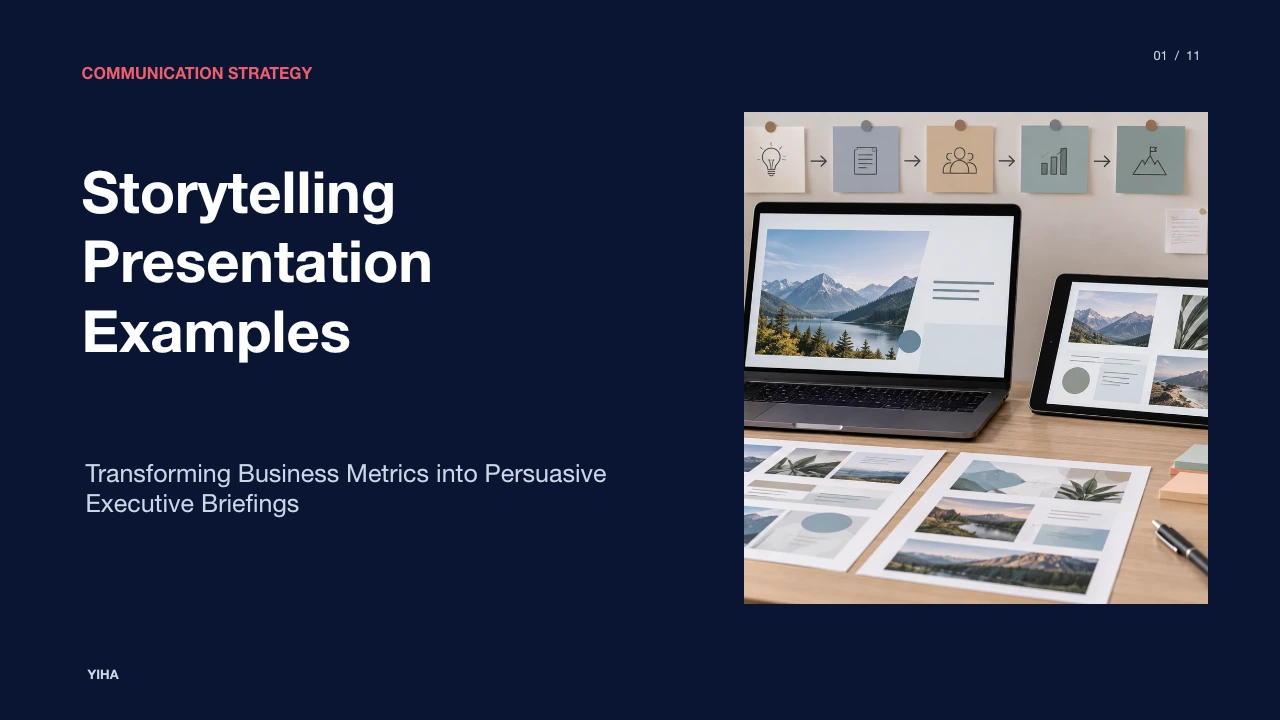
Storytelling Presentation Examples
Learn how to apply proven storytelling presentation examples and narrative structures. Discover how framing data through human context improves audience comprehension and alignment.
Free download · 4.9 MB11 editable slides · PowerPoint format
Download the editable PPTX
PPTX · 4.9 MB · 11 editable slides · Free to edit and reuse with attribution to Yiha.ai
View every slide
Use ← →, Home/End, or swipe on mobile
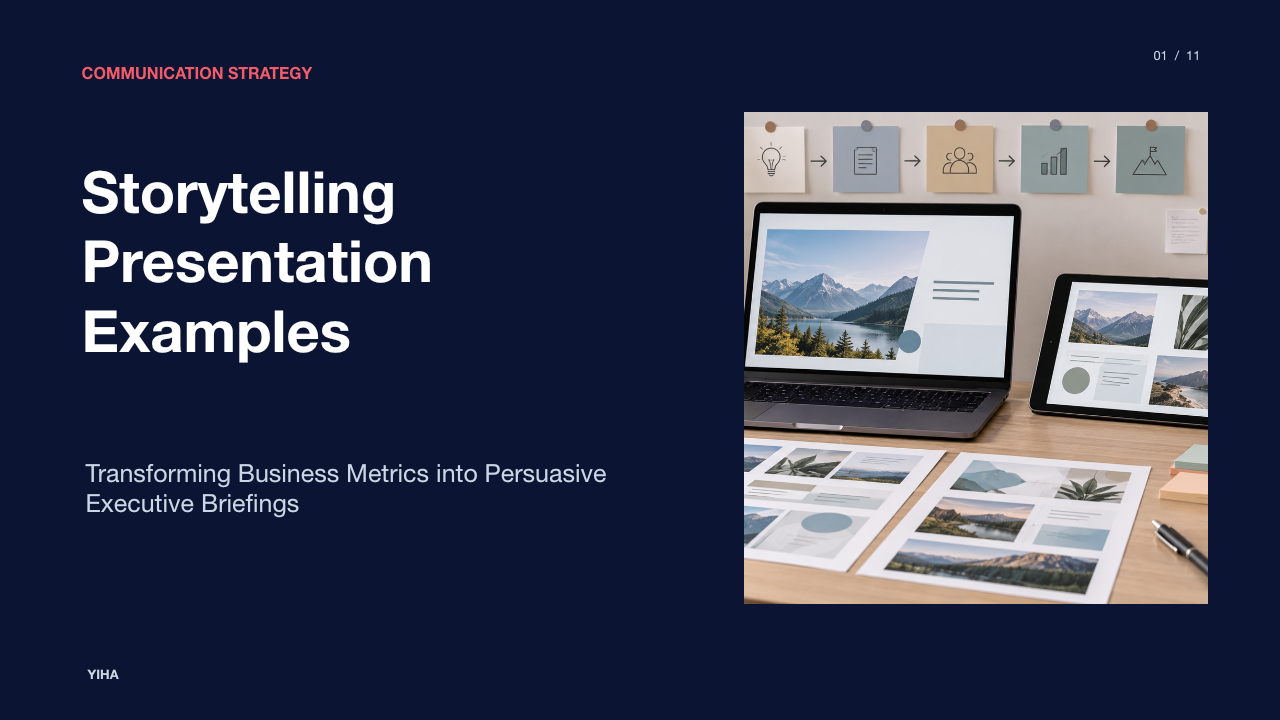
Corporate communication frequently defaults to dense spreadsheets, disjointed bullet points, and exhaustive status reports. While quantitative rigor remains critical, raw metrics delivered in isolation rarely produce organizational alignment or decisive action. Presenters who rely on data dumps often struggle to hold attention because listeners are forced to determine why specific numbers matter on their own. By examining established storytelling presentation examples, professionals can structure complex business information into coherent narratives that clarify trade-offs, highlight strategic implications, and guide stakeholders toward informed choices.
The Breakdown of Attention in Data-Heavy Presentations
Presentations that consist primarily of disconnected facts and tabular figures place an unnecessary cognitive burden on audiences. As communication coaches at Effective Presentations observe, many professional briefings feel overloaded with slides and data but fail to establish a meaningful connection with listeners. When an audience is confronted with slide after slide of uncontextualized metrics, cognitive fatigue sets in, making it difficult to discern the central strategic message.
This breakdown occurs because human working memory cannot easily process isolated data streams without an organizing schema. In an analysis of executive communication, Moxie Institute notes that presenters struggle most when they treat meetings as basic information transfers rather than decision-focused discussions. Presenting every available data point overwhelms stakeholders instead of directing their focus toward what matters most. In contrast, narrative presentation formats documented by Storydoc deliver a structured beginning, middle, and end. Narrative framing provides context for quantitative findings, allowing audiences to grasp why a problem arose, what operational friction exists, and which specific actions are needed to address it.
The Neuroscience of Speaker-Listener Neural Coupling
When a speaker presents purely dry statistics or bullet lists, neural processing remains largely confined to language-processing areas such as Broca's area and Wernicke's area. Listeners decode syntax and evaluate logical propositions, but their emotional and experiential processing remains inactive. In contrast, rich narratives activate wider neural networks across the listener's brain.
As explained by public speaking analysts at Orateur, descriptive storytelling activates sensory cortices, motor processing areas, and emotional systems. This neurological synchronization is known as neural coupling, a phenomenon researched by neuroscientist Uri Hasson where the listener's brain activity mirrors the speaker's brain activity during narrative comprehension, as highlighted in creative strategy analyses by StudioBinder. Furthermore, distinct neurochemicals regulate audience focus throughout a narrative arc. Narrative tension stimulates the release of cortisol, which sharpens focus and alertness. Empathetic character challenges trigger oxytocin, fostering trust and rapport. Finally, resolving the central conflict triggers dopamine, reinforcing memory and comprehension. While these biological mechanisms explain why stories engage listeners, presenters must recognize that storytelling does not replace substantive analysis; it simply provides a cognitive framework for processing complex information.
Casting Your Audience as the Hero and Yourself as Mentor
One frequent error in corporate communication is the self-centered organizational pitch. Presenters often dedicate significant portions of their decks to detailing company history, client rosters, and organizational awards. This approach mistakenly casts the presenter or vendor as the protagonist of the narrative.
As presentation designer Nancy Duarte explains on Duarte, high-performing presentation examples invert this relationship by deliberately casting the audience as the hero. The customer, department, or executive stakeholder is the central character navigating operational challenges, while the presenter adopts the role of the mentor or guide. Rather than claiming center stage, the mentor provides the critical tools, strategic insights, or methodology required for the protagonist to succeed. Brand narrative guidelines outlined by StudioBinder reinforce this distinction, noting that the organization functions like a guide that equips the hero to overcome obstacles and then steps back. Structuring the relationship this way, as Orateur notes, prevents presentations from sounding self-congratulatory and ensures that the discussion remains focused on solving the stakeholder's specific operational challenges.
Structuring Tension Between What Is and What Could Be
Persuasive presentations do not merely present facts in a flat, chronological sequence. Instead, they sustain engagement by introducing dynamic contrast between the status quo and an improved future state. This alternating structure creates constructive tension that keeps stakeholders invested in exploring strategic alternatives.
In her analysis of influential historical speeches, Nancy Duarte introduced the Presentation Sparkline structure, documented on Duarte and examined by Orateur. This structure creates momentum by repeatedly alternating between "what is" (current baseline costs, operational bottlenecks, and risks) and "what could be" (improved workflows, increased capacity, and strategic advantages). Continually contrasting present realities with future potential prevents audience passivity and clearly illustrates the consequences of inaction. As StudioBinder emphasizes in narrative analyses, conflict gives a story its momentum; avoiding real challenges produces superficial presentations. The narrative concludes by defining an achievable new baseline that the audience can reach by adopting the recommended path.
Practical Narrative Frameworks Across Business Formats
Different communication scenarios require tailored structural models. Business professionals can choose from several established narrative frameworks outlined by Orateur depending on the context of their meeting:
- The Pixar Story Spine: Organized around cause-and-effect transitions ("Once upon a time... Every day... Until one day... Because of that... Because of that... Until finally..."). This model works well for technical roadmaps and product development reviews because it links historical triggers directly to future initiatives.
- The Situation-Task-Action-Result (STAR) Framework: Focused on describing the initial context, the central operational task, the specific action taken, and the measurable outcome achieved. Widely applied in operational case reports and performance reviews, STAR provides a compact structure that highlights operational causality.
- The Before-After-Bridge (BAB) Model: Clearly details the friction of the current baseline (Before), paints an aspirational objective (After), and positions the proposal as the operational connector (Bridge). This model is particularly suited for sales proposals and business case approvals.
As executive communication trainers at Moxie Institute emphasize, using a repeatable narrative framework ensures that data serves a clear strategic conclusion. However, these models require careful adaptation. For instance, highly technical reviews may require additional time on methodology, whereas high-level executive updates require tighter focus on decisions and trade-offs.
Grounding Abstract Metrics in Tangible Human Experience
Quantitative rigor is vital for professional credibility, but abstract figures presented without context rarely motivate change. Effective data storytelling requires humanizing metrics without compromising analytical validity. As coaching frameworks from Moxie Institute explain, presenters must connect analytical findings to real-world implications, translating numbers into concrete stakes for employees, customers, or operations.
Techniques shared by Orateur demonstrate how contextualization translates abstract numbers into recognizable scenarios. For an illustrative example of this mechanism, rather than presenting a detached statistic about workplace anxiety, a presenter might note that within a representative department of fifty people, forty-two individuals face recurring workflow disruption. Similarly, Effective Presentations highlights that anchoring data to specific customer journeys or workplace routines provides cold figures with tangible substance. Presenters can also use memorable physical demonstrations to ground technical scale, such as the famous product reveal highlighted by Duarte where Steve Jobs demonstrated laptop thinness by pulling the device directly out of an ordinary paper envelope. Grounding data in tangible reality ensures that audiences grasp the operational meaning behind quantitative figures.
Narrative Progression Compared with Deductive Briefings
While narrative structures build engagement, presenters must recognize when to use inductive storytelling and when to employ deductive executive briefings. Inductive narrative builds chronological curiosity, leading listeners through initial context, complications, and evidence before revealing the strategic solution. This approach is well suited for keynotes, training workshops, and client acquisition presentations.
In contrast, senior executive meetings often require deductive structures such as the Minto Pyramid Principle, where the core recommendation is stated immediately, followed by supporting pillars and detailed evidence. As Moxie Institute notes, executive communication requires rigorous editorial focus: the presenter's primary role is not to display everything they know, but to provide stakeholders with the exact information needed to evaluate options. When presenting under tight time constraints or to highly analytical committees, professionals can integrate narrative principles into deductive frameworks. A presenter can state the conclusion first, introduce narrative tension around operational trade-offs, and ground supporting findings in human terms, as detailed in presentation guides from Orateur.
Recognizing Narrative Bias and Safeguarding Analytical Rigor
Despite its advantages, storytelling carries intellectual risks when applied without safeguards. Compelling narratives can lead audiences into narrative fallacy, where complex, chance-driven events are retroactively simplified into tidy causal relationships. A well-delivered story can also obscure survivorship bias, cherry-picked metrics, or unexamined assumptions.
As narrative strategy guides on StudioBinder emphasize, authenticity and truthfulness remain foundational pillars of credible communication. Presenters who rely on emotional appeals without robust empirical foundations lose credibility when stakeholders probe underlying assumptions. Similarly, Moxie Institute warns against presentations that construct engaging storylines on weak or selective evidence. To maintain intellectual rigor, business presenters must separate storytelling techniques from analytical evaluation. Best practices require disclosing data collection methods, identifying boundary conditions, explicitly acknowledging operational uncertainties, and presenting anecdotal case examples alongside comprehensive statistical baselines.
Building an Iterative Workflow for Story-Led Communication
Developing an impactful narrative presentation requires a disciplined preparation process rather than opening slide software immediately. Guidance from AiPPT and presentation scaffolding methods detailed by Everyday UX outline a four-stage development workflow:
- Audience Profiling: Clarify stakeholder priorities, technical familiarity, and current operational pain points before writing content.
- Analog Storyboard Mapping: Map narrative beats on paper or note cards, defining the hook, the central problem, supporting evidence, and the resolution before creating digital slides.
- Visual Contrast Design: Build slide layouts where each visual asset reinforces a single message, avoiding crowded bullet lists and ensuring charts clearly highlight the key takeaway.
- Rehearsal and Cadence Testing: Practice delivering the presentation aloud to evaluate transition clarity, test pacing, and confirm that the narrative links naturally between sections.
By following this structured workflow, professionals can combine compelling storytelling with rigorous analysis, ensuring that business briefings inform, engage, and lead to sound organizational decisions.
Research sources
- Storytelling Techniques for Presentations (+10 Examples) · www.effectivepresentations.com
- Data Storytelling Examples: Real-World Business Presentations That Drive Impact · www.moxieinstitute.com
- Presentation Storytelling Examples & Techniques (2026) · www.storydoc.com
- Storytelling for Presentations: Frameworks, Examples & Exercises That Captivate Any Audience | Orateur Blog · orateur.app
- What is Brand Storytelling? Definition, Strategy & Examples · www.studiobinder.com
- Storytelling in Presentations: 7 Tips and Examples | Duarte · www.duarte.com
- Storytelling Presentation Examples to Inspire Your Own - AiPPT · www.aippt.com
- 30 storytelling techniques you can use in your presentations (with examples) · www.everydayux.net