Short Film Lesson Plan
A comprehensive pedagogical guide to short film lesson plans, detailing active viewing frameworks, film grammar instruction, storyboard drafting, and multimodal analysis.
Free download · 4.9 MB11 editable slides · PowerPoint format
Download the editable PPTX
PPTX · 4.9 MB · 11 editable slides · Free to edit and reuse with attribution to Yiha.ai
View every slide
Use ← →, Home/End, or swipe on mobile
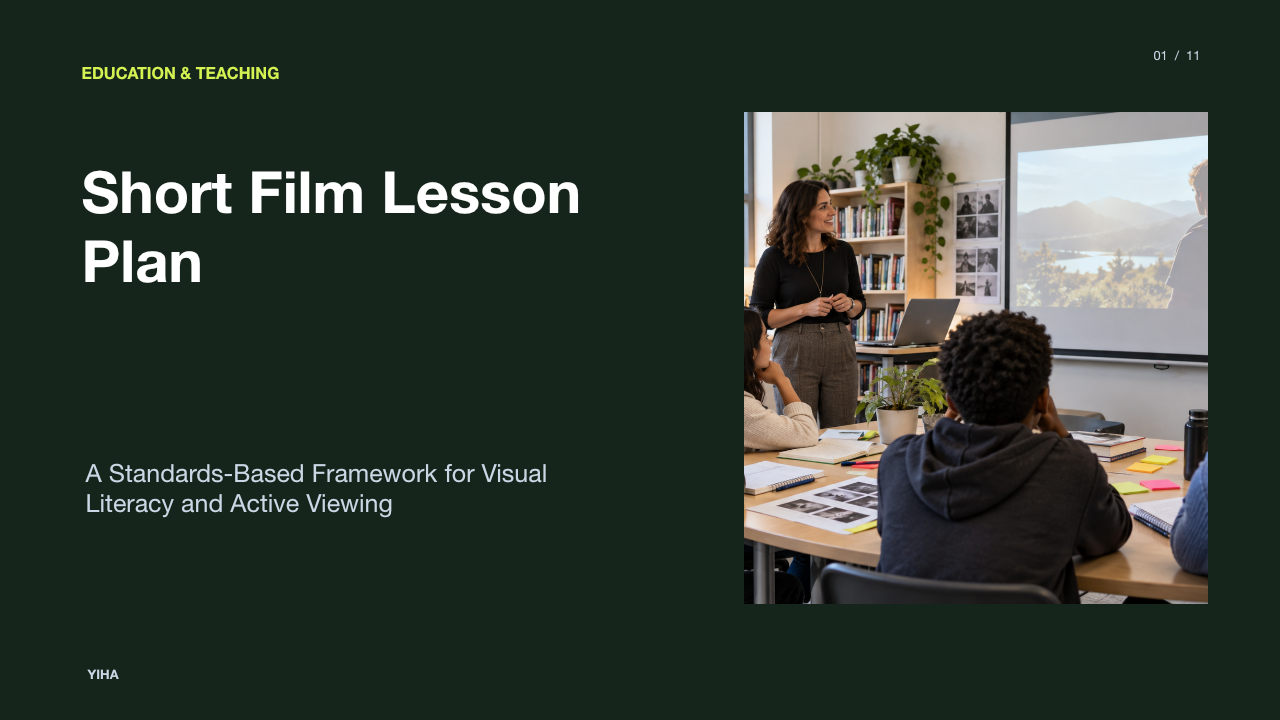
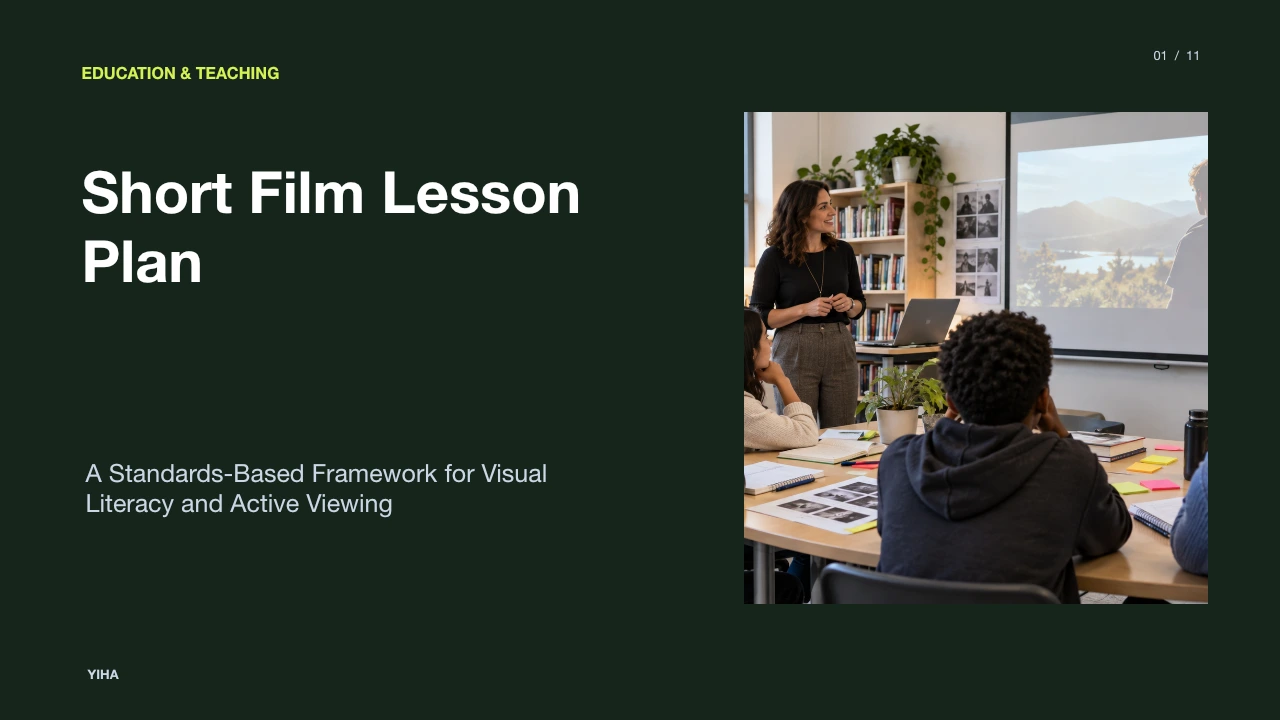
Short films offer educators a compact medium to teach complex narrative structures, visual rhetoric, and thematic analysis. Unlike full-length movies that require multiple days or weeks to screen, short cinema delivers an entire dramatic arc within a single instructional period. By treating short films as complex multimodal texts, educators can teach analytical viewing habits, bridge literary concepts, and transition students from passive media consumers into perceptive critics and creators.
Why Short Films Serve as Potent Curricular Anchors
A primary operational hurdle in media education is time allocation. As noted by Short Films for Students: Engaging Classroom Activities and Lesson Plans, screening feature-length motion pictures frequently presents logistical friction because class periods are typically constrained to forty-five to sixty minutes. When an instructor attempts to screen a two-hour film, the experience must be fragmented across three or four days. This fragmentation degrades narrative momentum and limits the time available for analytical writing and discussion. Short films resolve this constraint by presenting a complete narrative arc in three to fifteen minutes, leaving ample room in a single class period for pre-viewing preparation, targeted viewing, and immediate post-screening synthesis.
Furthermore, short films establish high student engagement while maintaining rigorous intellectual expectations. Resources cataloged by Short Film Lesson Plans & Worksheets Reviewed by Teachers highlight how brief animated and live-action narratives help students dissect literary elements, explore social themes such as empathy or gratitude, and practice descriptive writing. Because short films distill storytelling down to essential beats, students observe cause-and-effect relationships without the cognitive fatigue that lengthy subplots often generate. Additionally, Filmmaking Lesson Plan | eMedia shows that starting with short commercial clips or brief films allows students to quickly understand narrative planning and story skeletons within single class periods.
Core Concepts of Film and Visual Literacy
Teaching students to interpret film requires introducing cinematic grammar. Just as written texts use syntax, diction, and figurative language, cinematic texts rely on camera angles, framing, editing pace, lighting, and sound design to construct meaning. According to Filmmaking Lesson Plan | eMedia, students develop foundational media literacy by learning the basic terms, concepts, and technical modes of media production, evaluating how distinct techniques influence storytelling and point of view.
Cinematic techniques directly mirror literary devices. A close-up framing functions much like descriptive character interiority in prose fiction, drawing attention to emotional conflict. Similarly, high or low camera angles communicate power dynamics and character status. As explained in Teaching with Short Films in Middle & High School ELA - Nouvelle ELA Teaching Resources, visual choices such as rapid jump cuts and selective framing build dramatic tension and suspense. In short cinema, where verbal exposition is minimal or entirely absent, these visual semiotics bear the primary narrative weight. This visual economy makes short films accessible for English language learners and struggling readers. Guiding students to recognize how visual composition and audio effects establish tone and mood equips them to read moving images with the same analytical depth they apply to traditional literature.
The Three-Phase Active Viewing Pedagogical Model
Treating film as a serious text requires transforming passive spectatorship into deliberate visual deconstruction. This transformation is best accomplished through a structured three-phase model: pre-viewing schema activation, active during-viewing observation, and post-viewing reflective synthesis. Curriculum materials developed by Lesson Plans – FilmEd Classroom demonstrate how inquiry-based discussions, focused viewings, and structured reflections guide students to analyze character perspective, filmmaker craft, and central themes such as identity.
In the pre-viewing phase, teachers establish a clear viewing lens. Rather than simply playing a video, the educator activates prior knowledge and prompts predictions. For example, as suggested in Short Films for Students: Engaging Classroom Activities and Lesson Plans, presenting character stills prior to screening invites students to evaluate visual first impressions and reflect on preconceptions before testing those assumptions against the film narrative. During viewing, teachers can pause at pivotal dramatic moments to check comprehension and prompt predictive thinking. Active viewing sheets or graphic organizers help students track visual motifs, musical cues, and character decisions. In the post-viewing phase, students synthesize their notes through guided discourse, text-dependent questioning, and analytical writing, grounding their personal responses in specific audiovisual evidence from the film.
Aligning Visual Texts to Core Curriculum Standards
A short film lesson plan should never function as filler entertainment. Instead, it must be explicitly tied to instructional objectives and academic standards. As outlined in 10 Lesson Plan Examples, Plus Helpful Expert Tips, high-impact lesson design relies on specific, measurable learning objectives aligned with standards, utilizing scaffolded instructional models such as gradual release of responsibility or Understanding by Design.
Visual narratives align directly with standard language arts competencies. For instance, Teaching with Short Films in Middle & High School ELA - Nouvelle ELA Teaching Resources highlights how short films serve as practical tools for plot diagramming, tracing character growth over time, and evaluating authorial intent. Students can practice identifying inciting incidents, rising tension, climaxes, and resolutions on a visual timeline before transferring those competencies to complex written texts. Furthermore, cross-curricular curriculum guides published by Make Teaching Easy with Classroom-Ready Lesson Plans - Journeys in Film prove that cinematic analysis supports standards across English language arts, social studies, civics, mathematics, and visual arts by prompting students to examine diverse perspectives, historical context, and multimodal rhetoric.
Exemplar Short Film Selection and Inquiry Design
Selecting appropriate short films requires careful attention to student developmental maturity, narrative density, and curricular alignment. Not every popular animated clip provides sufficient thematic depth for academic inquiry. Educators should choose titles where visual composition, sound, and character development reward close analysis. As emphasized by Lesson Plans – FilmEd Classroom, curating grade-appropriate films around cohesive themes such as identity and community helps students engage in meaningful, inquiry-driven dialogue.
Formulating sharp inquiry questions ensures that classroom conversations transcend surface-level plot recall. According to Teaching with Short Films in Middle & High School ELA - Nouvelle ELA Teaching Resources, targeted questions should challenge students to evaluate visual contrasts, environmental symbolism, and pacing. For example, when viewing character-driven animations, teachers can ask: How does the physical setting reflect the protagonist's emotional state? What specific visual contrast highlights tension between the central figure and their peers? How does the director use silence or music rather than dialogue to signal an internal transformation? In addition, Filmmaking Lesson Plan | eMedia suggests having students evaluate the specific point of view a film adopts, challenging learners to defend their arguments using visual evidence.
Connecting Visual Analysis to Student Production
A well-rounded media literacy framework bridges analysis and creative synthesis. Once students understand how directors use visual grammar to communicate ideas, they can apply those concepts as creators. In the unit sequence outlined by Filmmaking Lesson Plan | eMedia, students begin by reverse-engineering existing short video clips into storyboard sketches to uncover underlying production choices, before brainstorming their own personal stories and mapping them into camera shots, audio cues, and scene descriptions.
Transitioning to student production does not necessitate high-end studio technology. Practical guides such as Crash Course Film Making Lesson Plan of Happiness illustrate that foundational filmmaking can be executed with standard smartphones or through analog screenwriting and storyboarding when hardware is limited. Working in small collaborative teams, students assume specialized roles, including screenwriter, director, and storyboard artist. By planning shot compositions, writing concise scripts, and selecting background audio, students gain practical insight into authorial intentionality, realizing that every cinematic choice represents a purposeful rhetorical decision.
Evaluating Short Films Against Feature Screenings
When planning curriculum units, teachers must weigh the benefits and drawbacks of complete short films against feature-length films or isolated movie clips. While feature films provide intricate plots and layered character development, screening them in a standard classroom carries significant curriculum opportunity costs. Days spent watching a long movie reduce instructional time for writing instruction, collaborative debate, and skill application.
As observed in Short Films for Students: Engaging Classroom Activities and Lesson Plans, short cinema avoids these temporal bottlenecks by delivering succinct, focused narratives that fit cleanly within single class periods. While isolated feature excerpts can illustrate isolated techniques, such as a single chase scene to demonstrate rapid editing, they often detach the technique from the story's overall emotional payoff and thematic resolution. In contrast, short films preserve narrative integrity, allowing students to trace how an opening establishing shot directly connects to the final scene's thematic resolution. The primary pedagogical limitation of short films is their compressed timeframe, which rarely accommodates extensive subplots or historical world-building. As noted in curriculum collections from Make Teaching Easy with Classroom-Ready Lesson Plans - Journeys in Film, feature films and documentaries remain valuable for deep historical immersion, while short films excel at concentrated skill demonstration and immediate synthesis.
Navigating Licensing, Sensitivity, and Access
Screening media in educational environments requires adherence to legal and pedagogical safeguards. Educators must ensure their film screenings comply with copyright and fair use guidelines, prioritizing films distributed on open educational platforms, licensed district databases, or free creator channels. Beyond legal considerations, instructors must conduct diligent pre-screenings to evaluate mature content, thematic sensitivity, and emotional safety.
Even short animated titles can address challenging topics, including violence, prejudice, or trauma. As highlighted by Short Films for Students: Engaging Classroom Activities and Lesson Plans, previewing films allows educators to identify mature scenes, such as depictions of violence or substance use, and determine age appropriateness before classroom presentation. Furthermore, teachers must ensure full accessibility for diverse student populations. As demonstrated in Filmmaking Lesson Plan | eMedia, supporting diverse learners involves providing multiple modalities, peer modeling, and clear audio-visual materials. Integrating closed captioning, transcripts, and audio descriptions supports English language learners and students with hearing or visual impairments. Classroom equipment should also be tested in advance, ensuring that display monitors, projectors, and speakers present clear sound and imagery without technical disruption.
Cultivating Lifelong Critical Media Literacy
In a digital environment saturated with short-form videos, algorithmically generated feeds, and moving imagery, critical media literacy is an essential academic competency. Analyzing short films equips students with analytical tools that extend far beyond classroom assignments. As demonstrated across the instructional materials provided by Make Teaching Easy with Classroom-Ready Lesson Plans - Journeys in Film, teaching with film empowers students to analyze cultural perspectives, evaluate rhetoric, and recognize bias across diverse multimodal texts.
When students practice deconstructing short cinematic narratives, they become attentive to visual framing, emotive musical scoring, and implicit messages. As shown in curated educational projects indexed by Short Film Lesson Plans & Worksheets Reviewed by Teachers, students explore social dynamics, examine diverse life perspectives, and critique manufactured media messages. They begin to ask critical questions about everyday media: Who created this media message? What perspectives are spotlighted or omitted? What techniques are employed to influence my emotional reaction? By anchoring short film lessons in rigorous visual literacy and inquiry, teachers equip students with lifelong critical thinking habits necessary to navigate modern information ecosystems with discernment.
Research sources
- Short Films for Students: Engaging Classroom Activities and Lesson Plans · sisterhoodmedia.net
- Filmmaking Lesson Plan | eMedia · emedia.uen.org
- Short Film Lesson Plans & Worksheets Reviewed by Teachers · www.lessonplanet.com
- » Crash Course Film Making Lesson Plan of Happiness · lessonplanofhappiness.com
- Teaching with Short Films in Middle & High School ELA - Nouvelle ELA Teaching Resources · teachnouvelle.com
- Make Teaching Easy with Classroom-Ready Lesson Plans - Journeys in Film · journeysinfilm.org
- Lesson Plans – FilmEd Classroom · classroom.nyicff.org
- 10 Lesson Plan Examples, Plus Helpful Expert Tips · www.weareteachers.com