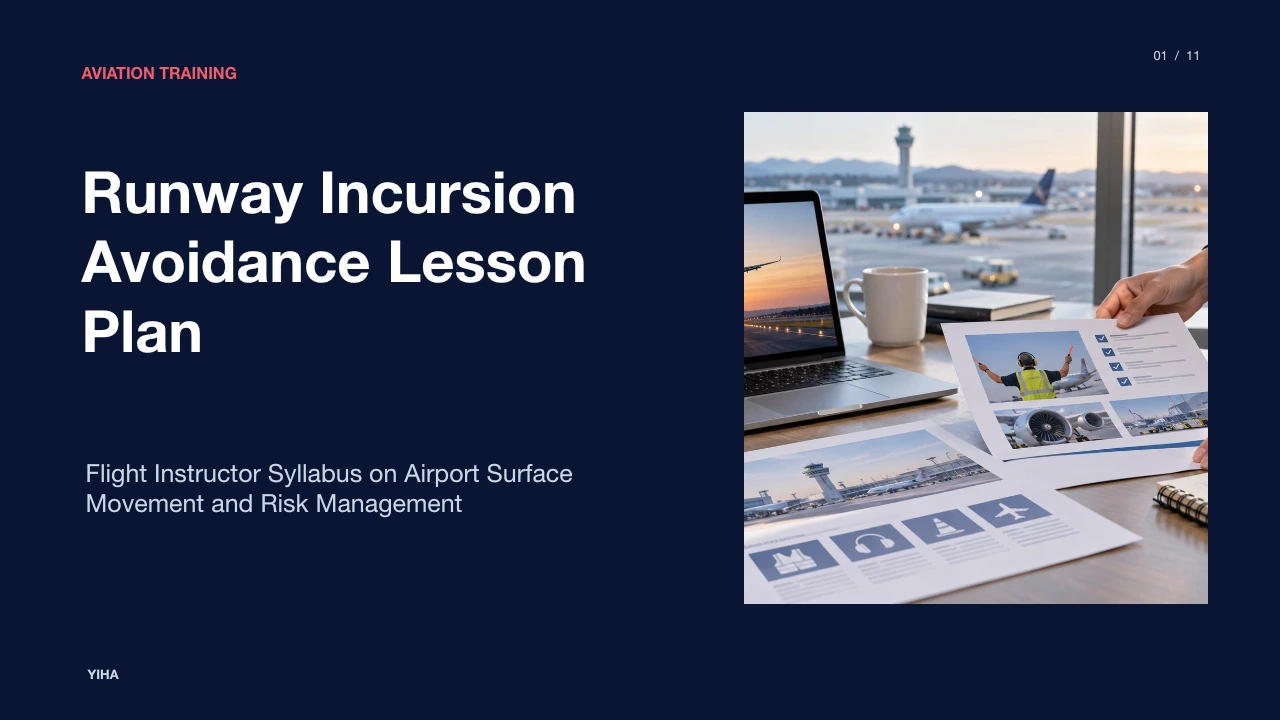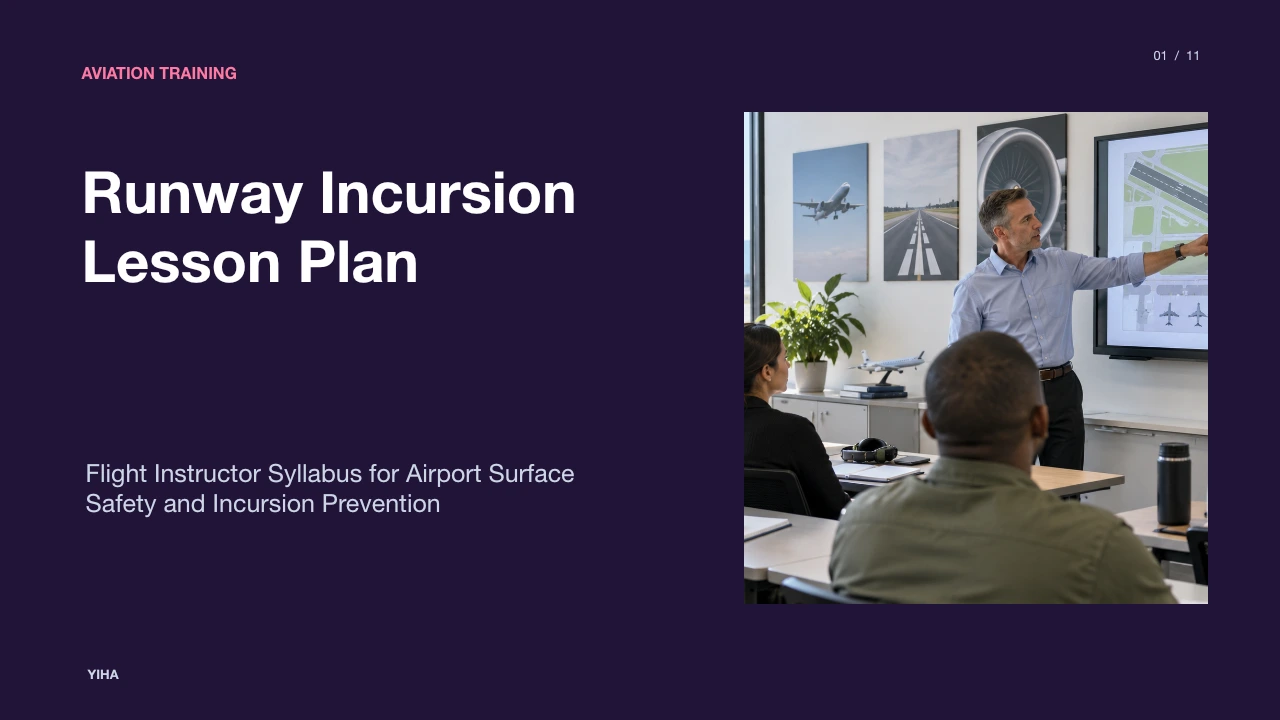
Runway Incursion Lesson Plan
This structured runway incursion lesson plan prepares flight instructors to teach surface safety, visual markings, clearances, and cockpit discipline in line with FAA standards.
Free download · 4.9 MB11 editable slides · PowerPoint format
Download the editable PPTX
PPTX · 4.9 MB · 11 editable slides · Free to edit and reuse with attribution to Yiha.ai
View every slide
Use ← →, Home/End, or swipe on mobile
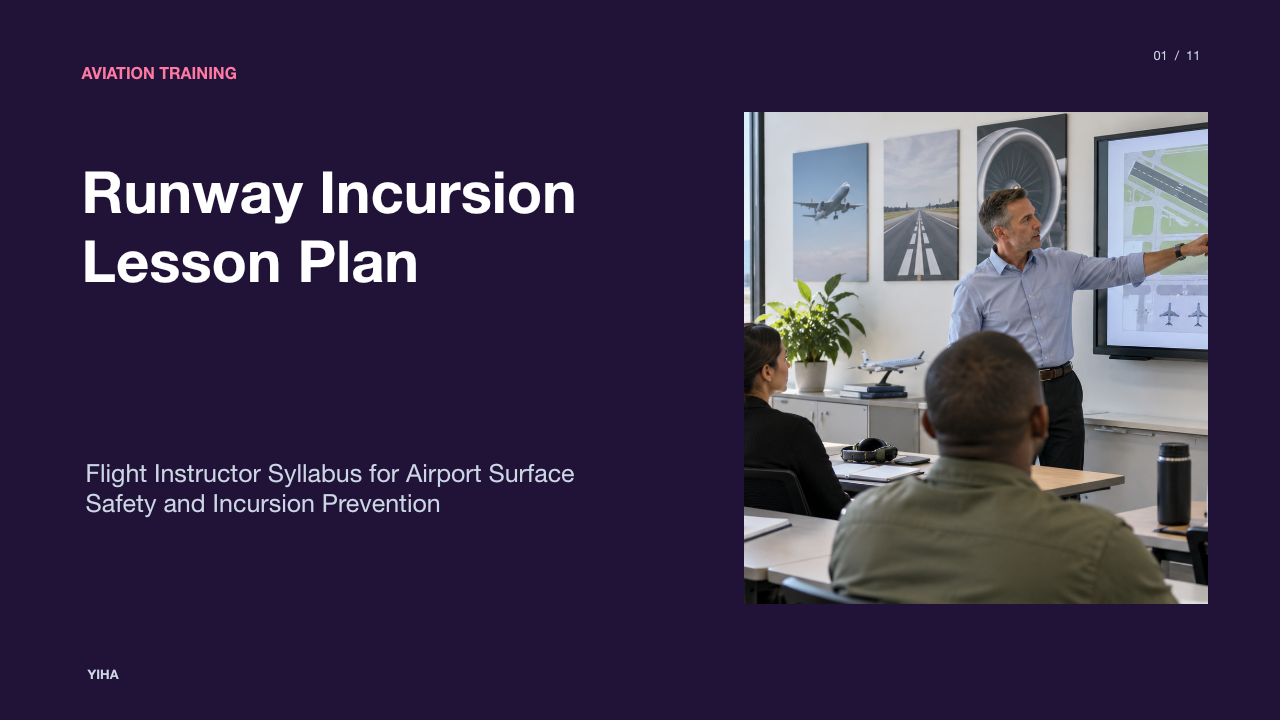
Runway safety remains one of the highest operational priorities across all sectors of civil aviation. While airborne traffic separation benefits from radar surveillance and established navigation procedures, airport surfaces present dynamic environments where high-speed aircraft, ground vehicles, and maintenance personnel intersect. A structured instructional syllabus enables flight instructors to develop systematic ground habits, eliminate communication breakdowns, and maintain continuous situational awareness during all taxi phases.
Operational Risk and the Definition of a Runway Incursion
A runway incursion is formally defined as any occurrence at an aerodrome involving the incorrect presence of an aircraft, vehicle, or person on the protected area of a surface designated for the landing and takeoff of aircraft. As outlined in the Runway Incursion Avoidance lesson, this differs from a general surface incident, which occurs in a designated movement area outside active runways but could still affect flight safety. Surface operations represent a major safety concern in aviation because aerodrome expansion and complex taxiway configurations increase the likelihood of pilot confusion.
Catastrophic ground collisions historically underscore the severe risks inherent in surface movements. The disaster at Tenerife demonstrated how fog, nonstandard phraseology, and simultaneous radio transmissions can lead a crew to commence a takeoff roll on an occupied runway without explicit authorization. Routine taxiing, landing rollout, and runway crossings can quickly become hazardous when planning or communication degrades. To mitigate these risks, the Federal Aviation Administration provides visual planning tools, including Arrival Alert Notices, From the Flight Deck videos, and the interactive Runway Safety Pilot Simulator, which assist pilots in identifying surface hazards and complex geometry prior to arrival.
Airport Markings, Signage, and Surface Lighting Systems
Surface navigation relies on standardized visual cues that demarcate the boundaries between movement areas and protected runway surfaces. Runway holding position markings serve as the primary ground barrier. These markings consist of four parallel yellow lines across the taxiway pavement, arranged as two solid lines and two dashed lines. As detailed in the Flight Instructor (Airplane) Runway Incursion Avoidance Lesson Plan - CFI Notebook, the solid lines are positioned on the side where the aircraft must hold short, and no part of an aircraft may cross this boundary without explicit air traffic control authorization.
Mandatory instruction signs feature white text on a red background. These signs identify entrances to active runways, critical protected surfaces, and areas where aircraft entry is prohibited. Holding position markings for Instrument Landing System (ILS) critical areas consist of two horizontal solid yellow lines connected by pairs of vertical solid lines. Air traffic control directs pilots to hold short of these markings during degraded weather conditions so taxiing aircraft do not disrupt instrument landing guidance signals. Runway guard lights, consisting of elevated or in-pavement flashing yellow lights located at runway holding positions, provide supplementary warnings to prevent inadvertent runway incursions.
Pre-Taxi Route Planning and Airport Diagram Management
Effective surface navigation begins before releasing the aircraft parking brake. Flight instructors must teach learners to review and brief the planned taxi path using a current published airport diagram. As outlined in Task II.B: Runway Incursion Avoidance | Mark Berry - CFI Notebook, pilots should keep an active diagram accessible on their flight deck or electronic flight bag to trace assigned clearances and confirm physical location against physical signs and markings.
Pre-taxi planning includes identifying charted airport hot spots. Hot spots are designated locations with a documented history or potential risk for collisions or runway incursions, typically located at complex intersections or confusing pavement layouts. On published airport diagrams, hot spots appear as numbered shapes designated by the prefix HS. In addition to chart reviews, pilots must examine current Notices to Airmen (NOTAMs) for taxiway closures, surface construction, or displaced runway thresholds before commencing ground movement.
Flight Deck Workload Management and Sterile Cockpit Discipline
Surface movements demand complete crew focus outside the cockpit. As explained in the Runway Incursion Avoidance guidance, distraction during taxi represents a leading causal factor in surface deviations. Pilots must maintain a sterile flight deck during movement, eliminating mobile phone usage, non-essential casual conversation, and extraneous cabin tasks. All non-essential heads-down tasks must cease while the aircraft is rolling.
Pre-taxi checklists, communication frequencies, and avionics programming should be completed before initial taxi movement begins. If an amended route or system alert demands reprogramming avionics or reviewing documentation, the pilot should stop the aircraft on an unambiguous taxiway, set the parking brake, and complete the heads-down work before resuming movement. Training should instill habits where visual scanning and situational awareness remain directed outside the cockpit windscreen.
Air Traffic Control Clearances and Mandatory Readback Protocol
Verbal misunderstandings between air traffic control and pilots frequently trigger unauthorized runway entries. Under FAA standards detailed in the Flight Instructor (Airplane) Runway Incursion Avoidance Lesson Plan - CFI Notebook, pilots must copy complex taxi instructions, read back all hold short instructions, and include runway identifiers in their transmissions. An authorization to taxi to a departure runway does not grant permission to cross any intermediate runways along the route.
Pilots must receive an explicit clearance to cross each individual runway. When instructed to Line Up and Wait (LUAW), the crew may taxi onto the runway and position the aircraft on the centerline but may not take off until a specific takeoff clearance is issued. If a pilot feels uncertain about their assigned taxi route, physical position, or controller intent, they should stop the aircraft and request progressive taxi instructions. Progressive taxi requires the controller to issue step-by-step navigational guidance until the aircraft reaches its destination.
Surface Operations at Nontowered and Satellite Aerodromes
Nontowered airports lack active tower controllers to monitor traffic separation, placing the burden of situational awareness entirely on individual pilots. As highlighted in Task II.B: Runway Incursion Avoidance | Mark Berry - CFI Notebook, not all operating aircraft are equipped with two-way radios, meaning radio transmissions cannot replace visual scanning. Pilots must monitor and transmit on the designated Common Traffic Advisory Frequency (CTAF) before taxiing, crossing any runway, or taking off.
Before entering an active runway, the pilot must scan the full length of the runway surface and inspect the final approach path. Operating at nontowered fields requires interpreting visual wind direction indicators and observing existing traffic pattern flows. Pilots must avoid making assumptions based solely on advisory calls from other operators. When doubt exists regarding another aircraft's location or intentions, the pilot should hold their position and yield until the runway environment is visually clear.
Low-Visibility and Night Surface Movement Procedures
Operating in darkness or reduced visibility degrades optical cues and spatial orientation. According to the Flight Instructor (Airplane) Runway Incursion Avoidance Lesson Plan - CFI Notebook, night and low-visibility ground operations require reduced taxi speeds, diligent position cross-checks, and deliberate exterior light management. Pilots should adjust ground speed so that the aircraft can stop within the illuminated distance provided by the taxi lights.
Exterior aircraft lighting increases visibility to other aircraft and air traffic controllers. When taxiing, rotating beacons and position lights should be illuminated. Before crossing an active runway or entering for takeoff, strobes and landing lights should be turned on. At night, pilots holding in position under a Line Up and Wait clearance may position the aircraft slightly offset from the runway centerline so trailing or landing traffic can differentiate the aircraft's lights from the runway centerline lighting.
Post-Landing Rollout, High-Speed Exits, and Parallel Runways
The post-landing rollout introduces unique hazards because pilot mental workload often eases immediately after touchdown. As reviewed in the Runway Incursion Avoidance syllabus, an aircraft exiting an active runway must completely cross the runway holding position marking before coming to a stop. The protected runway safety area is not clear until the entire aircraft, including the tail section, has passed beyond the solid boundary lines.
Closely spaced parallel runways present severe operational traps. A pilot exiting the primary landing runway may inadvertently cross directly onto an adjacent active runway before receiving tower clearance. As an illustrative example, a training flight landing on Runway 28R might roll out onto an exit taxiway that immediately meets the hold line for Runway 28L within 200 feet. In this mechanism, if the crew fails to identify the intermediate hold line, an unauthorized crossing occurs. Post-landing checklists should never be started while the aircraft is rolling; they must wait until the aircraft has stopped completely beyond all runway boundaries.
Instructional Delivery and Scenario-Based Practical Evaluation
Teaching runway safety requires active scenario-based methods rather than passive lecture delivery. Under the FAA Airman Certification Standards (ACS Area II, Task C), flight instructor applicants must demonstrate instructional knowledge and assess practical ground management skills. Incorporating structured educational elements improves learner engagement and long-term retention, as detailed in the overview of instructional development by 9 Components of an Effective Lesson Plan - Teacher Strategies.
Instructors should introduce realistic ground navigation exercises that test student decision-making under stress. Effective flight training scenarios include assigning complex taxi clearances at unfamiliar aerodromes, inserting simulated runway crossing ambiguities, and practicing rapid stop-and-clarify responses. By observing how learners react to simulated ATC clearance changes or high-workload surface environments, instructors can identify weaknesses, correct checklist discipline, and ensure safe operating habits.
Research sources
- Runway Incursion Avoidance · mycfibook.com
- Flight Instructor (Airplane) Runway Incursion Avoidance Lesson Plan - CFI Notebook · www.cfinotebook.net
- Task II.B: Runway Incursion Avoidance | Mark Berry - CFI Notebook · cfi.treklog.com
- 9 Components of an Effective Lesson Plan - Teacher Strategies · www.teacherstrategies.org