Lesson Plan Generator
A comprehensive guide examining how AI lesson plan generators structure curriculum objectives, automate routine preparation, support differentiation, and require teacher oversight.
Free download · 4.9 MB11 editable slides · PowerPoint format
Download the editable PPTX
PPTX · 4.9 MB · 11 editable slides · Free to edit and reuse with attribution to Yiha.ai
View every slide
Use ← →, Home/End, or swipe on mobile

Educational planning requires transforming curriculum standards into coherent, daily learning experiences. Historically, teachers have spent substantial hours outside the classroom organizing instructional units, drafting practice prompts, aligning state benchmarks, and tailoring tasks for diverse student populations. An automated lesson plan generator applies natural language processing to produce initial instructional blueprints from specific user inputs. While these systems dramatically accelerate routine drafting, their effective use relies on instructional clarity, pedagogical judgment, and continuous teacher review.
Addressing the Teacher Workload Crisis in Lesson Preparation
Lesson preparation represents one of the most demanding non-instructional responsibilities in primary and secondary education. Industry guides such as Free AI Lesson Plan Generator: The Complete Guide for Teachers 2026 note that teachers frequently spend 7 to 12 hours every week drafting plans and organizing classroom resources outside of instructional time. This structural preparation burden diverts energy from direct student engagement and contributes significantly to educator fatigue.
Recent empirical research demonstrates that automated drafting tools can alleviate part of this prep burden. A randomized controlled trial conducted by the National Foundation for Educational Research and released in an Education Endowment Foundation evaluation evaluated Oak National Academy's planning tool, Aila. In the trial involving 464 teachers across 108 schools, teachers using the tool spent 76% of the time on preparation compared to those who did not, yielding an average weekly savings of approximately 49 minutes without compromising lesson quality. Early-career teachers and educators addressing subjects outside their primary area of expertise experienced the most noticeable relief, reducing the friction of starting instructional sequences from scratch.
However, technology is not an automatic remedy for systemic burnout. As highlighted in Time Thrills, generative planning tools function as efficiency aids rather than replacements for teacher agency. While algorithms generate viable structural outlines in minutes, educators must continue evaluating content relevance, student readiness, and classroom dynamics to ensure learning goals are genuinely attained.
Key Input Parameters That Shape Generative Lesson Quality
Generative planning models produce generic, unhelpful outlines when prompted with vague topics. Effective generation depends on precise parameters that constrain the model's output to realistic classroom environments. Instructional designers note that prompts must establish pedagogical alignment, clear frameworks, and operational boundaries, as outlined in Practical AI Prompts for Instructional Designers.
Key inputs required for dependable lesson drafting include:
- Discipline and Specific Topic: Defining the academic subject and explicit conceptual boundaries prevents rambling summaries and ensures appropriate terminology.
- Grade Level and Learner Profiles: Specifying developmental stages ensures appropriate reading comprehension levels and cognitive demands.
- Allocated Instructional Time: Establishing exact durations (for example, a 45-minute period versus a 90-minute block) forces algorithms to calibrate pacing.
- Available Classroom Materials: Listing physical constraints, such as the absence of digital projectors or science lab equipment, eliminates impractical activity suggestions.
- Instructional Framework: Designating pedagogical approaches, such as backward design or explicit direct instruction, ensures coherent sequence progression.
As explained by 101Planners, entering operational constraints in prompt notes produces far more grounded, functional plans than generic requests for engaging activities. Explicit constraints help algorithms filter out unworkable tasks before generation begins.
The Core Anatomical Structure of Generated Lesson Plans
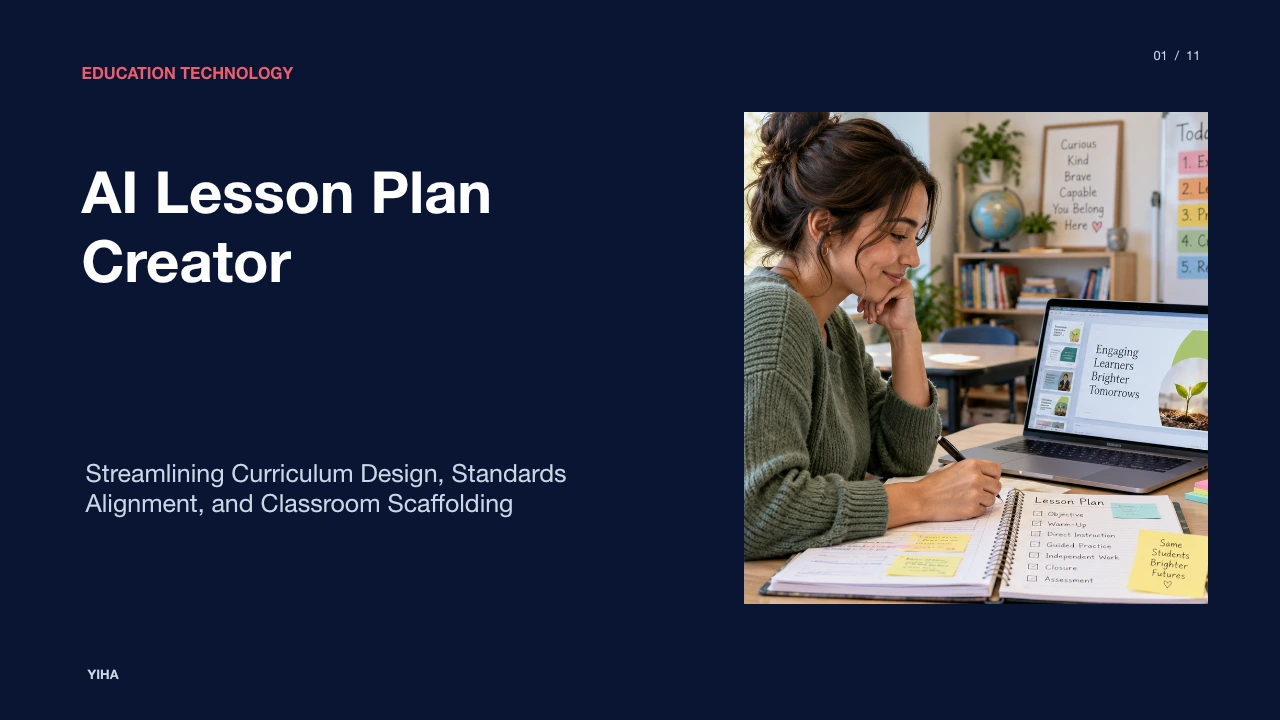
Structured lesson generators produce consistent instructional progressions by organizing outputs into standardized modules. A complete plan generated by tools such as TeachTools typically includes explicit learning targets, required supplies, warm-up exercises, direct instructional steps, guided paired practice, independent tasks, and evaluation mechanisms.
This structure reflects established direct instruction methodology:
- Anticipatory Hook: A brief introductory scenario or inquiry question activating prior knowledge and framing the upcoming learning objective.
- Direct Instruction (Model): Clear educator-led explanations breaking down core concepts into digestible steps using explicit worked examples.
- Guided Practice: Structured, collaborative exercises where students apply skills with immediate feedback from peers and the teacher.
- Independent Practice: Autonomous work allowing learners to demonstrate understanding without teacher prompting.
- Closure and Formative Checks: Brief summary tasks, such as exit tickets, that gauge pupil mastery before class ends.
While platforms like 101Planners distribute lesson minutes systematically across these phases, educators must verify that time allocations align with realistic student processing speeds and classroom transition routines.
Curriculum Standards Integration and Framework Mapping
Mandated accountability frameworks require lessons to align directly with specific jurisdictional proficiencies, such as Common Core State Standards, Next Generation Science Standards (NGSS), or Texas Essential Knowledge and Skills (TEKS). When planning manually, matching narrative objectives to hundreds of code references is exhaustive.
As explored by Chalkie, a critical distinction exists between tools that merely label lessons with broad grade bands and platforms that map content to explicit standard codes (such as NGSS 5-PS3-1). Without genuine alignment, teachers face an administrative burden where they spend more time auditing and correcting misaligned objectives than they saved during initial drafting.
Systematic strategies discussed in AI Made For demonstrate how inputting focused grade-level standards allows language models to match lesson objectives directly to required cognitive verbs. Teachers must verify that the cognitive action in the generated plan matches the exact rigor specified by the formal standard code, ensuring instructional tasks hit the targeted benchmarks.
Tiered Differentiation for Diverse Classroom Needs
Contemporary classrooms include varied student needs, including English language learners, students with Individualized Education Programs (IEPs) or 504 accommodation plans, and advanced learners requiring extension tasks. Designing multiple distinct tiers manually often triples planning demands.
Specialized tools address this bottleneck by scaffolding identical core objectives across tiered variations. As detailed in the Education Copilot Differentiation Helper, effective differentiation does not change the ultimate learning destination; instead, it modifies task scaffolding, language complexity, and process pathways. For example, a generated accommodation might introduce sentence starters, graphic organizers, and bilingual word banks for multilingual learners without lowering conceptual expectations.
Similarly, TeachQuill emphasizes that high-ability extensions should focus on inquiry-based depth and cross-disciplinary transfers rather than simply assigning extra practice items. Automated tools provide actionable adjustments that integrate differentiated access directly into the initial lesson design, ensuring teachers can support diverse classrooms effectively.
Generating Companion Instructional Assets and Materials
Textual lesson plans represent only the first phase of instructional readiness. To execute a lesson successfully, educators require aligned ancillary materials, including rubrics, guided note sheets, slideshow outlines, and visual walkthroughs. Generating these companion items manually often consumes significant planning time.
Instructional frameworks outlined by Harvard Generative AI Teaching Resources illustrate how language models assist educators across preparation workflows, transforming core syllabi and plans into lecture outlines, problem sets, and interactive role-play scenarios. Furthermore, platforms reviewed in TeachTools allow teachers to generate companion practice sheets that link directly to generated lesson objectives.
Multimodal tools also expand support into video production and slide preparation, enabling educators to create visual tutorials and demonstration scripts from lesson outlines. Pairing structural text generators with material-generation tools streamlines the progression from theoretical outline to classroom-ready collateral, reducing administrative overhead.
Cognitive Depth and Critical Limitations of AI Drafting
Despite their processing speed, automated lesson generators carry notable pedagogical limitations. Left unprompted, generative language models default to low-level cognitive exercises. Analysis from OpenEduCat Bloom's Taxonomy Alignment Tool reveals that instructional plans frequently skew heavily toward the lower tiers of Bloom's Taxonomy, specifically basic recall and comprehension.
As highlighted in LessonDraft, vague prompts yield activities centered on defining or identifying terms rather than analyzing, evaluating, or synthesizing ideas. To achieve adequate cognitive rigor, educators must explicitly instruct models to build from foundational recall toward evaluative and creative problem-solving.
Illustrative Example (Mechanism Demonstration): Consider a prompt instructing a tool to generate an eighth-grade civics lesson on the US Constitution. An unguided generator typically produces basic recall questions asking students to list the three branches of government. A calibrated prompt specifying higher-order analysis instructs the model to stage a mock congressional committee debate evaluating the balance of power during emergency declarations. The revised prompt forces the output to target evaluative decision-making rather than basic memorization.
Furthermore, generative models can introduce factual errors or overlook cultural nuances, reinforcing the need for continuous professional verification before delivering content in the classroom.
Data Privacy Standards and FERPA Compliance in School Tools
Adopting digital planning tools within public education requires adherence to data privacy mandates, specifically the Family Educational Rights and Privacy Act (FERPA) and the Children's Online Privacy Protection Act (COPPA). School districts face substantial legal and ethical obligations when selecting external software.
As outlined in the TeachTools FERPA Compliance Guide, educators must distinguish between teacher-only planning utilities and student-facing platforms. Teacher-only tools operate behind the scenes: the instructor inputs academic concepts and curriculum standards to generate materials, and outputs are distributed to students as static documents. Because no student personally identifiable information (PII) is entered or stored, teacher-only tools present minimal privacy compliance risks.
Conversely, entering identifiable student records, IEP details, or evaluation logs into public, consumer-facing models introduces severe privacy vulnerabilities. The U.S. Department of Education does not certify individual commercial tools, meaning school districts remain legally responsible for governance, vendor vetting, and ensuring data privacy agreements prohibit model training on educational records.
Establishing a Human-in-the-Loop Review and Adaptation Model
An automated lesson plan generator produces a functional first draft, not a finalized classroom routine. Best practices in instructional leadership mandate a structured human-in-the-loop review protocol before instructional delivery. As noted by 101Planners, an automated system supplies a structured draft that serves as an initial starting point, while educator judgment provides the essential pedagogical tailoring.
Operational guidelines from SubSchool emphasize that educators must maintain authority over all consequential instructional decisions. A comprehensive adaptation review should evaluate four baseline dimensions:
- Factual Accuracy: Cross-checking all generated dates, scientific definitions, and textual citations against verified curricula.
- Pacing Calibration: Adjusting algorithmic minute-by-minute schedules against actual classroom transition dynamics.
- Instructional Context: Refining examples to reflect the cultural, socioeconomic, and community context of the classroom.
- Cognitive Rigor: Elevating lower-order recall tasks to ensure meaningful analytical inquiry.
By treating generative engines as drafting assistants rather than autonomous planners, teachers harness time savings while safeguarding pedagogical excellence.
Research sources
- Free AI Lesson Plan Generator: The Complete Guide for Teachers 2026 | Guidde · www.guidde.com
- Time Thrills · www.timethrills.com
- AI tool reduced primary teachers’ lesson planning time by a… | EEF · educationendowmentfoundation.org.uk
- Practical AI Prompts for Instructional Designers · www.ispringsolutions.com
- AI Lesson Plan Generator | Online lesson planner · www.101planners.com
- AI Lesson Plan Generator for Teachers | Free for Teachers | TeachTools · teachtools.co
- Align Your Curriculum to Standards in Minutes with AI · www.aimadefor.com
- 7 AI Classroom Activity Generators That Are Actually Standards-Aligned | Chalkie · chalkie.ai
- Differentiated Instruction Generator - Custom Lesson Adapter · teachquill.com
- AI Differentiation Helper for Teachers (Free) | Education Copilot · educationcopilot.com
- Teach with Generative AI - Generative AI @ Harvard · www.harvard.edu
- AI Bloom's Taxonomy Alignment Tool for Teachers | OpenEduCat · openeducat.org
- Using Bloom's Taxonomy to Level Up Your AI-Generated Lesson Plans · lessondraft.com
- FERPA Compliant AI Tools: 2026 K–12 Vetting Checklist | TeachTools Blog · teachtools.co
- Best Free Lesson Plan Generators for Teachers: 2026 Guide · teachers-blog.com
- AI Feedback Workflow for Teachers: Human-in-the-Loop Guide · subschool.us