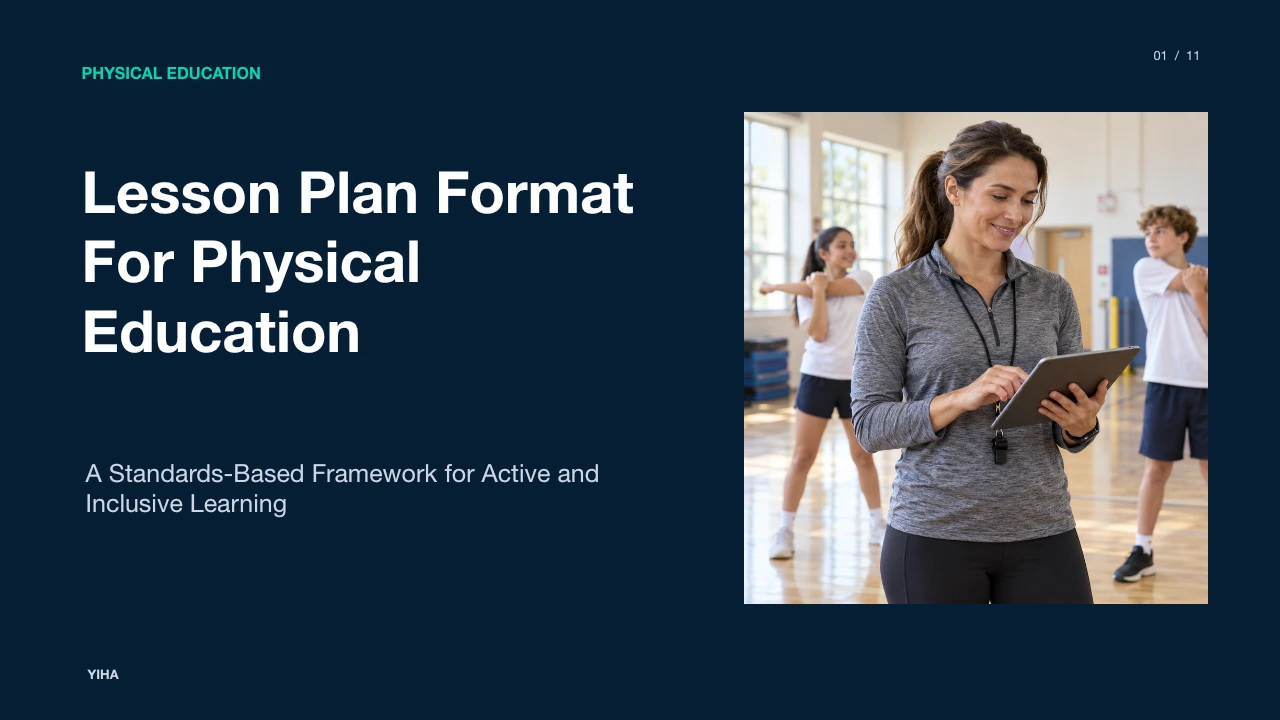
Lesson Plan Format For Physical Education
A comprehensive guide to designing standards-based physical education lesson plans that balance instructional intent, active movement, inclusion, and assessment.
Free download · 4.9 MB11 editable slides · PowerPoint format
Download the editable PPTX
PPTX · 4.9 MB · 11 editable slides · Free to edit and reuse with attribution to Yiha.ai
View every slide
Use ← →, Home/End, or swipe on mobile
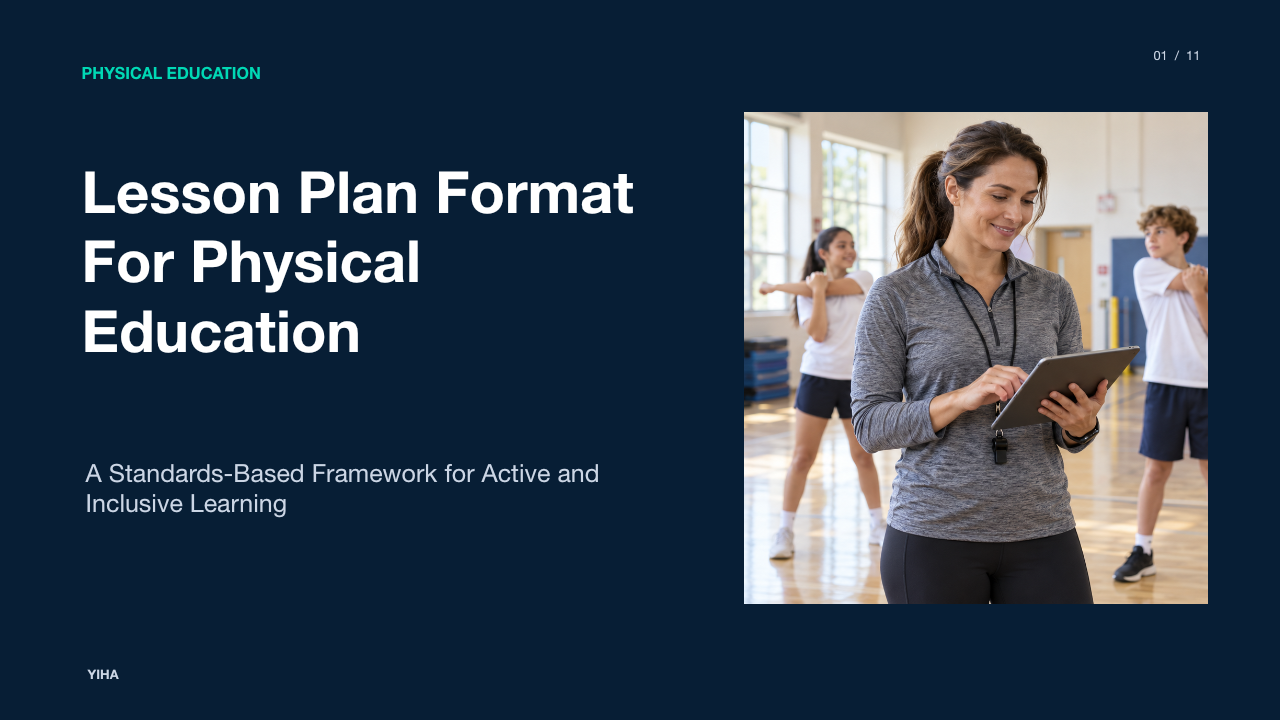
Effective physical education requires deliberate instructional planning rather than spontaneous, unguided gym activities. A structured physical education lesson plan organizes instructional time, equipment, space, and pedagogical strategy to develop motor competence, conceptual knowledge, and social behavior. By establishing a reliable framework, educators ensure that each class session aligns with long-term curriculum goals while keeping students active, safe, and engaged.
Foundations of Physical Education Lesson Design
A deliberate lesson plan transforms physical education from open gym recreation into a sequential instructional experience. According to the foundational curriculum model outlined in Lesson Plans for Dynamic Physical Education for Elementary School Children, structuring lessons into distinct activity segments ensures that teachers address fitness, skill instruction, and movement application within a balanced organizational framework. In that classic model, plans balance four primary activity parts: introductory activities, fitness development activities, lesson focus activities, and game activities.
The material and organization in that foundational lesson plan format is broken into four distinct functional columns. The first column outlines movement experiences and content sequences. The second column provides organization points and teaching hints for efficient class management. The third category lists expected student objectives and learning outcomes. Finally, the fourth column provides evaluation criteria and curriculum references. Establishing this structured format eliminates unstructured downtime, clarifies managerial expectations, and ensures that gym time systematically cultivates motor competence rather than ad-hoc play.
A practical limitation of lesson planning is that gym dynamics fluctuate based on student arrival times, facility constraints, and equipment transitions. Instructors must maintain the discipline to follow structured instructional sequences while remaining flexible enough to adjust when class routines take longer than anticipated.
Setting Multi-Domain Behavioral Objectives
Clear learning objectives form the backbone of physical education instruction. Rather than merely stating what drill or game will take place, objectives must articulate what students will demonstrate by the end of the class. As highlighted in planning frameworks such as the Physical Education Lesson Plan Template, high-quality plans establish two to three specific learning objectives outlining what students will be able to do, which drives instruction and makes student learning measurable.
Secondary lesson planning frameworks also incorporate key vocabulary terms tied directly to the movement concepts being taught, supporting the cognitive dimensions of physical activity and helping students accurately describe performance mechanics. Comprehensive physical education objectives address three distinct educational domains:
- Psychomotor Domain: Focuses on physical movement, motor skill execution, and coordination, such as stepping with the opposition foot during a throwing motion.
- Cognitive Domain: Encompasses knowledge of rules, tactical concepts, biomechanical principles, and movement vocabulary so students understand how and why skills work.
- Affective Domain: Targets teamwork, personal responsibility, fair play, and emotional regulation during cooperative and competitive activities.
For an illustrative example of an instructional target, a teacher might write an objective where students execute an underhand serve landing past a designated boundary line, explain the mechanical importance of weight transfer during contact, and demonstrate encouraging communication toward peers during gameplay. Multi-domain planning ensures that physical education educates the whole child rather than isolating repetitive mechanical drills.
Aligning With National Standards and Outcomes
Every physical education lesson should connect directly to overarching state and national frameworks. As established by SHAPE America's National Physical Education Standards, comprehensive standards and grade-span learning indicators provide the foundation that educators use to deliver high-quality instruction and support student development. Aligning daily activities with recognized standards prevents isolated, disconnected gym experiences.
Released in March 2024 following an extensive multi-year revision process, the updated national standards emphasize grade spans that support developmental progression and teacher planning. In primary grade spans, indicators emphasize the acquisition and refinement of fundamental movement patterns in locomotor, non-locomotor, and manipulative skills. In secondary grade spans, learning indicators advance toward tactical problem-solving, lifelong personal fitness design, and cooperative social dynamics.
A structured lesson format incorporates standard codes directly alongside behavioral objectives. This vertical continuity ensures that daily practice tasks link systematically to multi-year physical literacy goals, validating physical education as an essential academic discipline.
Structuring the Opening and Instant Activities
The opening segment of a physical education class establishes the instructional tone, expectations, and physiological readiness for the entire period. Pedagogical frameworks detailed in AskSmarter.ai's Standards-Aligned Lesson Plan Generator emphasize that specifying exact minute blocks in an instructional sequence creates an executable routine that avoids aimless drifting.
In physical education, this opening phase is structured as an introductory activity or instant activity. As a pacing recommendation, an instructor can budget an initial five-minute block for this phase. Rather than having students sit passively on lines waiting for attendance, students immediately enter the gymnasium and transition into an active, low-organization movement task. This prompt movement elevates heart rate, prepares major muscle groups for physical work, and reinforces previously learned motor skills.
While students engage in this dynamic entry routine, the instructor can complete visual attendance checks and monitor student energy levels without interrupting class momentum. A well-designed lesson template explicitly details the entry routine, spatial perimeter boundaries, audio signals, and transition protocol needed to shift students smoothly from the introductory warm-up into direct instruction.
Structuring Core Instruction and Teaching Cues
The core instructional segment represents the central learning experience of the period. As outlined in the Physical Education Lesson Plan Template, effective instructional plans detail specific movement cues and points of performance paired with visual technique demonstrations. This multi-modal approach enables students to observe proper mechanics and immediately apply them during physical practice.
Because lengthy teacher monologues substantially decrease student activity levels, direct verbal explanations must remain concise, targeted, and clear. Teachers structure content using brief verbal cues: memorable phrases that isolate critical biomechanical checkpoints. For example, when teaching an overhand throw, cues such as "side to target," "reach back," "step opposite," and "follow through" translate complex biomechanical principles into accessible guidance. Furthermore, structured lesson plans sequence tasks through deliberate pedagogical progressions:
- Extension Tasks: Adjustments that modify the complexity or difficulty of the movement, such as altering the distance to a target or changing the speed of practice.
- Refinement Tasks: Focused instructional cues that target movement quality and mechanical form rather than outcome.
- Application Tasks: Dynamic challenges, small-sided partner games, or simulated competitive scenarios where students execute the skill under varying conditions.
Maximizing Active Movement and Space Management
Optimizing student movement time is a central objective of physical education management. According to the Physical Activity Guidelines for School-Aged Children and Adolescents published by the CDC, children and adolescents aged 6 through 17 years should accumulate 60 minutes or more of moderate-to-vigorous physical activity daily. The guidelines note that most of this daily total should consist of moderate-to-vigorous aerobic activity, with vigorous physical activity, muscle-strengthening, and bone-strengthening activities each included at least three days per week. The CDC notes that schools occupy a unique position to help students attain this national recommendation.
To maximize moderate-to-vigorous physical activity, lesson plans must incorporate deliberate floor management strategies, equipment distribution workflows, and group rotation systems. Planning must actively eliminate structural bottlenecks, such as long single-file waiting lines or large-group elimination games where less proficient movers spend extended periods sitting on sidelines.
Instead, lesson designs should feature small-sided game stations, partner practice grids, and pre-distributed equipment pods. For an illustrative example of space organization, an instructor managing a large class can divide the gymnasium floor into four distinct quadrant grids with designated equipment boxes, enabling every participant to engage in continuous skill repetitions rather than waiting for turns.
Applying Inclusive Modifications and the STEP Model
Physical education environments must provide equitable learning experiences for students of all abilities, fitness levels, and neurodivergent profiles. Frameworks explored in AskSmarter.ai's Standards-Aligned Lesson Plan Generator emphasize that effective lesson designs build in differentiation from the start through Universal Design for Learning principles, rather than attempting to retrofit accommodations during live delivery.
In physical education, instructors apply differentiated adaptations to ensure every student works toward the common instructional target. As an illustrative analysis of pedagogical adaptation, instructors frequently utilize the STEP model, which structures modifications across four distinct variables:
- Space: Modifying playing boundaries, target distances, or court zones, such as moving targets closer or establishing quiet practice zones.
- Task: Adapting rules, movement requirements, or pacing, such as allowing multiple bounces in striking sports or providing rolling alternatives to throwing.
- Equipment: Varying equipment size, weight, texture, or color, such as providing larger foam balls, lightweight bats, or high-contrast auditory balls.
- People: Structuring team balances, matching peer partners intentionally, or adjusting group sizes to ensure positive cooperative interactions.
Documenting these planned adaptations directly within the lesson template ensures that all students access meaningful physical education instruction without being excluded from core activities.
Formative Assessment and Intentional Closure
A complete lesson plan format dedicates intentional time at the end of class for closure, pedagogical reflection, and formative assessment. As explained by the Center for the Professional Education of Teachers in Exit Tickets as Formative Assessments, short end-of-class tasks provide teachers with authentic data in real time, informing subsequent instruction regarding whether to clarify concepts, reteach skills, extend practice, or introduce new ideas.
To be effective, exit tasks should incorporate specific prompts and require only a short completion window, often taking about five minutes. Because formative exit tickets are not graded, students take on very little risk and can provide honest reflections about what they understand and where they struggle.
In a physical education context, reserving the final minutes of class allows teachers to bring heart rates down safely, organize equipment return, and check for understanding across psychomotor, cognitive, and affective goals. Teachers can implement brief observational checklists, peer-assessment rubric scoring, or quick exit slips where students summarize a mechanical cue or tactical decision. This intentional closure verifies learning outcomes and facilitates an orderly transition back to academic classrooms.
Post-Lesson Evaluation and Curriculum Iteration
The physical education planning process continues after students exit the gymnasium. As highlighted in curriculum design resources like AskSmarter.ai's Standards-Aligned Lesson Plan Generator, capturing summary exit data and instructional reflections produces continuity across sequential lessons within a unit rather than running isolated activities.
A robust lesson template includes a dedicated section for post-lesson teacher self-reflection. Educators should promptly document operational and pedagogical observations following each session:
- Did spatial layouts provide adequate safety buffers during high-speed transitions?
- Did equipment distribution and collection routines run smoothly or cause unnecessary downtime?
- Were instructional cues clear enough for independent student application?
- Did task progressions offer suitable challenge for students across varying skill levels?
Recording concise reflections immediately after teaching ensures that real classroom evidence directly shapes upcoming lesson modifications, driving continuous curriculum improvement and higher instructional quality over time.
Research sources
- ERIC - ED173299 - Lesson Plans for Dynamic Physical Education for Elementary School Children. Second Edition., 1979 · eric.ed.gov
- Art & Architecture (Education at the Getty) · www.getty.edu
- Lesson Plan AI Prompt (Standards-Aligned) | AskSmarter.ai · www.asksmarter.ai
- Physical Education Lesson Plan Template | PLT4M · plt4m.com
- National PE Standards-Highly Effective Physical Education | SHAPE America · shapeamerica.org
- Principles of Design For the Artist - Free Lesson Plan - BRUCE BLACK ART: OIL PAINTINGS, STILL LIFES & ART EDUCATION · www.bruceblackart.com
- Physical Activity Guidelines for School-Aged Children and Adolescents | Physical Education and Physical Activity | CDC · www.cdc.gov
- Lesson Plan Template | How to Write a Lesson Plan | Discovery Education · www.discoveryeducation.com
- VAPA Lesson Plan PPT Template Guide | ReelMind · reelmind.ai
- Exit Tickets as Formative Assessments - CENTER FOR THE PROFESSIONAL EDUCATION OF TEACHERS · cpet.tc.columbia.edu
- What Is Vapa In Education Lesson Plan - neonjs · neonjs.com