Chatgpt Pitch Deck Prompt
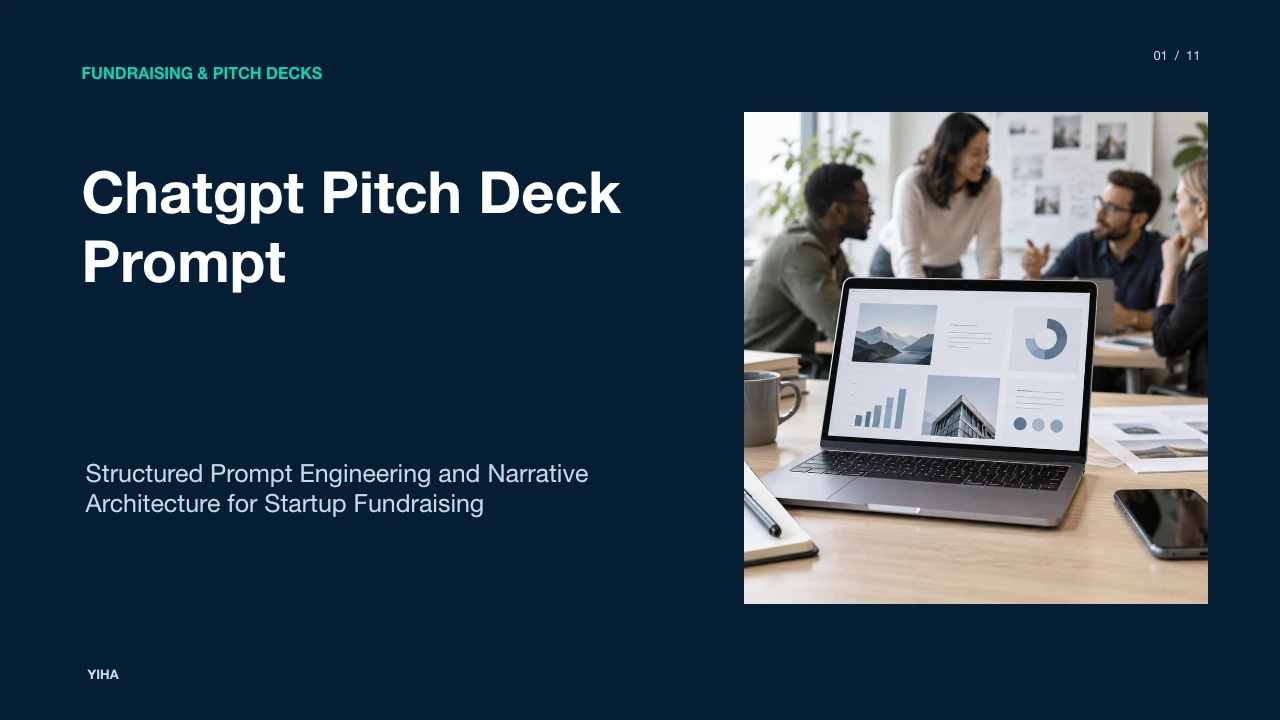
A technical guide to engineering ChatGPT pitch deck prompts. Learn how to structure context injection, enforce bottom-up market calculations, sequence stage-specific narratives, and simulate adversarial venture capital due diligence.
Free download · 4.9 MB11 editable slides · PowerPoint format
Download the editable PPTX
PPTX · 4.9 MB · 11 editable slides · Free to edit and reuse with attribution to Yiha.ai
View every slide
Use ← →, Home/End, or swipe on mobile
Crafting a venture fundraising presentation requires translating raw operational progress, technical architecture, and financial models into a coherent narrative. Large language models offer significant leverage in this process when used with disciplined prompt engineering. Rather than relying on generic generation, founders must structure prompts that enforce factual discipline, define investor personas, and isolate verified business metrics.
The Strategic Role of LLMs in Fundraising Decks
Founders often confront significant friction when distilling months of operational progress into a concise investor presentation. Generative language models serve as editorial partners to accelerate narrative synthesis and cross-slide cohesion. As outlined in the guide on How to Use ChatGPT for Pitch Decks: 2026 Guide (7 Steps), language models function effectively as narrative clarity tools, objection simulators, and market sizing guides. They are not repositories of private operational facts or verified market statistics.
When founders attempt to use language models without pre-existing materials, outputs default to superficial cliches. In contrast, an interview-style prompt workflow, such as the framework provided by Web Innoventix, demonstrates that starting with a structured founder diagnostic generates an actionable narrative arc rather than passive slide copy. The workflow functions best when the founder supplies authentic customer anecdotes, verified unit metrics, and precise product boundaries. As noted in advice on How to Use ChatGPT to Create a Winning Pitch Deck, the model then sharpens sentence structures, eliminates passive phrasing, and highlights gaps in narrative momentum.
Context Injection and Role Prompting Fundamentals
Effective pitch deck prompting begins with context injection and role specification before requesting slide text. A prompt that merely instructs the model to draft a presentation produces vague marketing language. Research documented in Persona Prompts for ChatGPT: How to Assign Expert Roles highlights that structuring system roles and target constraints primes the model to access specific reasoning frameworks and industry vocabulary.
An effective system prompt architecture requires four foundational inputs: the startup funding stage, the target investor archetype, the exact round size, and the explicit capital milestones. A seed deck presented to angel syndicates requires a narrative centered on founder insight and early product discovery, whereas an institutional Series A presentation demands strict scrutiny of cohort retention and customer acquisition efficiency. As noted by Friendly Prompts, assigning explicit roles such as an analytical institutional partner or an early-stage pitch coach sets the critical evaluation standards needed to avoid ungrounded marketing copy.
Stage-Specific Slide Sequencing from Seed to Series A
Presentation prompts must adapt their structural logic to the company funding stage. A seed round deck and a Series A deck represent fundamentally different conversations. According to Seed Round vs Series A Pitch Deck: Key Differences (2026), seed decks typically span 10 to 12 slides focused on founder-market fit, product vision, and early pilot signals. A Series A deck typically spans 15 to 20 slides, where the core narrative shifts entirely to proven unit economics, repeatable customer acquisition, and net revenue retention.
When generating outlines, prompts must instruct the model to alter information priority based on round maturity. Commentary in Seed vs Series A Pitch Deck: What Changes Between Rounds highlights that Series A diligence requires defensible financial models and proven go-to-market motions rather than speculative growth hypotheses. Analysis by Zamora Design notes that Series A decks exhibit higher proof density, where customer retention and sales efficiency replace generalized problem statements. For example, an illustrative seed prompt asks for narrative hooks around early discovery insights, whereas an illustrative Series A prompt instructs the model to organize the pitch around annual recurring revenue trajectory, customer acquisition payback, and gross retention stability.
Framing the Problem and Operational Mechanism
Problem and solution slides frequently falter because founders describe high-level market pain and laundry lists of technical features. Investors review hundreds of presentations annually and evaluate whether a problem represents genuine commercial friction. In the collection of 16 Best ChatGPT Prompts for Pitch Decks (2026), the recommended approach for problem formulation is painting the operational pain viscerally through quantifiable customer costs rather than abstract claims of industry inefficiency.
Similarly, prompts must guide the solution slide away from technical jargon toward the core operational mechanism. Founders should instruct the model to explain how a workflow functions differently after implementation. As demonstrated in Free ChatGPT Prompts for Startup Pitch Deck Writing - 2026 Entrepreneur Collection, using a structured workflow transformation prompt allows the model to contrast the broken baseline against the transformed operating workflow, illustrating why the approach works structurally where existing tools fail. Prompts structured via ChatGPT Prompts to Create a Pitch Deck further require separating demonstrated customer outcomes from future capabilities.
Enforcing Bottom-Up Market Sizing Formulas
Market sizing slides regularly damage founder credibility when relying on ungrounded top-down figures. Presenting a multitrillion-dollar industry aggregate suggests an absence of analytical discipline. Specialized market sizing techniques outlined by AIUnpacker demonstrate that prompts must enforce bottom-up mathematical structures: total addressable market (TAM), serviceable addressable market (SAM), and serviceable obtainable market (SOM).
To engineer a defensible market slide, prompts must supply verifiable account counts and average contract values rather than broad industry percentages. As detailed in the Promptifi modeling framework, an investor-grade prompt instructs the model to calculate TAM based on verifiable target enterprise populations multiplied by real contract pricing, derive SAM using strict geographic and product positioning boundaries, and project SOM based on explicit team capacity and sales cycle velocity. Complementary workflows on How do you use ChatGPT Deep Research for market sizing? recommend cross-checking addressable market figures against bottom-up account directories to verify that calculated targets remain realistic.
Traction Guardrails and Hallucination Prevention
Large language models naturally attempt to complete conversational patterns, which can lead to fabricated customer references, synthetic contract values, or unrealistic growth curves if unchecked. To prevent hallucination in fundraising slides, founders must use negative prompt constraints and data isolation boundaries. As modeled in ChatGPT Prompts to Create a Pitch Deck, prompts should include negative constraints that strictly forbid the creation of unsupplied logos, customer names, financial projections, or undocumented metrics.
The prompt should require the model to flag missing validation data and explicitly distinguish between historical performance, management forecasts, and core operating assumptions. For instance, founders should provide an isolated context block containing audited metrics, such as monthly recurring revenue, net retention, and active accounts. Guidance in Friendly Prompts and 16 Best ChatGPT Prompts for Pitch Decks (2026) reinforces that founders must feed real metrics into the model, using AI strictly to synthesize momentum rather than fabricate performance figures.
Simulating Adversarial Investor Due Diligence
One of the most valuable applications of generative models in fundraising preparation is running simulated due diligence reviews. Rather than relying solely on supportive peers, founders can instruct the model to adopt the persona of a skeptical venture partner. The methodology in How to Use ChatGPT for Pitch Decks: 2026 Guide (7 Steps) highlights that running an adversarial question-and-answer simulation frequently uncovers three to five foundational objections regarding defensibility, channel economics, or market dynamics before live meetings take place.
To conduct this exercise, the founder feeds the complete slide narrative into the model with instructions to interrogate unit economics, examine customer concentration risks, and challenge competitive advantages. As recommended by Friendly Prompts, instructing the model to act as a skeptical investor prompts it to generate probing diligence inquiries that expose narrative vulnerabilities. Prompting patterns from ChatGPT Prompts to Create a Pitch Deck similarly advise ending deck reviews with an unverified diligence checklist so that founders can rehearse spoken responses before meeting institutional partners.
Slide-by-Slide Iteration and Model Tradeoffs
Generating an entire presentation in a single prompt rarely yields presentation-ready copy. Single-pass generations often produce generic structures and repetitive language across slides. High-performing workflows break generation into modular, slide-by-slide iterations. As outlined by Friendly Prompts, treating each slide as a focused editorial task and conducting iterative refinement loops uncovers narrative blind spots and sharpens clarity.
Furthermore, model architectures offer distinct operational strengths. In comparative analyses from How to Use ChatGPT for Pitch Decks: 2026 Guide (7 Steps), multi-pass reasoning models such as OpenAI o1 or o3 evaluate logical connections across slides, ensuring the problem framing links directly to the solution mechanism and unit economics. Conversely, long-context models such as Claude excel when synthesizing extensive data rooms, customer transcripts, and detailed financial spreadsheets in a single pass. Recommendations from 16 Best ChatGPT Prompts for Pitch Decks (2026) emphasize keeping slide text concise while relegating dense financial models to appendix sections.
The Boundary Between Narrative Tools and Founder Authority
Language models provide exceptional leverage for editorial polish, formatting consistency, and argumentative pressure-testing. However, there is a strict boundary between narrative assistance and founder authority. As stressed in How to Use ChatGPT for Pitch Decks: 2026 Guide (7 Steps), venture investors evaluate founder conviction, domain expertise, and authentic operational command during live meetings.
If a founder relies on language models to invent problem definitions, market sizing logic, or strategic moats, the presentation falls apart under direct questioning. Additional guidelines in ChatGPT Prompts to Create a Pitch Deck and 16 Best ChatGPT Prompts for Pitch Decks (2026) underscore that models should be restricted to structuring facts, refining phrasing, and surfacing tough questions. The authentic company insights, real customer data, and operational judgment must originate directly from the founding team.
Research sources
- How to Use ChatGPT for Pitch Decks: 2026 Guide (7 Steps) · gptprompts.ai
- Pitch deck: the AI prompt for an outline and investor narrative · webinnoventix.com
- How to Use ChatGPT to Create a Winning Pitch Deck · aicontentworks.com
- Persona Prompts for ChatGPT: How to Assign Expert Roles · www.aipromptlab.io
- AI Prompts for Startup Pitch Decks: Sharper Presentations - Friendly Prompts · friendlyprompts.com
- Seed Round vs Series A Pitch Deck: Key Differences (2026) · www.slideegg.com
- Seed vs Series A Pitch Deck: What Changes Between Rounds · www.brandappart.com
- Seed vs Series A vs Series B Pitch Deck: Narrative Strategy - Zamora Design · zamora.design
- 16 Best ChatGPT Prompts for Pitch Decks (2026) | AI Academy · academy.techpresso.co
- ChatGPT Prompts to Create a Pitch Deck | Something Big · somethingbig.ai
- Free ChatGPT Prompts for Startup Pitch Deck Writing - 2026 Entrepreneur Collection · gptpromptengine.com
- Market Sizing (TAM/SAM/SOM) AI Prompts for Founders · aiunpacker.com
- How do you use ChatGPT Deep Research for market sizing? | SaaS Hackers · www.saas-hackers.com
- Build a Rigorous TAM/SAM/SOM Market Sizing Model — AI Prompt for B2B Sales | Promptifi · promptifi.co