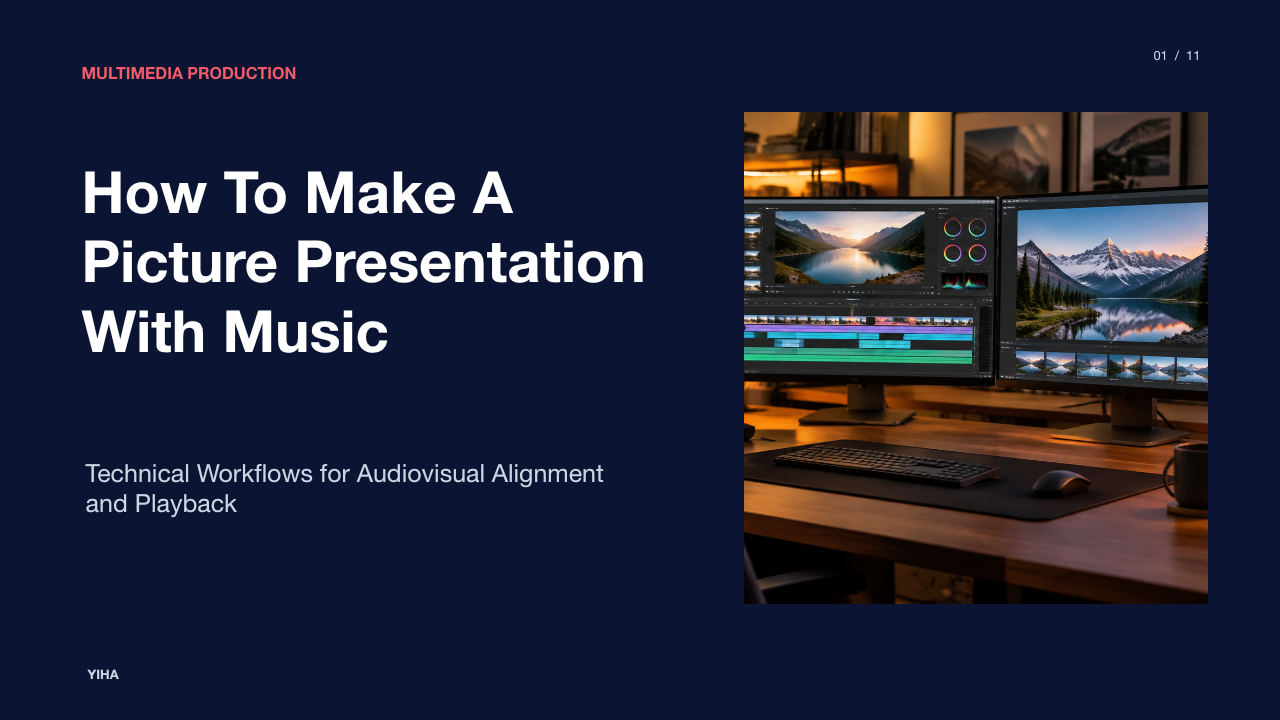
Background Music For Video Presentation
Discover research-backed principles for adding background music to video presentations, managing auditory cognitive load, vocal masking, and audio workflows.
Free download · 4.9 MB11 editable slides · PowerPoint format
Download the editable PPTX
PPTX · 4.9 MB · 11 editable slides · Free to edit and reuse with attribution to Yiha.ai
View every slide
Use ← →, Home/End, or swipe on mobile

Adding an audio track to a video presentation is often viewed as a decorative choice, but sound profoundly alters how audiences process spoken narrative and visual information. While music can cultivate an inviting tone and reinforce visual pacing, it simultaneously introduces competing acoustic streams that challenge human cognitive architecture. To produce effective multimedia content, creators must understand the perceptual mechanisms governing speech reception, auditory capacity limits, and audio mixing techniques.
The Purpose and Risks of Audio in Video Presentations
Video producers routinely incorporate background music to establish narrative mood, maintain audience attention, and smooth out visual transitions. A well-placed acoustic bed can unify disparate presentation clips into a cohesive timeline. Professional video production training emphasizes using music to support emotional pacing and structure, using digital audio workstations such as GarageBand or Cakewalk alongside nonlinear editing software like DaVinci Resolve, as outlined by Berklee Online.
However, pairing continuous music with spoken narration introduces substantial perceptual risks. Research published in PMC9599198 demonstrates that speech comprehension drops measurably when background music competes directly with speech, even when tested against silence. The primary hazard is acoustic masking, where musical components obscure spoken phonemes. When a soundtrack contains lyrical vocalizations, speech tracking degrades further because the linguistic content acts as an informational distractor. Uncalibrated background tracks force listeners to exert extra effort to isolate the speaker's voice, resulting in cognitive fatigue and reduced message retention.
How Working Memory Processes Audio and Speech
To understand why concurrent speech and music conflict, one must examine human cognitive architecture. Auditory perception relies on limited cognitive resources. In Kahneman's cognitive capacity model, detailed in research on auditory processing in PMC4606564, the brain possesses a finite pool of mental processing capacity at any single moment. When concurrent inputs demand more resources than are available, capacity interference occurs, and performance on the primary task declines.
When a presentation delivers both spoken narration and an instrumental background, the auditory system must segregate the sound into distinct streams. Electroencephalography research in PMC9599198 shows that cortical tracking of speech envelopes slows down and weakens in the presence of background music, evidenced by delayed auditory N1 wave latencies around 100 milliseconds. The human auditory channel struggles to parse complex, competing acoustic patterns simultaneously. If the background audio contains melodic contours that mirror human pitch variations, the brain continuously splits attention between interpreting the vocal message and monitoring musical signals.
Mayer's Coherence Principle and Extraneous Load
In multimedia instruction, unnecessary elements frequently harm learning outcomes rather than assisting them. Richard Mayer's Coherence Principle establishes that learners acquire deeper understanding when extraneous words, sounds, and pictures are excluded rather than added. The related seductive details effect illustrates that interesting but non-essential elements drain working memory away from core conceptual themes.
A meta-analysis by Kämpfe and colleagues cited in PMC4606564 confirmed that background music exerts a consistent negative effect across memory-related tasks, including memorizing verbal texts, reading comprehension, and multimedia learning. Neurophysiological data from PMC9599198 explains this breakdown: background music functions as an auditory masker, delaying cortical tracking and forcing the brain to expend energy filtering out non-essential acoustic information. For technical and educational video presentations, adding continuous music beds often creates extraneous cognitive load that actively degrades conceptual transfer.
Arousal, Mood, and the Role of Musical Complexity
Despite cognitive constraints, music can influence listener alertness and emotional state. The arousal-mood hypothesis suggests that music can enhance task performance under specific conditions by elevating affective valence and physiological alertness. In an experimental investigation documented in PMC4606564, researchers found that listening to emotionally touching music improved memory encoding for faces and accelerated recall compared to joyful music or rain sounds, while also increasing participant heart rate.
Crucially, this benefit was heavily constrained by the nature and complexity of the sound. In that same study, joyful music produced identical increases in heart rate and blood pressure but caused an increased number of recognition errors. Furthermore, secondary research literature reviewed in that paper noted that older adults experienced reduced recall performance when studying under background music or rain compared to silence. As noted in PMC9599198, fast-tempo music may accelerate spatial processing, but it frequently impairs reading and detailed verbal comprehension. Analysis suggests that while gentle, emotionally resonant music can elevate arousal, structurally complex or upbeat tracks overload processing channels during demanding conceptual tasks.
Equalization and Frequency Carving for Speech Intelligibility
When background music is deemed necessary for video pacing, audio engineering adjustments must prevent vocal masking. Spoken human speech concentrates vital intelligibility cues within the mid-frequency range. As established in PMC9599198, background songs introduce substantial informational and acoustic masking that directly degrades speech comprehension and cortical tracking.
To counter this conflict, editors working in digital audio workstations use parametric equalization (EQ) to carve out competing frequencies, a production discipline highlighted in Berklee Online.
Technical Recommendation: Audio engineers recommend applying a wide parametric EQ cut on the background music track between 1 kHz and 4 kHz, dipping the track by 3 dB to 6 dB (Recommendation: 1 kHz to 4 kHz mid-frequency attenuation). This dip clears spectral room for vocal formants and consonant clarity. Additionally, rolling off music frequencies below 80 Hz with a high-pass filter eliminates low-end rumble that muddies voice resonance. Frequency carving ensures that the music sits behind the narrative stream without competing for the same spectral bandwidth.
Dynamic Sidechain Ducking and Loudness Standards
Static volume adjustments often fail across an entire presentation because narrative delivery fluctuates naturally. Dynamic sidechain ducking automatically reduces background music levels whenever the voiceover track contains signal, restoring music levels during vocal pauses. As shown in Berklee Online, digital audio workstations and nonlinear editors provide automation tools to manage these dynamic interactions.
Technical Recommendation: A standard ducking setup routes the vocal track as an external key trigger into a compressor on the music track. Illustrative settings recommend a moderate compression ratio of 2:1 to 4:1, an attack time of 20 to 50 milliseconds to preserve initial speech transients, and a release time of 300 to 500 milliseconds (Recommendation: 300 to 500 ms release) to create smooth, unobtrusive volume swells between sentences.
In addition to sidechaining, final mixes must respect broadcast and digital loudness standards such as ITU-R BS.1770 and EBU R128. While speech intelligibility remains paramount, as documented by cognitive masking studies in PMC9599198, professional delivery guidelines recommend balancing integrated presentation audio to approximately -24 LUFS for broadcast or -16 LUFS to -14 LUFS for web streaming (Recommendation: -16 to -14 LUFS web target). The background music bed should rest roughly 18 dB to 24 dB below the integrated dialog level.
Aligning Musical Cues with Visual Transitions
In video presentations, sound and image must operate synchronously to reinforce pacing. Unaligned music creates perceptual friction, distracting the audience from the narrative flow. Professional video editing emphasizes creating rough edits that establish structural pacing and visual alignment with the music, using storyboards and timeline workflows described by Berklee Online.
Aligning musical cues with visual slide changes leverages natural musical cadences. Editors can plan transitions by marking musical phrases, downbeats, or percussion accents on the timeline.
Illustrative Example: In a product overview video, the editor positions major chapter title cards exactly on the first beat of a four-bar musical phrase (Example: 4-bar phrase transition). When the speaker concludes a technical topic, the music swells slightly during an illustrative transition before ducking back down as narrative resumes. This technique prevents random audio clashes and gives the presentation an intentional, organized cadence supported by audiovisual binding principles identified in PMC4606564.
Licensing Requirements and Public Performance Rights
Using commercial popular music in video presentations involves significant legal constraints. Under copyright law, synchronizing recorded audio with moving images requires two distinct authorizations: a synchronization license for the musical composition and a master use license for the specific sound recording. Academic curricula at Berklee Online teach industry-standard production workflows, which include clearing intellectual property rights for media distribution.
Using unlicensed popular songs on video hosting platforms triggers automated Content ID algorithms that identify copyrighted audio fingerprints. Infringements can lead to muted audio, monetization redirection, or automated video removal. Furthermore, corporate and educational broadcasts frequently require public performance clearance from performance rights organizations. To avoid copyright disputes, creators should utilize royalty-free music libraries or commercial production catalogs where sync, master, and public performance rights are bundled into explicit licenses. Avoiding commercial pop songs also aligns with cognitive findings from PMC9599198, which show that familiar commercial tracks distract listeners from spoken content.
A Decision Framework for Using Music or Silence
Deciding whether to incorporate background music requires evaluating presentation objectives, subject complexity, and audience cognitive demands. Instead of treating audio as a default decorative layer, instructional designers and video creators should employ an objective decision checklist.
Pedagogical Audio Decision Matrix (Recommendation):
-
High Cognitive Density (Technical Training, Financial Reports, Scientific Lectures):
- Recommendation: Complete silence during body content. Use short 4 to 8 second instrumental bumpers exclusively on intro and outro title cards (Recommendation: 4 to 8 second bumpers).
- Rationale: Extraneous cognitive load and informational masking documented in PMC9599198 degrade recall on analytical tasks.
-
Moderate Cognitive Density (Corporate Case Studies, General Onboarding):
- Recommendation: Subtle, low-tempo instrumental bed, carved with parametric EQ and ducked under speech.
- Rationale: Enhances engagement without triggering severe vocal masking, balancing mood and attention as noted in PMC4606564.
-
Narrative and Motivational Presentations (Brand Stories, Keynote Overviews):
- Recommendation: Dynamic scoring aligned with visual scene cuts, utilizing strategic silent pauses before major announcements.
- Rationale: Leverages emotional binding and structural alignment to reinforce key narrative moments.
By treating audio as an intentional communication tool rather than continuous filler, video creators preserve audience working memory while maximizing clarity and narrative impact.
Research sources
- Familiarity of Background Music Modulates the Cortical Tracking of Target Speech at the “Cocktail Party” - PMC · pmc.ncbi.nlm.nih.gov:443
- Familiarity of Background Music Modulates the Cortical Tracking of Target Speech at the “Cocktail Party” - PMC · pmc.ncbi.nlm.nih.gov
- Music Video Production Course - Berklee Online · online.berklee.edu
- The effect of background music on episodic memory and autonomic responses: listening to emotionally touching music enhances facial memory capacity - PMC · pmc.ncbi.nlm.nih.gov:443
- The effect of background music on episodic memory and autonomic responses: listening to emotionally touching music enhances facial memory capacity - PMC · pmc.ncbi.nlm.nih.gov