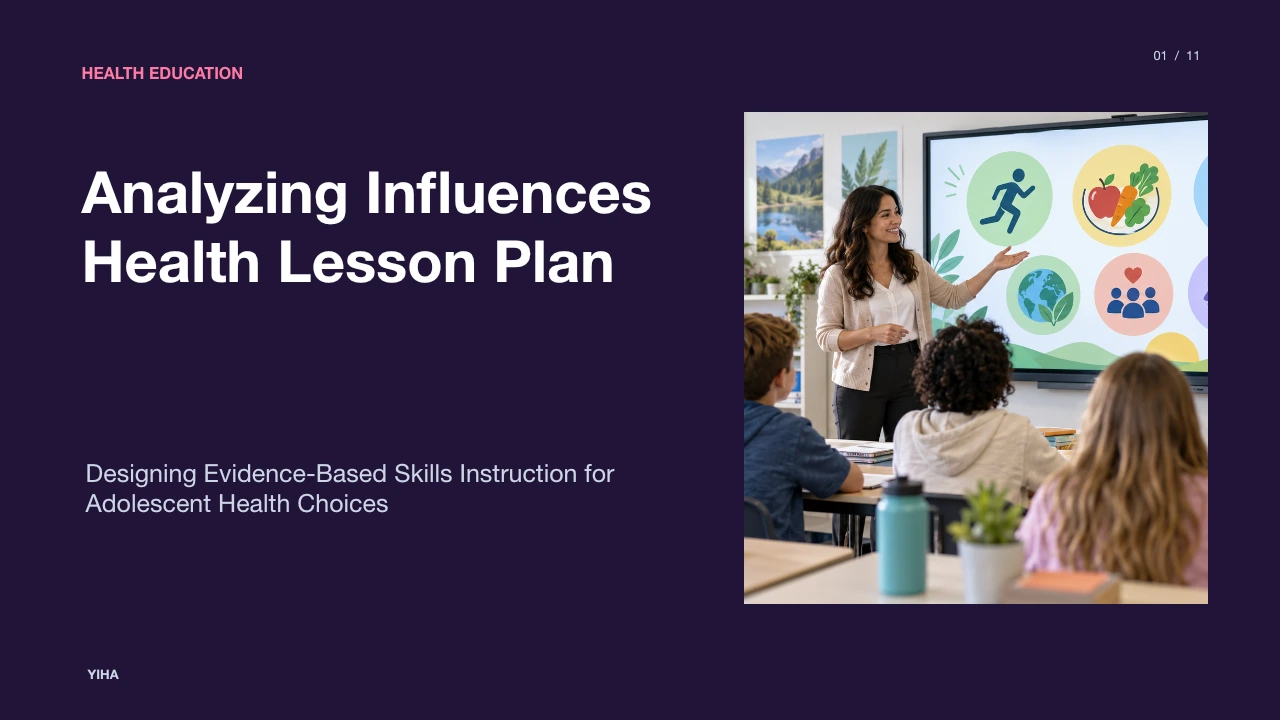
Analyzing Influences Health Lesson Plan
A comprehensive guide to designing a skills-based health lesson plan on analyzing internal and external influences, supported by adolescent behavioral research.
Free download · 4.9 MB11 editable slides · PowerPoint format
Download the editable PPTX
PPTX · 4.9 MB · 11 editable slides · Free to edit and reuse with attribution to Yiha.ai
View every slide
Use ← →, Home/End, or swipe on mobile
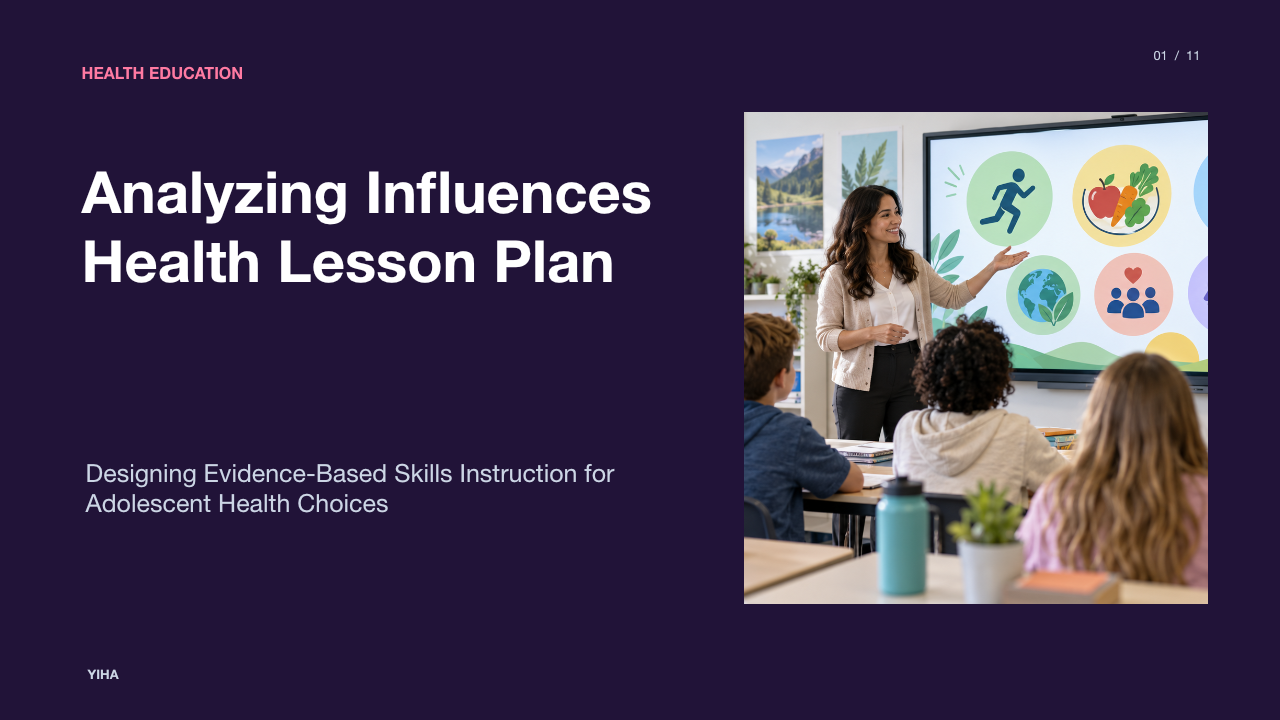
Health literacy requires far more than memorizing dietary guidelines or listing the biological consequences of substance use. Effective health education empowers students to understand why they make specific choices and how unseen social, environmental, and emotional pressures shape their daily habits. Designing a rigorous skills-based health lesson plan focused on analyzing influences equips adolescents with the critical thinking skills needed to navigate media environments, peer networks, and cultural expectations.
Grounding Lesson Design in National Health Standards
Instructional planning begins by establishing clear, measurable targets grounded in professional educational benchmarks. Rather than delivering passive lectures, teachers structure lessons around active skill development. In curriculum design, an effective lesson plan operates as a navigational roadmap that directs instructional flow and learning outcomes, as outlined in 9 Components of an Effective Lesson Plan - Teacher Strategies. When teachers establish clear objectives linked to established educational standards, instruction shifts from disjointed activities into intentional skill development.
Planning an analyzing influences health lesson plan requires framing objectives around demonstrable student capabilities. Following student-centered educational models inspired by reformers like John Dewey, lessons must emphasize experiential understanding over rote memorization. Teachers should write learning goals that define what students can perform by the end of the lesson, such as categorizing social pressures or critiquing digital marketing claims. Planning these coordinates in advance frees the instructor to remain observant, responsive, and supportive during active classroom discussions.
Distinguishing Internal Beliefs from External Pressures
To deconstruct daily decision making, students need an objective taxonomy that separates personal attitudes from surrounding social forces. Educators often utilize backward design frameworks, such as Understanding by Design, to determine the targeted analytical competency before arranging instructional tasks, a method highlighted in 10 Lesson Plan Examples, Plus Helpful Expert Tips.
In this framework, internal influences encompass factors originating within the individual, including personal values, self-efficacy, biological drives, and perceived social norms. In contrast, external influences arise from the social and physical environment, including peer circles, family expectations, community rules, and targeted marketing campaigns. As an illustrative example, a student might decide to stay up late browsing videos due to an internal feeling of curiosity combined with an external push from algorithmic notification loops. Helping students map these contrasting forces allows them to identify where external pressures attempt to overwrite internal personal boundaries.
How Social Media and Peer Dynamics Alter Decision Making
Adolescent health decisions cannot be understood without examining the developmental neurobiology of the teenage brain. Research published in Peer Influences on Adolescent Decision Making - PMC demonstrates that elevated risk taking in youth stems from a maturational gap between the early development of the brain's socio-emotional reward system and the prolonged, gradual maturation of the prefrontal cognitive control system. When adolescents are in the presence of peers, their neural socio-emotional reward centers become sensitized to the immediate social reward of risk taking.
Experimental testing confirms this contextual shift. In a computerized driving simulation cited in the PMC review, early adolescents, late adolescents, and adults tested alone engaged in comparable levels of risk taking. However, when observed by two same-aged peers in the room, early and late adolescents engaged in significantly greater risky driving, whereas adults showed no difference in behavior related to social context. Compounding this neurobiological sensitivity, digital media platforms create constant peer visibility and automated feedback loops. According to the Mental health of adolescents fact sheet published by the World Health Organization, pressure to conform with peers, exploration of personal identity, and media influence represent substantial stressors affecting youth psychological well-being. Classrooms must therefore analyze how digital interactions trigger immediate emotional responses.
Empirical Evidence on Norm Perception and Risk Taking
Adolescents frequently respond to environmental behavioral cues established within their immediate peer communities. Empirical behavioral research demonstrates that classroom structures and peer interactions play an etiological role in the trajectory of adolescent risk behaviors. Longitudinal evidence from universal prevention trials, such as the Good Behavior Game evaluated in The Good Behavior Game and the Future of Prevention and Treatment - PMC, shows that early classroom behavioral management produces profound long-term health outcomes. Long-term followups of first-grade cohorts evaluated at ages 19 to 21 documented significantly lower rates of regular smoking, drug and alcohol abuse disorders, delinquency, and violent criminal behavior compared to standard classrooms.
Furthermore, the quality of classroom behavioral norms dramatically influences subsequent risk trajectories. In standard, poorly managed first-grade classrooms, children displaying high disruptive behaviors were up to 59 times as likely to exhibit severe aggressive behavior by middle school compared to the average child, whereas in well-managed classrooms that differential dropped to 2.7 times. International replications in the Netherlands demonstrated that structured peer group contingencies reduced relational and physical victimization, increased affiliation with nondeviant peers, and reduced tobacco use between ages 10 and 13. By building instructional environments that deliberately reinforce supportive peer dynamics, educators replace negative social reinforcement with protective classroom norms.
A Four-Step Model for In-Class Skill Acquisition
Translating analytical concepts into repeatable student actions requires an explicit instructional sequence. Teachers can implement a four-step pedagogical sequence using the gradual release of responsibility model, often referred to as 'I Do, We Do, You Do,' as outlined in 9 Components of an Effective Lesson Plan - Teacher Strategies:
- Identify the Influence: The student detects the presence of an internal emotion or external stimulus impacting a health choice.
- Analyze the Underlying Message: The student investigates the motive, marketing tactic, or peer expectation embedded in that influence.
- Evaluate Alignment: The student checks whether conforming to the influence supports their personal values, long-term health goals, and family rules.
- Formulate an Intentional Response: The student plans and articulates an active decision, whether resisting peer pressure, seeking adult guidance, or adopting a healthier alternative.
During initial modeling, the teacher walks through this four-step sequence using a shared scenario. Guided practice follows with peer pairings, culminating in independent application across varied health contexts.
Comparing Didactic Lectures with Skills-Based Inquiry
Traditional health education frequently relied on didactic lectures that delivered factual warnings about dangerous substances or poor nutrition. However, lecture formats rarely produce lasting behavioral change because they fail to engage student critical reasoning. In contrast, constructivist media analysis engages students in inquiry-driven investigations of authentic media artifacts, as demonstrated by the instructional resources at Project Look Sharp. Rather than preaching moral conclusions, inquiry-based approaches pose reflective questions that lead students to evaluate media construction independently.
Effective weekly instruction balances standards, learning targets, dynamic materials, assessment checks, and consistent classroom structure, as described in 5 Components to a Great Weekly Lesson Plan | Teacher.org. When analyzing commercial advertisements, students inspect lighting, celebrity endorsements, omitted safety warnings, and targeted emotional cues. This inquiry process transforms passive recipients of health messages into critical evaluators capable of identifying deceptive promotional strategies.
Navigating Socioeconomic Realities and Cultural Nuances
Health decisions do not occur in an isolated vacuum of personal willpower. Curricula that ignore living conditions risk promoting an unfair deficit model that blames individuals for circumstances beyond their control. According to the Social determinants of health guidance from the World Health Organization, health status is heavily influenced by the conditions in which people are born, grow, live, work, and age. Across populations, health follows a social gradient where lower socioeconomic status correlates with higher rates of illness and premature death, with structural factors often exerting greater influence than genetics or direct medical services.
Teachers must structure discussions with cultural responsiveness and economic awareness. For instance, when analyzing dietary influences, lessons should not frame fresh organic produce as the only responsible choice while shaming families that rely on non-perishable food pantries. Instead, instruction should explore community infrastructure, food access, marketing saturation in low-income neighborhoods, and cultural food traditions. This perspective teaches students to examine external structural drivers without attaching personal stigma to peers.
Scaffolding Instruction Across K-12 Topic Modules
Instructional design must adapt complexity to student cognitive development across different grade bands. As highlighted by Free AI Lesson Plan Generator for Teachers, high-quality educational planning must account for how children process information at distinct ages, adjusting pacing and expectations accordingly.
- Elementary Grades (K-5): Scaffolding focuses on identifying immediate external cues versus internal feelings. Students examine how colorful television toy commercials influence desires or how family routines shape physical activity and dental care.
- Middle School (Grades 6-8): Lessons address social identity and peer dynamics. Students examine social media algorithms, vaping marketing targeted at youth, energy drink promotions, and the influence of friendship groups on emotional wellness.
- High School (Grades 9-12): Analysis tackles complex, nuanced scenarios including relationship dynamics, digital privacy, commercial alcohol sponsorships, prescription drug misuse, and community health policies.
By revisiting the core skill across varied topics, schools create a cumulative progression that reinforces analytical fluency as adolescents mature.
Measuring Skill Mastery Through Performance Assessments
Skill acquisition cannot be verified through standard multiple-choice testing. Educators assess analytical mastery through authentic performance tasks evaluated with transparent rubric criteria, as emphasized in 9 Components of an Effective Lesson Plan - Teacher Strategies. Assessment must blend ongoing formative checks with summative demonstrations.
Effective performance assessments include structured media deconstruction portfolios, daily influence reflection journals, and scenario-based decision audits. In a decision audit, students document a real or simulated dilemma, identify at least two internal and two external influences, evaluate their personal values, and justify their selected course of action. Teachers grade these artifacts against clear rubric levels focusing on depth of analysis, recognition of implicit bias, and alignment of the chosen behavior with verified health facts. Through continuous performance feedback, students transfer classroom analysis into resilient habits outside school walls.
Research sources
- 9 Components of an Effective Lesson Plan - Teacher Strategies · www.teacherstrategies.org
- 8 Best AI Lesson Plan Generators for Educators · www.weareteachers.com
- Free AI Lesson Plan Generator for Teachers · www.theschoolhouse.org
- 10 Lesson Plan Examples, Plus Helpful Expert Tips · www.weareteachers.com
- Free AI lesson plan generator to create impressive lesson plans in minute · www.visme.co
- Peer Influences on Adolescent Decision Making - PMC · pmc.ncbi.nlm.nih.gov:443
- Mental health of adolescents · www.who.int
- The Good Behavior Game and the Future of Prevention and Treatment - PMC · pmc.ncbi.nlm.nih.gov:443
- Project Look Sharp · www.projectlooksharp.org
- 5 Components to a Great Weekly Lesson Plan | Teacher.org · www.teacher.org
- Social determinants of health · www.who.int