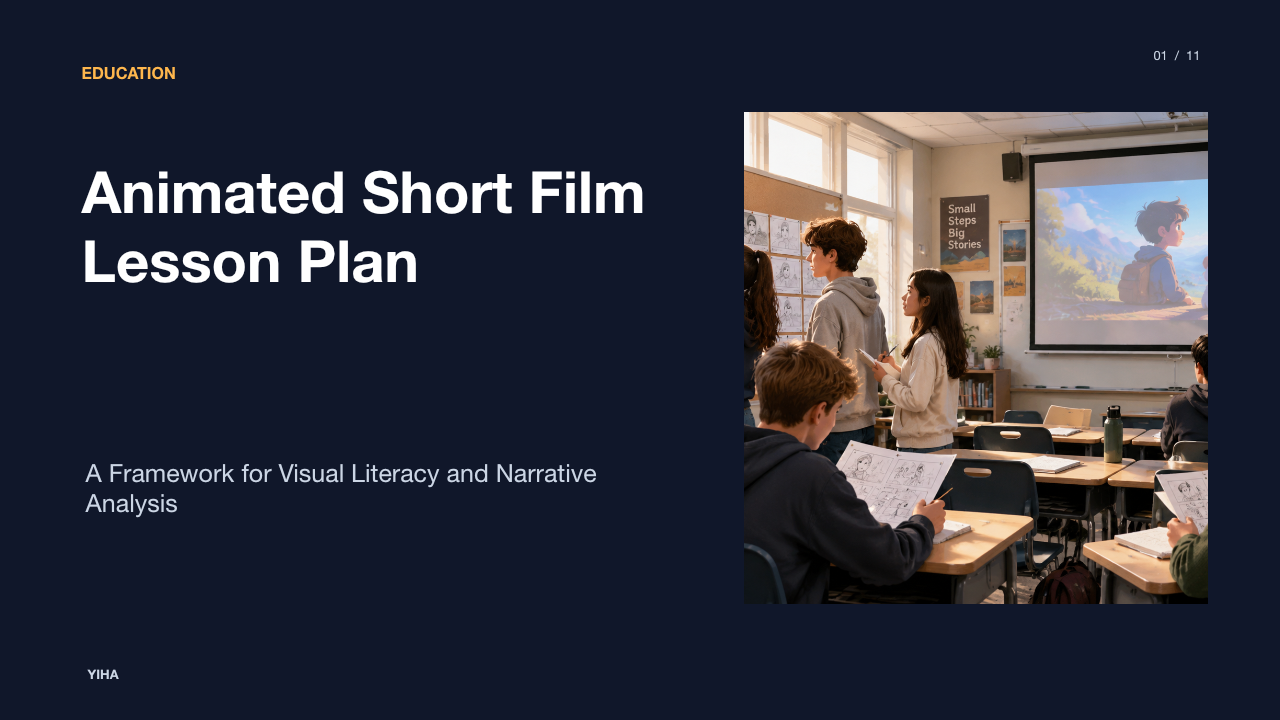
Alike Short Film Lesson Plan
A structured instructional lesson plan examining the animated short film Alike. Learn how to guide visual literacy, character arcs, color symbolism, and multimodal inquiry.
Free download · 4.9 MB11 editable slides · PowerPoint format
Download the editable PPTX
PPTX · 4.9 MB · 11 editable slides · Free to edit and reuse with attribution to Yiha.ai
View every slide
Use ← →, Home/End, or swipe on mobile
Short animated films provide concise, powerful texts for exploring visual literacy, media analysis, and personal reflection. By stripping away spoken dialogue, these films require viewers to decode character intentions, thematic tensions, and atmospheric shifts through composition, color, and gesture. The 2015 animated short Alike, directed by Daniel Martínez Lara and Rafa Cano Méndez, serves as an exemplary educational text for examining the friction between institutional routine and creative expression.
This lesson plan outlines how educators can integrate Alike into English Language Arts, media literacy, or visual arts curricula. Through structured pre-viewing preparation, active viewing protocols, and multimodal assessment tasks, students examine how non-verbal cinematic storytelling conveys complex societal critiques while fostering social-emotional reflection.
Curricular Context and Film Overview
Teaching visual narrative begins with understanding the technical production and artistic origin of a text. As highlighted by A Lust For Life, Alike is an animated short film directed by Daniel Martínez Lara and co-directed by Rafa Cano Méndez. The project was created with former students from Pepe-School-Land as a personal creative initiative rather than part of the school's formal itinerary. Developed primarily on the Linux operating system using Blender as the primary tool for modeling, animation, rendering, composing, and editing, the production stands as a model of independent open-source digital filmmaking.
In classroom settings, Alike functions as an accessible text across varied grade levels. Because the film contains no spoken dialogue, it eliminates linguistic barriers for emerging bilingual learners while offering rich interpretive layers for secondary students. The story introduces Copi, a father who tries to teach the right way to his son, Paste, while navigating the demands of a busy life. Curricular units focusing on narrative structure can use this text to introduce core storytelling elements—exposition, inciting incident, rising conflict, climax, and resolution—without requiring lengthy reading periods.
Educational resources from Film English Pip Lesson emphasize that short animated narratives naturally foster key multimodal skills: listening, viewing, speaking, reading, writing, and visually representing. Using Alike within an ELA or media literacy unit enables teachers to anchor standards around text analysis in an engaging, time-efficient visual medium.
Character Arcs and Thematic Conflict
The central tension of Alike revolves around the parallel daily routines of Copi and Paste. Copi spends his days filing repetitive paperwork in an uninspired office environment, while Paste is sent to a traditional school where he is instructed to copy alphabet letters repeatedly. In our curricular analysis, the dramatic conflict emerges when Paste's innate artistic impulse—drawing expressive figures rather than conforming to rigid letterforms—is systematically corrected and discouraged by the educational setting.
As examined in multimodal lesson structures from Film English Alma Lesson, short films allow students to explore character traits and motivations through observable action rather than explicit exposition. In Alike, Copi believes he is guiding Paste toward stability by instilling obedience and routine. However, as Copi enforces conformity, he inadvertently dampens his son's natural vitality. Paste's slumping posture, fading enthusiasm, and declining energy mirror Copi's own daily fatigue.
In our narrative analysis, the story reaches its thematic turning point when Copi recognizes the emotional toll of forced conformity on his child. Rather than continuing to demand mechanical compliance, Copi actively alters their routine. The conflict is resolved not by abandoning social responsibility entirely, but by validating creative expression as vital to personal well-being. Teachers can use this arc to introduce discussions on external expectations versus internal motivation.
Color Symbolism as a Narrative Device
Color design serves as the primary visual storytelling mechanism throughout Alike. In our aesthetic analysis, the directors establish a deliberate visual contrast: the wider urban workforce and school environment exist in muted, desaturated tones, while individual emotional engagement is signaled by saturated, vibrant colors. Copi is depicted in a cool blue hue, Paste radiates a warm golden-orange, and the majority of urban commuters appear in uniform monochrome grey.
Educational collections on Lesson Planet Short Film Resources document how educators routinely use animated shorts to teach students how specific aesthetic devices underscore narrative mood and characterization. In Alike, color is not static; it fluctuates directly with emotional connection. When Copi and Paste embrace, their colors revitalize and intensify. Conversely, as Paste spends hours tracing uniform black letters and Copi files stacks of monochrome sheets, both characters visibly lose their saturation, blending into the lifeless grey crowd.
Analyzing this color dynamic teaches students the cinematic principle of showing rather than telling. Instead of explaining that conformity causes alienation, the filmmakers externalize psychological states onto the characters' physical surfaces. An instructional recommendation is to have students map character color levels at three narrative stages: the morning walk, the afternoon reunion, and the evening conclusion.
Cinematic Techniques and Non-Verbal Storytelling
Beyond color, Alike relies on deliberate framing, character blocking, and staging to communicate systemic conformity. In our technical analysis, the directors utilize parallel staging and symmetrical framing to juxtapose Copi's corporate desk with Paste's classroom desk. Both environments feature rigid rows, identical postures, and repetitive physical motions, visually arguing that traditional schooling often mirrors assembly lines.
A central narrative catalyst is the street musician playing a violin in a small park along their route. While the surrounding pedestrians march forward with heads down, Paste is transfixed by the musician's performance. The camera employs low-angle framing from Paste's perspective, emphasizing the violin player as an isolated beacon of warmth in a cold environment.
As seen in instructional design frameworks on ReelMind Alma Lesson Template, deconstructing non-dialogue media requires students to look at visual staging, pacing, and auditory composition. In Alike, the musical score carries the emotional weight of the narrative. Melodic strings accentuate moments of connection and inspiration, while silence and mechanical ambient sound underscore the monotony of paperwork and handwriting drills. Students learn that sound design in animation operates as a full substitute for dialogue.
Pre-Viewing Framing and Schema Activation
Effective media literacy instruction requires deliberate schema activation prior to viewing. When students understand the conceptual frame of a text beforehand, their viewing shifts from passive entertainment to active critical observation. In the case of Alike, pre-viewing exercises should explore the concepts of conformity, individuality, societal routines, and creativity.
Structuring pre-viewing discussions around targeted prompts helps set this focus, as shown in the instructional framework from the ReelMind Ian Lesson Template. Educators can introduce essential questions such as:
- What does it mean for individuals or routines to be alike?
- Why do societies and institutions value uniformity, and what are its potential drawbacks?
- How do daily routines influence a person's emotional energy and enthusiasm?
Alongside thematic questions, teachers should establish a brief vocabulary preview. Terms such as conformity, monochrome, saturation, juxtaposition, and non-verbal cues give students the academic vocabulary needed to articulate their observations during subsequent analytical discussions.
Active Viewing Protocols and Observation Guides
To keep students engaged during the screening, teachers should implement a dual-entry viewing log or targeted observation protocol. Showing the short film twice is an effective pedagogical strategy: the first viewing allows students to experience the narrative flow, while a second viewing enables detailed tracking of specific cinematic techniques.
In the pedagogical sequence designed by Film English Alike Lesson Plan, viewing activities integrate predicting outcomes, noting routines, and tracking character behavior. During the viewing protocol, educators can divide the classroom into observation groups:
- Group A (Color Trackers): Record moments where Copi and Paste gain or lose color saturation.
- Group B (Spatial and Movement Observers): Document body language, posture, and movement speed in the office and school versus the park.
- Group C (Audio and Music Observers): Identify when musical themes appear and how tempo shifts align with narrative turning points.
This structured observation prevents students from treating the film as casual entertainment and prepares them with concrete visual evidence for post-viewing discourse.
Post-Viewing Socratic Inquiry and Analysis
Following the screening, educators should facilitate structured dialogue that prompts students to defend their interpretations with observational evidence. Socratic seminar prompts encourage students to move beyond surface summary into thematic critique.
Useful inquiry questions include:
- What does the violin player represent to Paste, and why does Copi initially pull him away?
- How does the film portray the purpose of the school, and is this depiction entirely fair or exaggerated?
- Why does Copi attempt to imitate the violin player at the climax of the film, despite having no musical ability?
- How does the ending redefine what success and support look like in a family relationship?
As described on Film English Alike Lesson, structured lesson routines prompt learners to describe characters, reflect on routines, predict narrative conclusions, and explore the central message of the film. When learners cite specific frame compositions or character actions to justify their answers, they practice the same text-evidence standards used in written literary analysis.
Differentiated Tasks and Multimodal Assessment
Assessment following Alike should accommodate varied learning styles and language proficiency levels. Because the film is dialogue-free, student outputs can span analytical writing, creative storyboarding, and spoken presentations.
Educators can implement tiered assessment pathways based on student readiness:
- Pathway 1 (Visual Storyboard Extension): As an illustrative example, students create a four-frame storyboard illustrating the next day in Copi and Paste's routine, incorporating deliberate color palettes to reflect emotional tone.
- Pathway 2 (Dual-Perspective Monologue): Students write two short interior monologues—one from Copi's perspective during his commute, and one from Paste's perspective in the classroom—articulating thoughts unsaid on screen.
- Pathway 3 (Analytical Critical Response): Secondary students write a formal essay analyzing how the directors use visual motifs to critique standardized schooling and corporate conformity.
As highlighted across lesson models on Film English Pip Overview, integrating traditional skills (reading and writing) with visual representation allows teachers to differentiate naturally, ensuring that emerging language learners and advanced analysts engage meaningfully with the core text.
SEL Synthesis and Classroom Culture Reflection
The ultimate curricular value of Alike lies in its capacity to stimulate reflection on learning environments and emotional well-being. According to Film English Alike Materials, short films provide powerful vehicles for exploring the impact of societal pressures on childhood, routines, and family relationships.
Teachers can conclude the instructional unit by having students assess their own educational spaces:
- Which classroom activities allow for personal creative expression, and which require uniform adherence?
- What daily practices help students and teachers maintain energy and avoid burnout?
- How can peer groups support classmates who express unconventional ideas?
By connecting the visual critique of Alike to their own school routines, students recognize that visual literacy is not merely an abstract academic skill, but a powerful lens for understanding personal agency, emotional balance, and the social structures around them.
Research sources
- Alike short film | A Lust For Life - Youth Mental Health Charity in Ireland · www.alustforlife.com
- Pip · film-english.com
- Pip Short Film Lesson Plan PPT Template | ReelMind · reelmind.ai
- Soar · film-english.com
- Alma · film-english.com
- B1 ESL Video Lesson Plan: Pip · film-english.com
- Short Film Lesson Plans & Worksheets Reviewed by Teachers · www.lessonplanet.com
- Alma Short Film Lesson Plan PPT Template | ReelMind · reelmind.ai
- Ian Short Film Lesson Plan PPT Template | ReelMind · reelmind.ai
- B1 ESL Video Lesson Plan: Alma · film-english.com
- B1 ESL Video Lesson Plan: Alike · film-english.com
- Alike · film-english.com