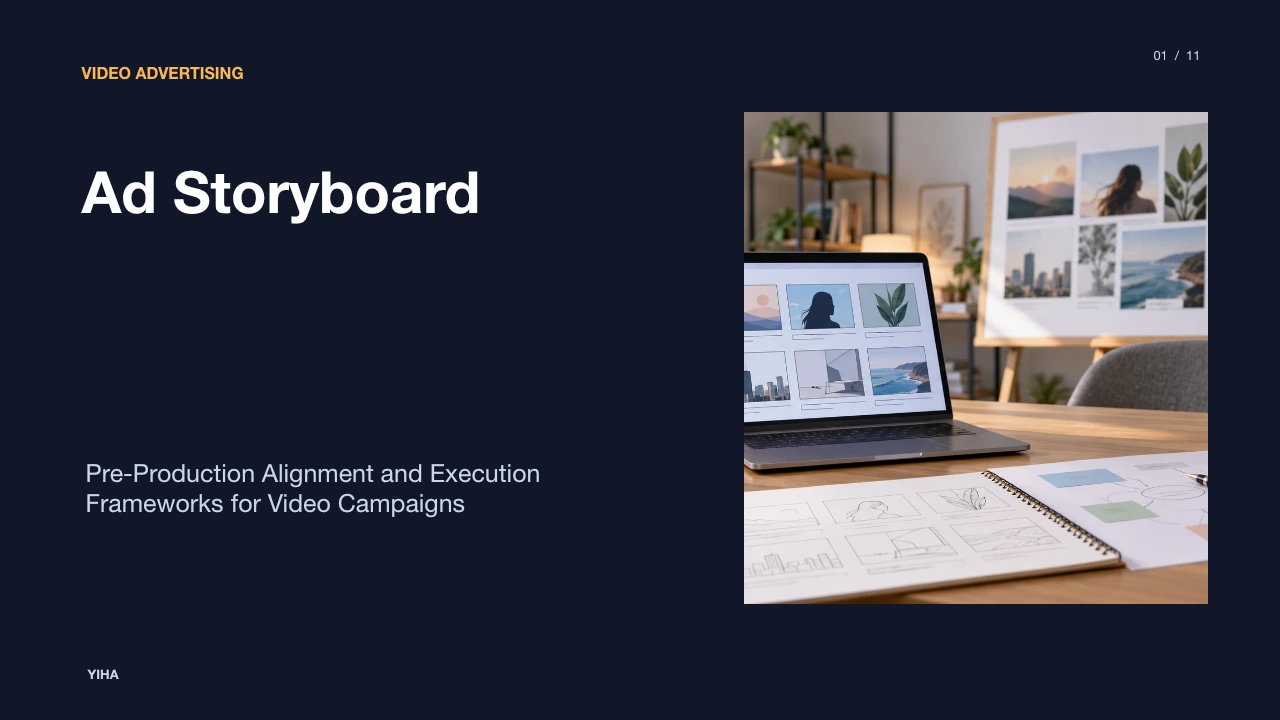
Ad Storyboard
A comprehensive guide to ad storyboarding, exploring how visual panels bridge commercial scripts, client approvals, and production execution across broadcast and digital formats.
Free download · 4.9 MB11 editable slides · PowerPoint format
Download the editable PPTX
PPTX · 4.9 MB · 11 editable slides · Free to edit and reuse with attribution to Yiha.ai
View every slide
Use ← →, Home/End, or swipe on mobile
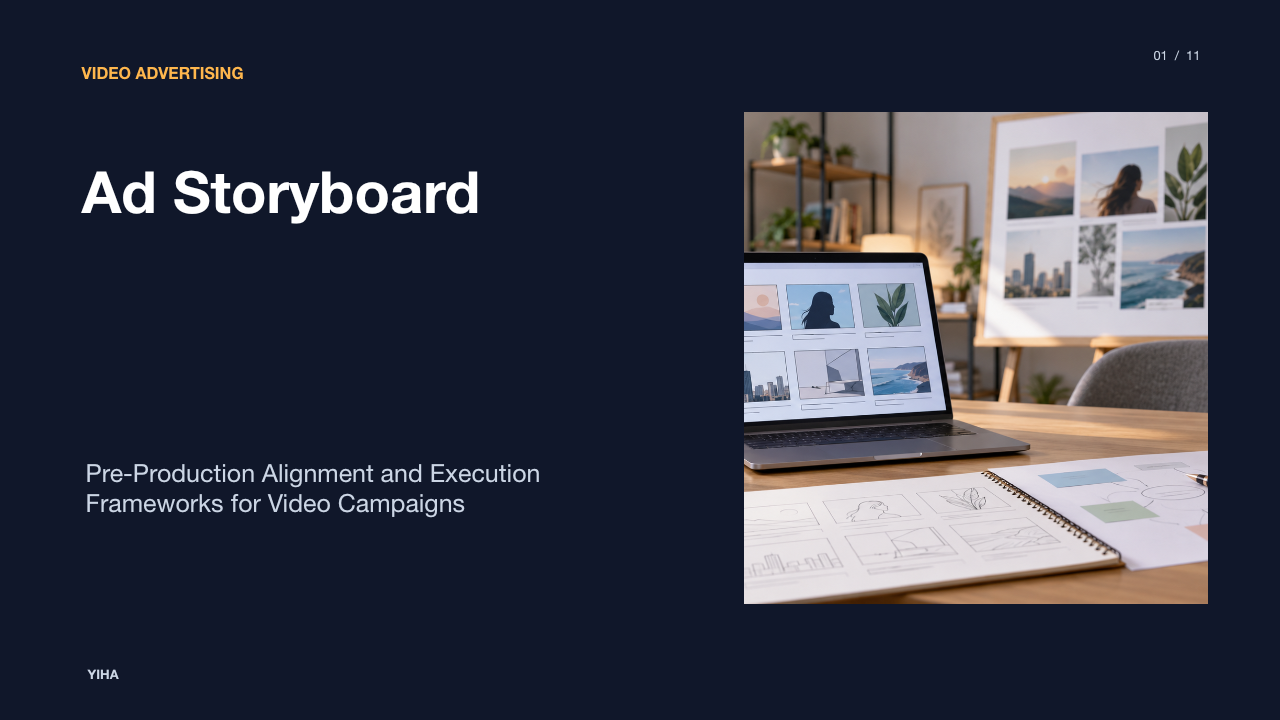
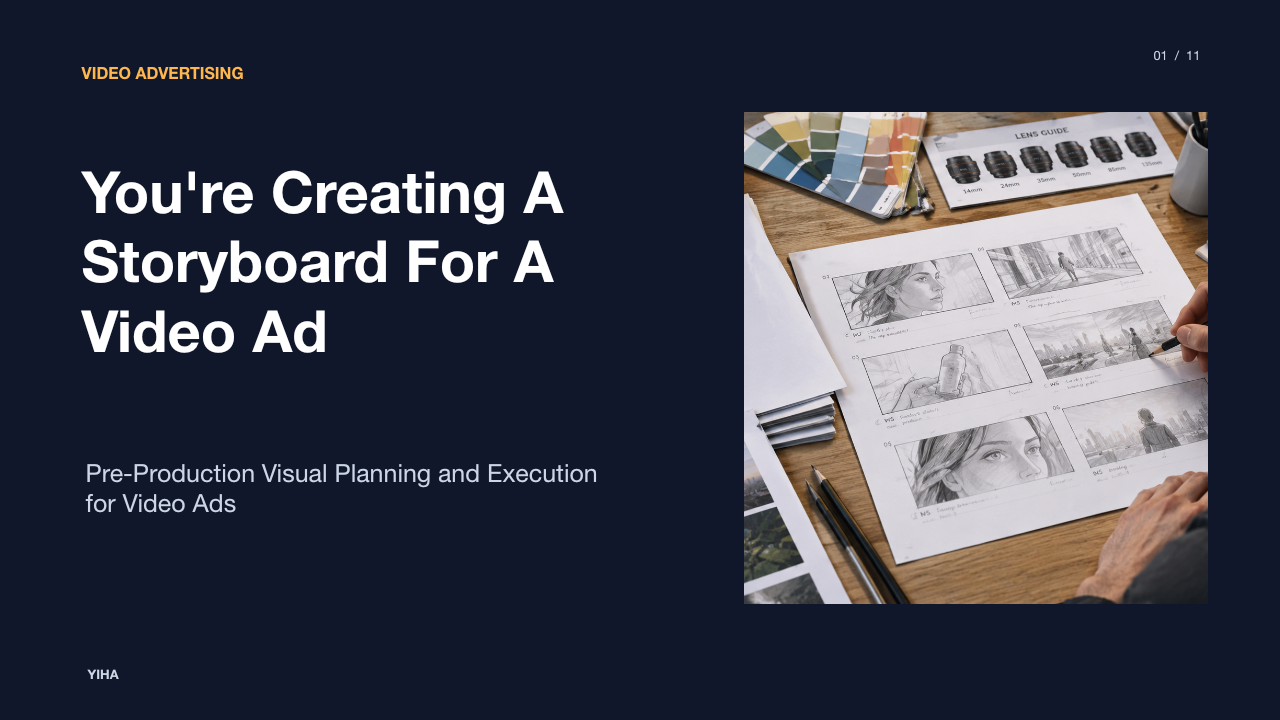
In commercial video production, an ad storyboard serves as the operational bridge connecting high-level advertising strategy to on-set execution. While feature films often use storyboarding to explore narrative flow across hours of storytelling, commercial advertising operates under tight constraints where every fraction of a second must earn its place. A commercial storyboard translates a marketing message into a sequential, visual contract that aligns brand directors, agency creatives, cinematographers, and editors before physical production begins.
Without a detailed visual plan, creative teams frequently experience misaligned expectations. Two stakeholders can read the identical sentence in a script while envisioning completely different pacing, framing, and visual priorities. By defining the exact visual and technical composition of each shot in pre-production, advertising teams eliminate guesswork, protect their production budgets, and verify that the core brand proposition lands effectively on screen.
The Core Function of Commercial Storyboards
A commercial storyboard is not merely an artistic exercise; it functions as an operational contract between the creative agency, the client, and the filming crew. As outlined in How To Plan Storyboards For Ad Shoots: A Practical Guide (2026), a storyboard establishes the single document that a director, cinematographer, client, and first assistant director agree upon weeks before principal photography. When teams skip or abbreviate this stage, critical creative decisions get postponed until filming day, which leaves an entire crew waiting while expensive production time ticks away.
Unlike narrative cinema, commercial storyboarding places paramount importance on the brand moment. Commercials exist to advance specific marketing goals, whether shifting brand perception or generating direct response actions. The storyboard specifies exactly when the product appears, the duration it remains on screen, and its framing prominence. Capturing these decisions early protects budgets against costly revisions during post-production. Furthermore, routing initial boards through the cinematographer and production manager allows the team to identify logistical constraints, such as unachievable camera setups or unconfirmed locations, well before physical setup begins.
The Five Essential Elements of a Storyboard Frame
To eliminate ambiguity on set, every individual storyboard card must contain consistent technical data. Industry standards outlined in Video Ad Storyboard Template: Free Frameworks for Every Ad Format establish five standard fields for every commercial panel: the visual sketch, the shot classification, the spoken audio or voiceover, the on-screen text overlays, and the planned duration.
The visual sketch illustrates the physical action, character staging, and prop placement. The shot classification indicates camera framing (such as wide shot, medium close-up, or macro insert) alongside physical camera motion. The voiceover field logs the precise spoken line synchronized to that specific visual beat. The on-screen text field records captions, pricing terms, or legal disclaimers. Finally, the duration field states the exact screen time allocated to that frame. As demonstrated in How to Storyboard TV Commercials: Brief to Final Frames, maintaining this structured anatomy prevents creative misalignment, ensuring that sound and imagery complement each other rather than competing for consumer attention.
Narrative Pacing and Structural Frameworks
Commercials must convey persuasion within strict, predetermined broadcast runtimes, typically fifteen, thirty, or sixty seconds. In Video Ad Storyboard Template: 7 Strategies That Convert, direct response structures such as Problem-Agitate-Solve (PAS) demonstrate how narrative tension maps directly to panel counts. Under this framework, the first third of the board introduces the consumer tension, the middle panels depict the escalating friction of leaving that problem unresolved, and the final panels reveal the product resolving the challenge alongside a clear call to action.
Pacing requires deliberate variation rather than uniform shot lengths. As detailed in Commercial Storyboard: The 30-Second Ad Board, high-performing commercials rarely maintain a flat cut rate. Effective visual rhythm often establishes an opening hook across two to three seconds, accelerates pacing through tighter reaction shots in the middle section, and deliberately holds the final brand card for three seconds so viewers can absorb the offer. For an illustrative example, a 30-second spot mapped across eight panels might budget 2.5 seconds for the hook, 1.5 seconds for the talent reaction, 2.0 seconds for the problem insert, 2.2 seconds for the product demonstration, and a sustained 3.0-second hold on the closing offer card.
Communicating Camera Movement and Action Dynamics
A static illustration cannot easily depict complex three-dimensional motion without standardized visual notation. Production crews rely on directional arrows and framing shorthand to interpret physical mechanics. According to How to Show Camera Movement in a Storyboard, bold arrows drawn across or extending beyond panel boundaries indicate physical camera paths or subject trajectory, preventing crew members from confusing camera direction with on-set props.
Different camera moves employ distinct notation symbols. Pans and tilts utilize curved arrows anchored at the camera pivot point to signal rotational movement. Physical zooms use four corner arrows expanding outward or contracting inward to signal focal length alteration without dolly movement. In contrast, three-dimensional perspective arrows receding toward a vanishing point indicate a physical push-in or dolly move. As noted in Camera Movement for Storyboards: Plan Motion Before Animation, camera movement must serve an expressive function, such as building psychological tension or revealing a product relationship, rather than functioning as visual clutter.
Platform Framing and Soundless Playback Design
Modern campaigns distribute content across multiple platforms simultaneously, each requiring distinct aspect ratios. A television spot natively shot in 16:9 landscape must often translate to 9:16 vertical video for mobile feeds or 1:1 square for digital placements. As highlighted in How to Storyboard a Commercial: A Step-by-Step Guide (2026), attempting to crop a wide landscape frame into a vertical format during post-production frequently cuts off critical product details or text elements.
Effective commercial storyboarding tackles platform constraints by designing safe-action overlays into initial panels. Framing must center core visual focal points so that compositions remain coherent across both 16:9 and 9:16 crops. Furthermore, because a substantial portion of mobile social media users browse feeds without sound, panels must communicate the value proposition visually. The storyboard integrates on-screen supers synchronized with spoken lines, verifying that the core claim, offer, and call to action register clearly even when playback is muted.
Brand Commercials Versus Performance Ad Boards
Storyboarding methodology varies depending on whether a campaign focuses on brand elevation or direct response performance. In How to Create an Ad Storyboard: From Script to Shot List in Minutes (2026), the contrast between traditional brand commercial boarding and agile performance boarding is clearly drawn. Traditional brand boards feature hand-illustrated artwork, granular lighting notes, and complex camera blocking suited for multi-tier client approvals and large production crews.
Conversely, performance ad storyboards prioritize clarity and rapid iteration over artistic polish. Teams planning social video ads, creator partnerships, or user-generated content often replace custom illustration with reference screenshots from successful ad swipe files, paired with precise script timing. Performance boards frequently design modular components, enabling editors to swap the initial three-second hook across several versions while retaining an identical middle demonstration and closing CTA. This modular approach supports multivariate testing across paid channels without inflating pre-production timelines.
Navigating Client Review and Production Hand-Offs
The storyboard serves distinct purposes depending on which stakeholder is reviewing it. Brand clients inspect storyboards to evaluate strategic messaging, brand visibility, and call-to-action prominence. In contrast, directors, cinematographers, and production managers review the boards to assess practical execution, lighting requirements, and technical feasibility. The guide in How to Create a TV Commercial Storyboard [2026] emphasizes that client sign-off establishes the creative parameters before crew members step onto a set.
To ensure clarity across both technical and non-technical stakeholders, commercial storyboards must explicitly label key narrative beats and hero product moments. Producers present these boards as versioned documents, securing written client approval on copy supers, legal disclaimers, and product framing. Once approved, the document transitions to the filming crew as a shooting board. Clear line art and explicit camera notes provide the cinematographer and gaffer with the exact specifications needed to rig lighting and frame shots without ongoing debate.
From Script Breakdown to Production Shot List
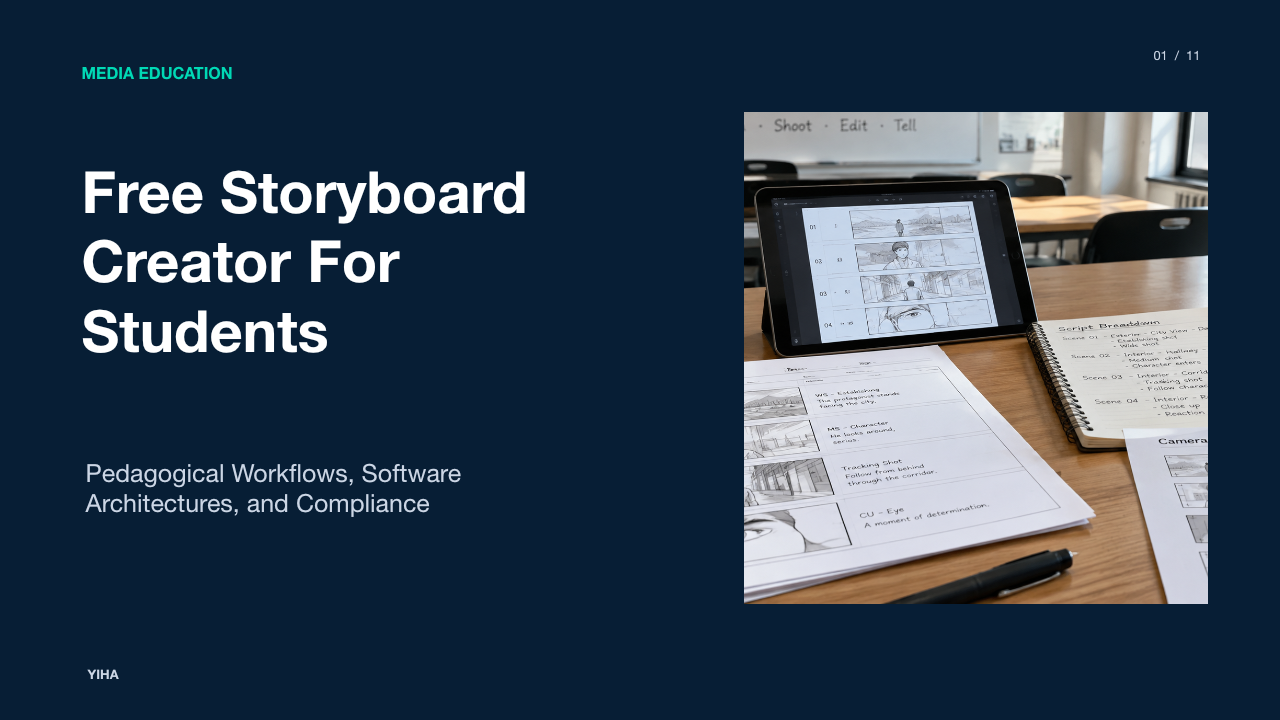
Transitioning from an approved written script to physical shooting requires a systematic breakdown. As detailed in How to Storyboard a Commercial: A Step-by-Step Guide, commercial storyboards start directly from a locked script and voiceover rather than originating from visual concepts. The production team breaks down the script sentence by sentence, translating each spoken line or key beat into a single shot that forms the structural spine of the board.
As noted in Video Ad Storyboard Template: Free Frameworks for Every Ad Format, a script becomes actionable for filming only when every beat is assigned a distinct visual responsibility, highlighting the specific phrase that changes the viewer's understanding or introduces a new claim, location, or product action. Each beat receives a dedicated storyboard frame with an assigned duration in seconds. The sum of these individual durations must match the total contracted broadcast length exactly. Once the creative sequence is locked on the board, the production manager extracts these panels into a production shot list. While a storyboard arranges shots in sequential narrative order, a shot list reorganizes those setups by physical location, camera lens, and lighting configuration. This reorganization enables the crew to film all related angles concurrently, maximizing efficiency on set while ensuring complete coverage of the approved board.
Creative Branching and the Limits of Static Frames
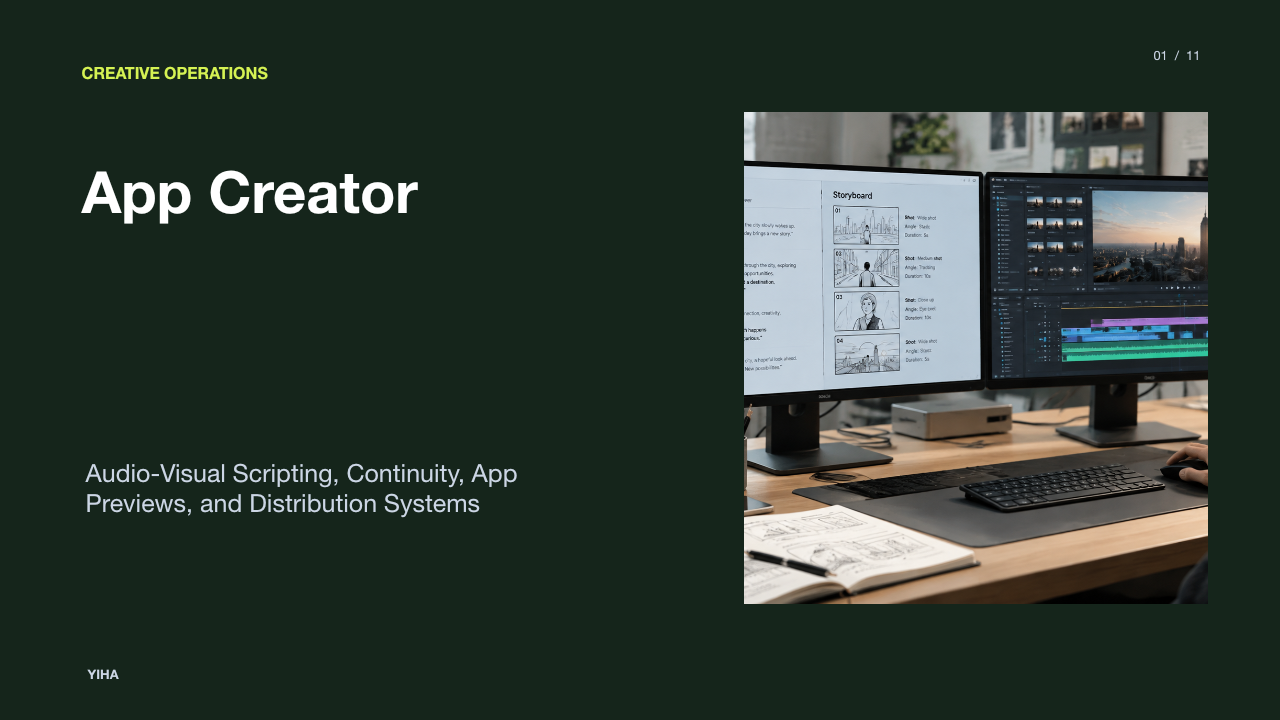
While static storyboard panels provide clarity for composition and framing, they possess inherent limitations when conveying rapid physical movement, comedic timing, or subtle tonal nuance. To overcome these constraints, commercial production workflows frequently convert static boards into animatics. As highlighted in 10 Best TV Commercial Storyboard Examples in Advertising, an animatic places storyboard panels onto an editing timeline alongside scratch voiceover tracks, temporary sound effects, and music cues.
Testing an animatic allows creative directors and clients to evaluate editorial pacing and rhythm before spending physical production resources. If a dialogue delivery feels rushed or an establishing shot drags, editors adjust the frame timing directly on the timeline. Furthermore, digital boarding tools facilitate creative branching, allowing teams to test multiple hook variations against a single product demonstration sequence. By validating structural timing and hook alternatives in animatic form, commercial teams enter production with absolute confidence in their editorial framework.
Research sources
- How To Plan Storyboards For Ad Shoots: A Practical Guide (2026) · cybertizemedia.com
- Advertising Storyboards: Campaign Planning Guide · ai-storyboard.com
- Shot List vs Storyboard: Understanding Their Importance in Filmmaking · www.shotkraft.com
- How to Storyboard TV Commercials: Brief to Final Frames · www.drawstory.ai
- Video Ad Storyboard Template: Free Frameworks for Every Ad Format · www.nereo.io
- How to Storyboard a Commercial: A Step-by-Step Guide (2026) | Storyflow · storyflow.so
- Video Ad Storyboard Template: 7 Strategies That Convert · www.adstellar.ai
- Commercial Storyboard: The 30-Second Ad Board | ScreenWeaver · www.screenweaver.ai
- How to Show Camera Movement in a Storyboard · scriptlyai.app
- Camera Movement for Storyboards: Plan Motion Before Animation | Story2Board Blog · story2board.com
- How to Storyboard a TV Commercial (2026 Guide) | Boords · boords.com
- How to Storyboard a Commercial: A Step-by-Step Guide · scriptlyai.app
- How to Create an Ad Storyboard: From Script to Shot List in Minutes (2026) · adlude.com
- Ad Storyboard: How to Plan a Commercial Before Production - LlamaGen.AI Blog · llamagen.ai
- How to Create a TV Commercial Storyboard [2026] · www.studiobinder.com
- 10 Best TV Commercial Storyboard Examples in Advertising · www.studiobinder.com